Thermal Management in Satellites: The Role of CAVU Aerospace’s Thermal Control Unit
Thermal management is a mission-critical function in satellite systems. In the vacuum of space—where convection is absent and thermal conditions can swing from extreme cold to intense solar heating—spacecraft must rely on carefully engineered thermal control architectures to ensure survivability, performance, and long-term reliability.
At the heart of many modern satellite thermal subsystems is the Thermal Control Unit (TCU). CAVU Aerospace’s TCU is a flight-proven thermal control solution, designed to provide precise, reliable, and autonomous temperature regulation for spaceborne electronics and payloads across a wide range of missions.
The Thermal Challenge in Space
Satellites are exposed to:
- Direct solar radiation
- Earth albedo and infrared radiation
- Deep-space cold during eclipse
- Internally generated heat from avionics, payloads, and power electronics
Because heat transfer in space is dominated by radiation and conduction, even small thermal imbalances can lead to:
- Degraded electronic performance
- Increased component aging
- Structural stress due to thermal gradients
- Mission-ending failures
Maintaining equipment within its qualified temperature limits is therefore essential for mission success.
Thermal Control Architecture and the Role of the TCU
A typical satellite thermal control system combines:
- Passive elements (MLI, radiators, coatings)
- Active elements (heaters, sensors, control electronics)
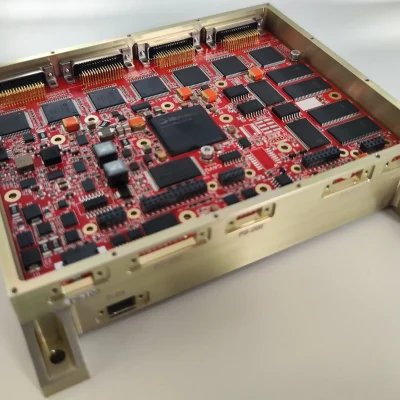
The Thermal Control Unit (TCU) acts as the central intelligence and power distribution node for active thermal control. It monitors temperature sensors, executes control logic, and drives heaters to maintain components within defined operational and survival limits.
CAVU Aerospace Thermal Control Unit (TCU)
CAVU Aerospace’s TCU is engineered as a space-qualified, high-reliability avionics unit capable of supporting both platform and payload thermal requirements.
Key functions:
- Closed-loop heater control
- Multi-channel temperature sensor acquisition
- Autonomous thermal regulation during nominal and contingency modes
- Interface with spacecraft power and data buses
- Deterministic and fault-tolerant operation
The unit is suitable for LEO, MEO, and GEO missions, as well as deep-space applications where thermal stability is critical.
Flight-Proven and Fully Qualified
CAVU Aerospace’s TCU is not a conceptual or prototype product—it is flight proven, with a comprehensive qualification and acceptance test pedigree.
Qualification and verification include:
- EMC / EMI testing
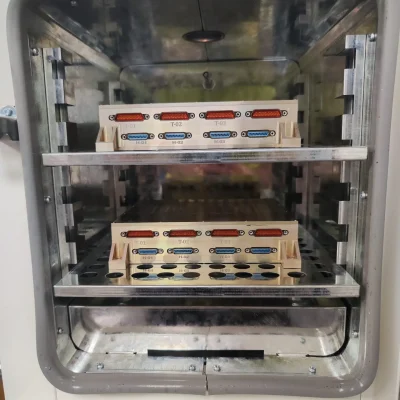
Ensures compatibility with sensitive spacecraft avionics and payloads. - Thermal Vacuum (TVAC) testing
Validates performance under vacuum and extreme temperature cycling. - Burn-In testing
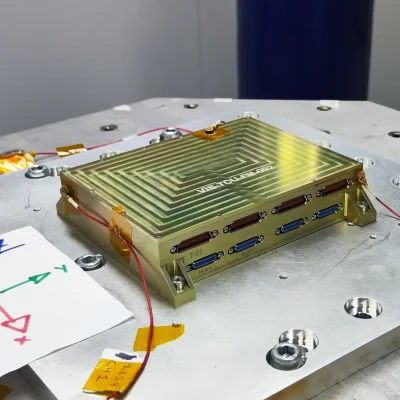
Screens early-life failures and ensures long-term reliability. - Vibration testing
Confirms survivability under launch loads. - Shock testing
Verifies resistance to separation and deployment events. - Radiation testing
Ensures tolerance to space radiation environments.
This test coverage significantly reduces program risk and qualification timelines for satellite integrators.
Reliability and Autonomy
The TCU is designed for autonomous operation, allowing satellites to maintain thermal safety even during:
- Communication outages
- Safe-mode operation
- Eclipse transitions
- Off-nominal thermal conditions
Its architecture supports fault detection and isolation, ensuring that heater control remains predictable and safe throughout the mission lifecycle.
Applications
CAVU Aerospace’s TCU is well suited for:
- Satellite avionics thermal control
- Payload and instrument temperature regulation
- Battery and power subsystem thermal management
- Small satellites, constellations, and high-reliability platforms
- Missions requiring rapid integration with low risk
Thermal management is fundamental to spacecraft reliability, and the Thermal Control Unit (TCU) plays a central role in ensuring stable operation in the harsh space environment.
With its flight-proven heritage, comprehensive qualification testing, and robust autonomous control capability, CAVU Aerospace’s TCU provides satellite manufacturers and mission operators with a trusted, low-risk thermal control solution—helping ensure mission success from launch through end of life.