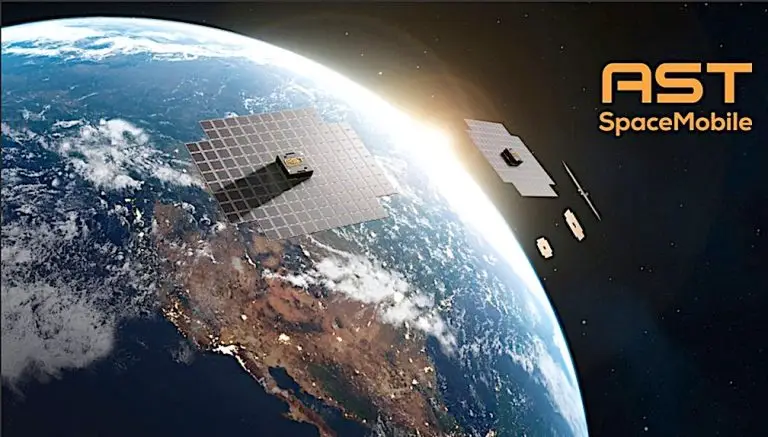
Space Mobiles, Direct to Cell Internet, How Uplink is possible?
Direct-to-cell (D2C) satellite internet—like what SpaceX (Starlink Direct-to-Cell) and AST SpaceMobile are building—is possible mainly because of advances in RF electronics, antennas, and signal processing. It wasn’t possible 10 years ago!
Uplink is harder because the transmitter is tiny, weak, and power-limited (the phone), while the receiver is far away (the satellite).
The core problem (electronics perspective)
A normal smartphone:
- Transmits ~0.2–1 W (23–30 dBm)
- Uses a tiny, inefficient antenna
- Was designed to talk to a cell tower a few km away
A satellite:
- Is 500–700 km away
- Sees huge free-space path loss (~160–170 dB)
- Must receive very weak signals
👉 The electronics must detect micro-volt level RF signals buried in noise and transmit back without draining the phone battery.
Key electronic technologies that make it possible
- Massive phased-array antennas (on the satellite)
This is the biggest enabler.
What changed?
- Thousands of antenna elements
- Each element has:
- RF front-end
- Phase shifter
- Gain control
- All controlled digitally
Why it matters
- Signals from many elements add coherently
- Effective gain becomes 30–40 dBi
- This compensates for the phone’s weak transmitter
📌 AST SpaceMobile satellites literally unfold into large RF “apertures” (~60–70 m²).
Ultra-low-noise RF front ends
The satellite receiver chain is extremely sensitive.
Key components:
- Low-Noise Amplifiers (LNAs) with noise figures ≈ 0.5–1 dB
- High-linearity mixers
- High-resolution ADCs
Electronics trick:
First amplifier dominates the entire noise budget (Friis equation)
Without modern GaAs / GaN / CMOS RF LNAs, D2C would not work.
Digital beamforming & DSP (very important)
Older satellites used analog beams.
D2C satellites use digital beamforming.
Electronics involved:
- High-speed ADCs
- FPGAs / radiation-hardened SoCs
- Massive DSP pipelines
What DSP does:
- Separates thousands of phones simultaneously
- Tracks Doppler shifts (~±40 kHz at LEO speeds)
- Cancels interference
- Dynamically steers beams
📌 This is only possible because space-qualified digital electronics have become powerful enough.
Using standard cellular frequencies
This is subtle but critical.
D2C uses:
- LTE / 5G NR waveforms
- Licensed cellular bands (e.g. 700 MHz, 850 MHz)
Why electronics matter here:
- Lower frequency = less path loss
- Smartphone RF chips already support these bands
- Satellite electronics must implement full cellular base-station functionality
So the satellite is electronically a:
Flying cell tower with a giant phased array
Advanced power electronics on the satellite
Big antennas + DSP = big power draw.
Needed:
- High-efficiency DC-DC converters
- Gallium Nitride (GaN) power amplifiers
- Smart power management ICs
GaN is key because:
- Higher efficiency
- Higher power density
- Better thermal handling in vacuum
Compare the two transmitters (electronics reality)
Smartphone (uplink transmitter)
- Output power: ~0.2–1 W (23–30 dBm)
- Antenna gain: −3 to 0 dBi
- Efficiency: poor (hand, body absorption)
- Strict SAR & battery limits
Satellite (downlink transmitter)
- Output power: 10–100+ W RF (40–50 dBm)
- Antenna gain: 30–40 dBi
- No human exposure limits
- Large solar arrays + batteries
📌 The satellite can transmit ~1,000,000× more effective power than the phone.
Effective Isotropic Radiated Power (EIRP)
EIRP = Transmit Power + Antenna Gain
Uplink (phone → satellite)
- Tx power: 23 dBm
- Antenna gain: −2 dBi
- EIRP ≈ 21 dBm (~0.13 W)
Downlink (satellite → phone)
- Tx power: 45 dBm
- Antenna gain: 35 dBi
- EIRP ≈ 80 dBm (100,000 W effective)
That’s a ~60 dB difference
→ 1 million times stronger downlink
Receiver sensitivity: who listens better?
Phone receiver (downlink)
- Noise figure: ~1–2 dB
- Bandwidth optimized
- Very short cable losses
- Designed to hear weak base stations
Satellite receiver (uplink)
- Noise figure: ~0.5–1 dB (excellent)
- But:
- Huge bandwidth
- Space radiation limits
- Long RF distribution networks
Even with a better receiver, the satellite is still trying to hear a whisper from 600 km away.
Free-space path loss (the killer)
Path loss increases with distance:
FSPL(dB) (For LEO satellite (~600 km, 800 MHz)): ~161–165 dB loss
This loss hits uplink and downlink equally — but only one side has power to spare.
- Antenna physics makes uplink brutal
Phone antenna:
- Tiny compared to wavelength
- Detuned by the hand
- Random orientation
- Polarization mismatch
Satellite antenna:
- Actively steered phased array
- Perfect polarization
- Huge effective aperture
👉 Antenna inefficiency hurts uplink much more, because there’s no transmit power margin.
Thermal noise sets a hard limit
Thermal noise floor:
N=−174 dBm/HzN = -174
If uplink bandwidth is wide:
- Noise power increases
- Required SNR increases
- Phone cannot increase power
Result:
Uplink data rate must be low
This is why early D2C supports:
- SMS
- IoT-like data
- Very low bitrate voice
Doppler + timing hurt uplink more
Satellite speed ≈ 7.5 km/s
Effects:
- Doppler shift ±40 kHz
- Fast timing changes
- Random access bursts from phones
The satellite must:
- Detect unsynchronized, weak uplink bursts
- Correct Doppler per user
- Separate thousands of phones
Downlink is synchronized and controlled — much easier.
Regulatory & safety limits (electronics constraint)
Phones are limited by:
- SAR (Specific Absorption Rate)
- Battery heating
- PA linearity
- Efficiency at low supply voltage
You cannot “just increase power” in uplink.
Practical consequence in system design
This is why:
- Uplink uses very robust modulation (QPSK, BPSK)
- Low coding rates
- Narrow bandwidth
- Long symbol durations
Downlink can:
- Use higher-order modulation
- Use wider bandwidth
- Serve many users at once
One-line engineering summary
Downlink is a shout from space; uplink is a whisper from Earth.
The entire electronics challenge of D2C is:
Designing satellite receivers, antennas, and DSP that can hear that whisper.