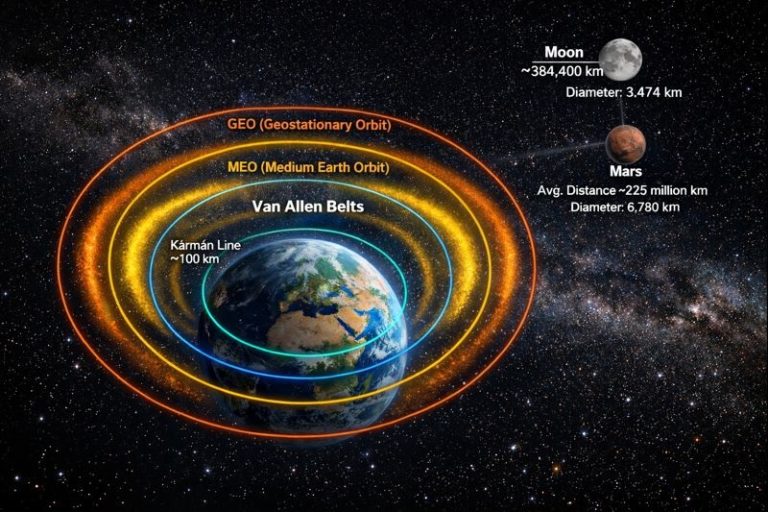
Space Exploration Then and Now: From Apollo Moon Landings to Commercial Spaceflight
Space exploration has changed dramatically since the 1970s. What began as a government-driven race to the Moon is now a mix of public and private initiatives, where civilians can briefly experience weightlessness and companies launch satellites by the thousands. Comparing the Apollo era with today’s commercial space age highlights advances in technology, accessibility, and the ambitions of humanity.
The Apollo Era
In the early 1970s, space exploration was dominated by NASA, shaped by Cold War competition between the United States and the Soviet Union. The Apollo program reached its peak with the first Moon landing in 1969, followed by missions until Apollo 17 in 1972.
Key characteristics of the era:
- Government-led missions
- Highly trained astronauts (test pilots, engineers, scientists)
- Extremely high cost and risk
- Scientific and geopolitical focus
- Limited access to space
Satellites were few, heavy, and expensive, mainly used for military intelligence, weather forecasting, and basic communications.
Commercial Astronauts in Kármán Line
Modern spaceflight includes private companies such as SpaceX, Blue Origin, and Virgin Galactic, which fly commercial astronauts to suborbital space. This is the current frontier of space tourism.
Suborbital Flights and the Kármán Line
- Reach ~100 km above Earth (the Kármán line, widely regarded as the edge of space)
- Provide several minutes of microgravity (zero gravity)
- Flight durations: 10–90 minutes, much shorter than orbital missions
- Open to civilians, entrepreneurs, researchers, and paying passengers
These flights let participants experience weightlessness, see Earth from space, and feel the thrill of space travel—something only elite astronauts could do in the Apollo era.
The Role of Reusable Rockets
The transition to commercial spaceflight became practical only after rapid advancements in reusable rocket technology, pioneered by SpaceX and Blue Origin.
- Reusable rockets dramatically reduce launch costs, allowing frequent flights.
- They make suborbital tourism, satellite constellations, and deep-space missions economically viable.
- Without these innovations, space would remain as exclusive as it was during the Apollo era, accessible only to government agencies with massive budgets.
This technological leap is the foundation of today’s commercial space economy.
The Return to the Moon: Artemis II and Artemis III
NASA is preparing humanity for sustainable lunar exploration with the Artemis program.
Artemis II
- First crewed mission of Artemis
- Will orbit the Moon without landing
- Tests spacecraft systems, life support, and navigation
- Marks the first humans beyond low Earth orbit since 1972
Artemis III
- Planned lunar landing at the Moon’s south pole
- Will include the first woman and first person of color on the Moon
- Aims for sustainable lunar exploration with repeated missions
- Prepares for future deep-space missions to Mars
These missions combine government expertise with commercial partnerships, creating a bridge to future civilian lunar tourism.
Space Tourism: Today and Tomorrow
Today: Suborbital Experience
Companies like Blue Origin and Virgin Galactic already offer short trips above the Kármán line. Space tourists experience:
- Weightlessness for several minutes
- A view of Earth from space
- A personal adventure once limited to professional astronauts
Tomorrow: Lunar and Martian Tourism
Looking ahead:
- Moon Tourism:
- NASA’s Artemis missions and commercial lunar landers may eventually allow paying passengers to orbit or land on the Moon.
- Lunar tourists could experience days in space, see Earth from orbit, and explore a historic frontier.
- Mars Tourism (long-term vision):
- SpaceX and other companies plan crewed Mars missions, possibly including private travelers.
- Mars tourism would involve months of travel, orbital insertion, and planetary surface exploration, representing the ultimate frontier.
Reusable rocket technology is the key enabler for this next generation of space tourism, making what once seemed impossible economically feasible.
Satellites: From Rare Machines to Global Infrastructure
Satellites have seen the most dramatic expansion:
1970s:
- Hundreds of satellites worldwide
- Large, expensive, and limited in capability
Today:
- Tens of thousands of satellites, including small CubeSats
- Used for:
- Internet and communications
- GPS navigation
- Earth observation and climate monitoring
- Disaster management and agriculture planning
- Scientific research
Again, reusable rockets allow rapid, cost-effective deployment of satellite constellations, which was impossible in the Apollo era.