Planetary Defense Missions
We are often asked why billions of dollars are invested in space technology. One compelling answer comes from a CAVU Aerospace engagement in planetary defence!
Our solar system contains millions of asteroids, and over Earth’s 4.6-billion-year history, many have collided with our planet. Several of these impacts were powerful enough to cause mass extinction events—at least three of them. The most recent major event led to the extinction of the dinosaurs.
For this reason, continuous asteroid detection, classification, naming, and tracking are essential to protecting human civilization. Quite simply, it would be tragic for humanity to go extinct in the same way the dinosaurs did.
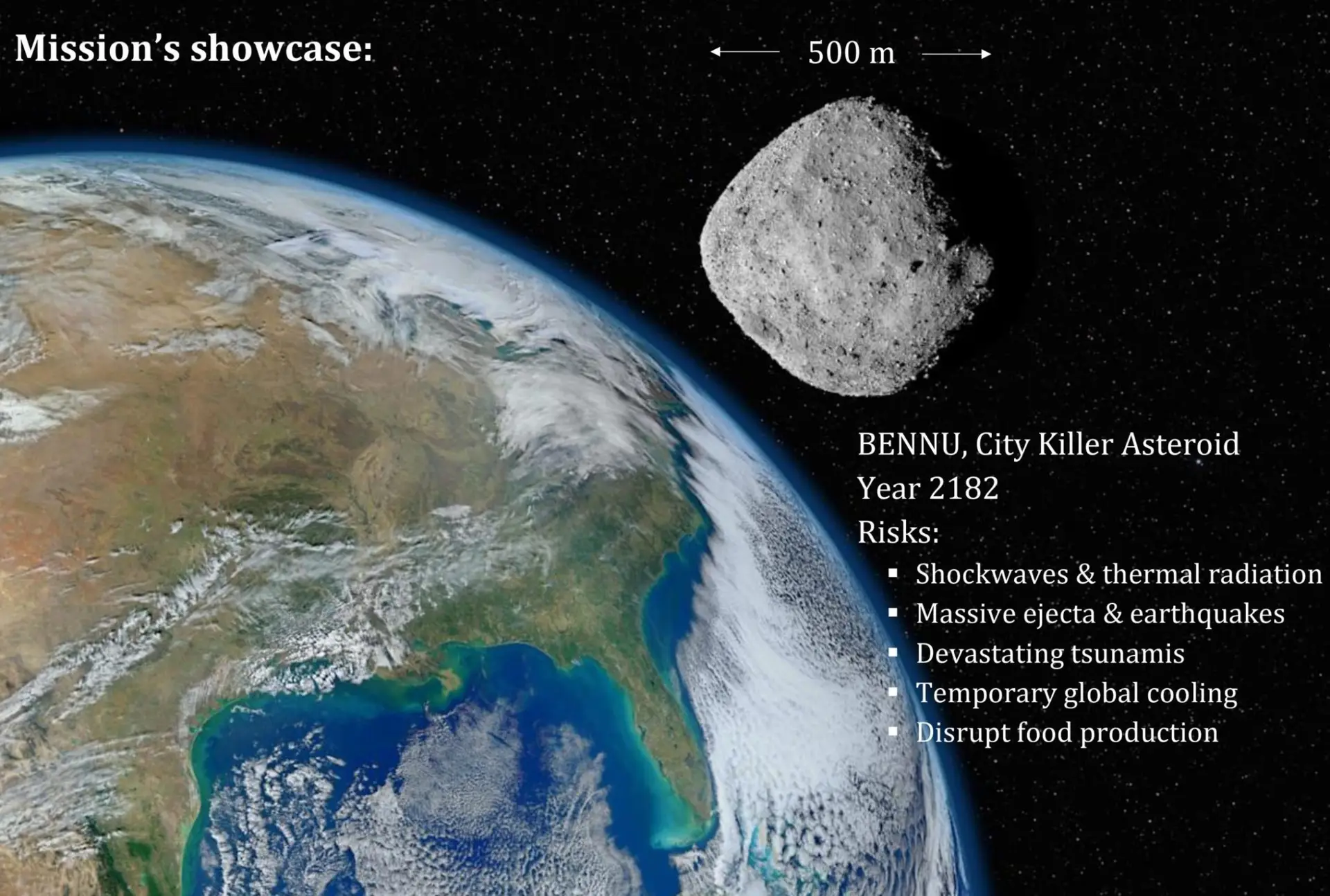
One such object is asteroid (101955) Bennu, classified as a Potentially Hazardous Asteroid. Bennu is approximately 500 meters in diameter, with a mass of about 7.8 × 10¹⁰ kg, and has a rubble-pile structure. While Bennu poses no imminent threat, it is considered one of the highest-risk known asteroids over the long term, with a small but measurable probability of Earth impact around the year 2182.
If such a collision were to occur, it could release energy equivalent to approximately 1,200 megatons of TNT, leading to severe global consequences, including:
- Powerful shockwaves and intense thermal radiation
- Massive ejecta and seismic activity
- Devastating tsunamis
- Temporary global cooling
- Disruption of global food production
To better understand and mitigate such threats, NASA launched a mission, which successfully returned approximately 250 grams of material from Bennu for detailed scientific analysis.
With early detection and sufficient warning time, humanity has viable planetary defence options, including kinetic impactors, gravity tractors, and, if necessary, nuclear deflection techniques—ensuring the long-term protection of human civilization.