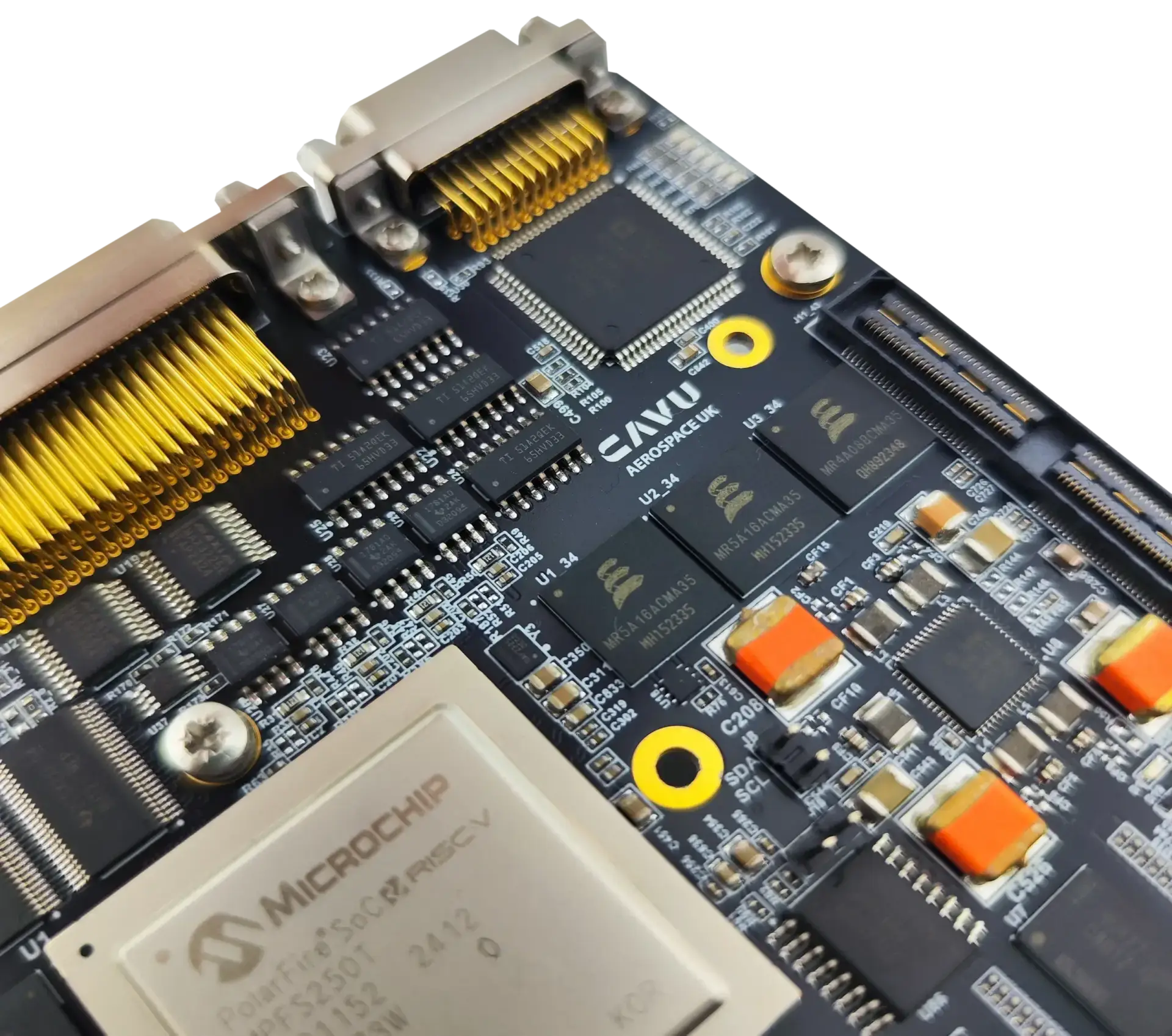
NEPP (NASA Electronic Parts and Packaging) findings on Radiation Tolerance PolarFire FPGA
NEPP has tested or reported on Microchip/Microsemi PolarFire FPGAs in radiation environments, providing insight into how they respond to radiation:
- NEPP presented FPGA radiation effects data including PolarFire SEE (Single Event Effect) results at the NASA Electronics Technology Workshop in 2021, where PolarFire devices were studied under heavy-ion conditions and other radiation environments. This shows PolarFire has been part of NASA’s independent radiation evaluation efforts.
- The NEPP tests indicated effects such as SEFI causes related to internal system controller voltage drops and concluded that configuration memory is not upset (non-volatile), but user logic and memories need mitigation such as ECC or redundancy.
PolarFire FPGA fabrics inherently handle no configuration upsets (non-volatile tech) under radiation, but user logic and soft state are susceptible to SEEs and need fault-tolerant design—a classic FPGA mitigation requirement highlighted by NEPP experiments.
NEPP’s Broader FPGA Advice Applies to PolarFire
- Radiation characterization is mission-specific — you must understand SEE, SEFI, TID for your orbit/trajectory.
- Non-volatile FPGAs (e.g., PolarFire / RTG4) can offer configuration robustness but don’t eliminate the need for mitigation in user logic or block memory.
- Mitigation techniques (TMR, ECC, watchdogs) are essential for user logic reliability in space.
- NASA requires documented radiation data and usage plans for any FPGA on flight hardware.
Even if a device performs well in basic testing, NEPP expects mission-level mitigation and evidence that the part matches mission radiation environments before acceptance.
Microchip’s Space-Qualified Radiation Tolerant PolarFire Series
While the NEPP doesn’t itself bestow qualification, Microchip has developed Radiation-Tolerant (RT) PolarFire FPGAs designed for space:
- These RT PolarFire devices (e.g., RTPF500ZT) have QML Class Q qualification and MIL-STD-883 testing, meaning they meet high reliability standards expected for military/aerospace systems.
- They are built to be immune to configuration upsets (no SEU in configuration memory) and have good SEL thresholds and TID tolerance.
Relevance to NEPP:
NEPP doesn’t forbid COTS usage, but NASA projects generally use qualified radiation-tolerant parts where available. The existence of QML-qualified RT PolarFire parts makes them far more appealing under NEPP/parts assurance than pure commercial PolarFire devices.
Technical Notes for PolarFire in Space
Configuration Robustness
- Non-volatile configuration means no reconfiguration upsets due to radiation — a big advantage over SRAM FPGAs.
User Logic and Memories
- PolarFire user fabric and memories can still exhibit SEEs and require mitigation techniques in design.
- NEPP data suggested SEFIs related to system controller behavior but configuration remains intact — meaning reset and recovery logic are important.
Mission Design
- NEPP’s goal is not to classify devices as merely “acceptable” or “not acceptable,” but to provide radiation performance data that engineers must use in their parts selection analysis, including modeling and mitigation plans.
Practical NEPP “Advice” Translation for a NASA Project
In practice, what NASA program engineers and NEPP practitioners would advise regarding PolarFire (based on radiation data and parts assurance expectations) is:
- Prefer Radiation-Tolerant PolarFire variants with formal qualification (QML/MIL-STD-883) for primary usage on flight systems rather than base commercial PolarFire parts.
- Plan for mitigation of SEEs in user logic and memories using TMR, ECC, watchdog timers, or restart logic as part of the FPGA architecture.
- Show mission-specific radiation analysis (TID, SEE rate) for the selected FPGA part for your orbit/trajectory.
- Provide documentation of radiation testing, mitigation strategies, and qualification status as part of the parts approval process.
This reflects how NEPP’s radiation evaluation data and parts assurance framework influence how components like PolarFire are used in NASA flight designs.
From NEPP’s published FPGA testing and NASA’s parts assurance context you can conclude that:
- PolarFire is being evaluated in radiation programs and has radiation data available.
- NEPP implies that non-volatile configuration and known radiation behavior are key benefits, but user logic still needs design mitigation.
- RT PolarFire variants with aerospace qualification (QML/MIL-STD) align better with NASA’s parts assurance expectations than unqualified versions.
TID and Important Notes for FPGA Designers
Rise and Fall Time degradation can affect performance & violate FPGA manufacturer reliability requirements (FPGA will not work properly)
Internal delay degradation Functional behavior
I/O delay: Can cause source synchronous designs to malfunction