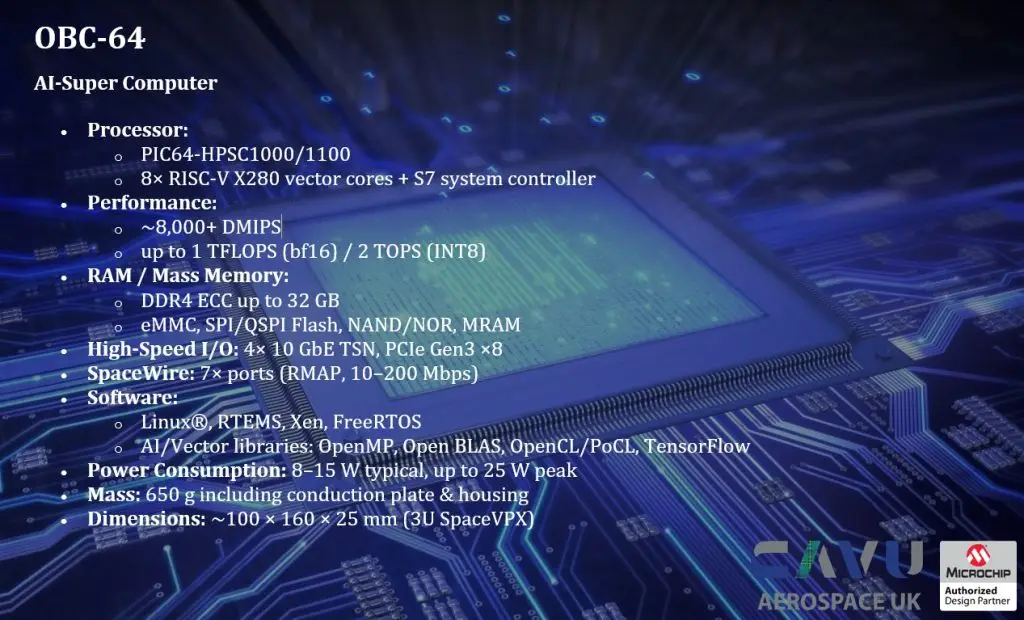
Microchip PIC64-Based AI Supercomputing for Space
Next-generation AI-capable OBC based on Microchip PIC64 technology, designed to deliver supercomputer-class performance per watt while maintaining the robustness required for space environments. Today’s AI-enabled satellites typically rely on one of the following approaches:
- Traditional Space OBCs with CPUs
- FPGA-Centric AI Acceleration
- COTS AI Modules (GPU-Based)
- Emerging RISC-V AI-Optimized SoCs (PIC64)
Each approach has strengths and limitations.
Microchip PIC64 is a 64-bit RISC-V–based multicore processor platform, designed with:
- High compute density
- Strong determinism and safety features
- Scalability for heterogeneous computing
- A pathway toward AI acceleration with significantly lower power overhead than GPU-centric systems
For CAVU, PIC64 enables the creation of an AI-capable OBC, rather than a payload add-on computer, allowing AI workloads to be deeply integrated into spacecraft operations.
Comparison: PIC64 vs Other AI Computers
PIC64 vs Traditional Space OBCs (CPU-Only)
Aspect | Traditional OBC | PIC64-Based OBC |
Architecture | Single / multicore CPU | Multicore 64-bit RISC-V |
AI Capability | Very limited | Native AI-ready compute |
Parallel Processing | Low | High |
Autonomy Support | Rule-based | AI-driven |
Performance per Watt | Low–moderate | High |
Key Difference:
Traditional OBCs can host AI experiments; PIC64 enables AI as a core spacecraft function.
PIC64 vs FPGA-Centric AI Solutions
Aspect | FPGA AI | PIC64 AI OBC |
Flexibility | High (hardware-defined) | High (software-defined) |
Development Complexity | Very high | Moderate |
AI Model Portability | Limited | Strong |
Runtime Adaptability | Low | High |
Software Ecosystem | Narrow | Expanding RISC-V ecosystem |
Key Difference:
FPGA-based AI excels in fixed pipelines, while PIC64 supports evolving AI models and software-driven missions, reducing development and operational risk.
PIC64 vs GPU-Based AI Computers (e.g. COTS Modules)
Aspect | GPU-Based AI | PIC64-Based AI |
Compute Density | Very high | High |
Power Consumption | High | Low–moderate |
Thermal Load | High | Manageable |
Radiation Strategy | Shielding / mitigation | Architecture-level resilience |
Space Integration | Payload-like | OBC-native |
Key Difference:
GPU systems deliver brute-force AI performance but at significant power, thermal, and system complexity cost.
PIC64 offers a more balanced, space-optimized AI computing approach.
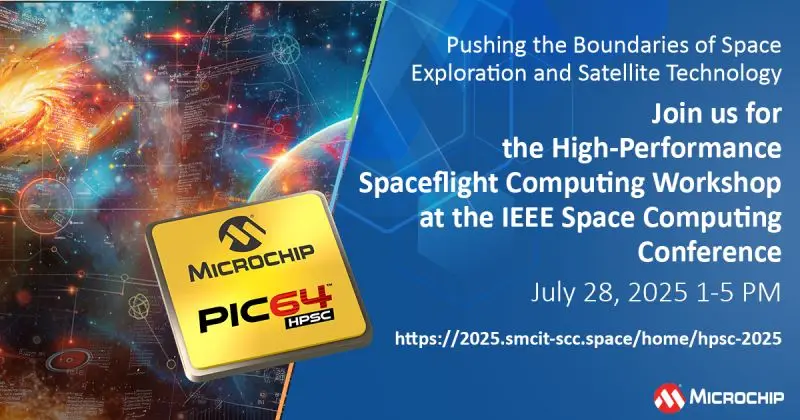
Why PIC64 Enables an “AI Supercomputer” OBC
Unlike bolt-on AI payload computers, a PIC64-based OBC allows:
AI at the Spacecraft Core
- AI participates in:
- Mission planning
- Data prioritization
- Fault detection
- Autonomous operations
- Not just payload processing
Exceptional Performance per Watt
- Designed for efficiency rather than peak GPU throughput
- Enables AI on power-constrained platforms (CubeSats to smallsats)
Software-Defined Intelligence
- RISC-V ecosystem
- Portable AI frameworks
- Long-term maintainability and mission upgrades
Scalable Architecture
- Single-satellite missions
- Constellations with distributed intelligence
- Cooperative and collaborative AI in orbit
PIC64 vs Other AI Computers — Summary Table
Capability | Traditional OBC | FPGA AI | GPU AI | PIC64 AI OBC |
AI Readiness | ❌ | ⚠️ | ✅ | ✅ |
Power Efficiency | ✅ | ✅ | ❌ | ✅ |
Software Flexibility | ⚠️ | ❌ | ✅ | ✅ |
Space Integration | ✅ | ⚠️ | ❌ | ✅ |
Autonomy Enablement | ❌ | ⚠️ | ⚠️ | ✅ |
Target Missions for PIC64-Based OBCs
CAVU’s PIC64-based AI OBC is particularly well suited for:
- Earth observation with onboard analytics
- Change detection and monitoring
- RF signal classification
- Autonomous spacecraft operations
- Smart constellations
- AI-first commercial missions
- In-orbit AI validation and experimentation
The transition from traditional OBCs to AI-enabled spacecraft demands a new class of computing architecture. While GPUs and FPGA accelerators have demonstrated AI feasibility in orbit, they introduce significant system-level challenges.
OBC-64 represents a balanced, space-optimized AI supercomputer, combining:
- High performance per watt
- Software-defined flexibility
- Native spacecraft integration
- A scalable path toward autonomous missions
This platform bridges the gap between mission-critical OBCs and AI payload computers, enabling satellites that do not just collect data — but understand and act on it in orbit.