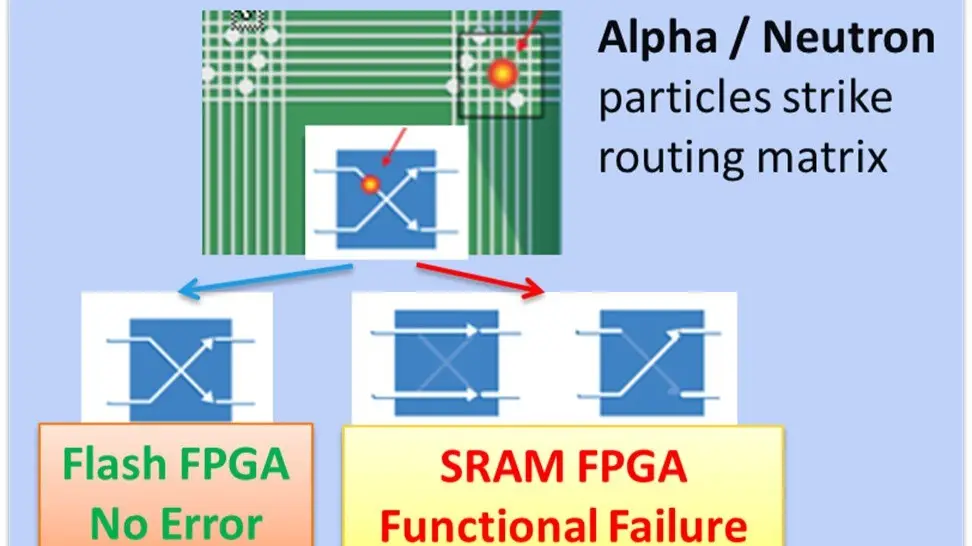
Flash vs SRAM FPGAs in Space: What Many Projects Overlook About Radiation
How about flying a “radiation-hardened Zynq-7000” as satellite onboard computer – and even a label “rad-tolerant specs” for it.
👉 Reality check: there is no radiation-tolerant or radiation-hardened Zynq-7000. If you’ve been told otherwise, something has been misunderstood or misrepresented.
And this isn’t an isolated case. I’ve seen many academic satellite projects pick SRAM-based FPGAs/SoCs as their OBC without fully appreciating the engineering needed to make them reliable in orbit.
To be clear: SRAM-based FPGAs/SoCs (including Zynq, Zynq UltraScale, UltraScale+) are excellent devices. We also use AMD/Xilinx parts in our ground equipment, test systems and tools – they’re powerful and very capable. 💻⚡
But for flight hardware, the story is different – and it actually gets worse as you go from 28 nm Zynq-7000 down to smaller geometries in UltraScale / UltraScale+: less critical charge per bit, more sensitivity to radiation-induced upsets.
With SRAM-based FPGAs, you typically need:
- Continuous scrubbing to repair SEUs in the configuration
- External configuration memories (often with backups) that also need protection
- Extra fault-handling logic and monitoring just to keep the device “healthy” over mission life
That’s why, for our space platforms at CAVU AEROSPACE UK, we favour flash-based FPGAs and SoCs – from Microchip Technology Inc. ProASIC-class devices up to PolarFire 🚀:
✅ Configuration in non-volatile flash – inherently immune to configuration upsets
✅ No external bitstream memory to harden, protect, and scrub
✅ Lower power consumption compared to many SRAM-based alternatives
✅ Simpler, more robust architectures for long-duration missions
At CAVU AEROSPACE UK , we’re doing our best to shine a light on these trade-offs and highlight the benefits of flash-based systems – especially for teams moving from lab prototypes to real space missions. 🌍🛰️
If you’re designing an onboard computer, it’s not enough that “it works on the bench”. You need to understand what technology you’re really flying, and what the radiation environment will do to it.
Flash-based FPGAs don’t solve every problem… but they eliminate entire classes of failure modes that SRAM-based devices must constantly fight.