
Edge Computing, Enables the satellite to think!
OBC-Polar Vs. OBC-Polar-Edge
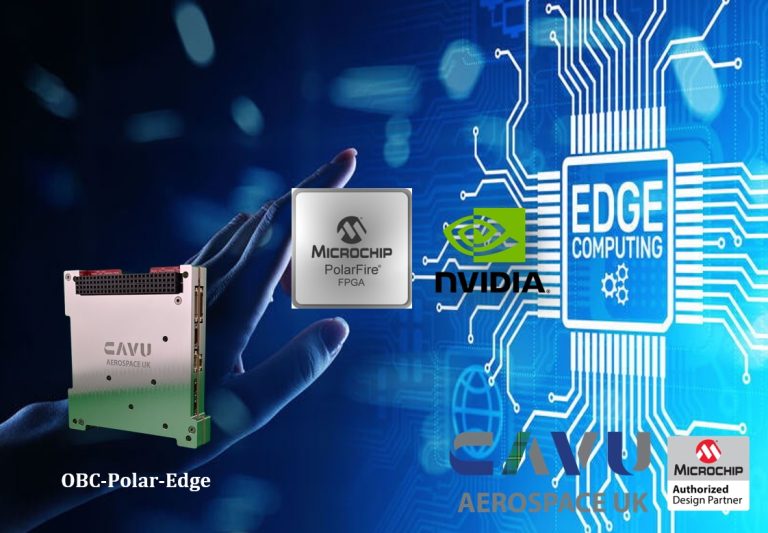
These edge computing solutions combine radiation-tolerant Microchip PolarFire FPGAs with NVIDIA Jetson Orin modules, delivering unprecedented on-board processing capability for next-generation satellite missions. This architecture enables satellites to move beyond traditional command-and-data handling and towards true on-orbit intelligence.
Edge computing refers to performing data processing, analysis, and decision-making directly on the satellite, rather than downlinking raw data to the ground for processing.
In space systems, this means:
- Processing payload data immediately after acquisition
- Extracting insights instead of transmitting large raw datasets
- Making autonomous decisions in orbit with minimal ground intervention
This paradigm shift is increasingly important as satellite payloads generate higher data volumes and missions demand faster response times.
Edge computing OBCs are designed around a heterogeneous computing architecture:
PolarFire FPGA (Mission-Critical Layer)
- Radiation-tolerant, low-power FPGA
- Deterministic real-time control
- Platform management, health monitoring, interfaces, and safety functions
- Secure boot, fault tolerance, and watchdog supervision
NVIDIA Jetson Orin (High-Performance Compute Layer)
- GPU-accelerated AI and machine-learning processing
- High-throughput data handling
- Support for modern AI frameworks (CUDA, TensorRT, ROS, PyTorch)
- Optimized for computer vision, signal processing, and autonomy
This separation allows the FPGA-based OBC to remain in control of the spacecraft at all times, while the Jetson Orin operates as a powerful co-processor for payload intelligence.
How Edge Computing Differs from OBC-Cube-Polar
The OBC-Cube-Polar is a high-performance, flight-proven CubeSat OBC based on a PolarFire SoC FPGA with multi-core RISC-V processors. It is well suited for:
- Command & data handling (C&DH)
- Payload control
- Moderate on-board data processing
- Running RTOS or embedded Linux
- Power-efficient, reliable CubeSat missions
However, edge computing platforms go significantly beyond this capability.
Key Differences
Aspect | OBC-Cube-Polar | CAVU Edge Computing OBC |
Processing Type | Embedded RISC-V CPUs | FPGA + GPU-accelerated AI |
AI / ML Capability | Limited / experimental | Native, high-performance |
Data Processing | Moderate | Very high (real-time analytics) |
Payload Intelligence | Basic | Advanced autonomy & inference |
Data Downlink Strategy | Raw or lightly processed data | Event-driven, insight-based data |
Mission Autonomy | Ground-centric | On-orbit decision making |
In essence, OBC-Cube-Polar is an advanced spacecraft brain, while edge computing platforms add a powerful “cognitive layer” on top.
What Difference Does Edge Computing Make?
Reduced Downlink Bandwidth
Instead of transmitting full datasets (e.g. images, spectra, RF captures), the satellite can:
- Downlink only relevant events
- Send extracted features or alerts
- Discard unimportant data autonomously
This dramatically reduces bandwidth requirements and ground station costs.
Real-Time On-Orbit Decision Making
Edge computing enables seeing, understanding, and acting in orbit:
- Detect targets or anomalies immediately
- Trigger follow-up observations
- Adapt mission behavior without waiting for ground commands
This is critical for time-sensitive missions.
AI-Enabled Payloads
With NVIDIA Jetson Orin, missions can deploy:
- On-board image classification and object detection
- Change detection and monitoring
- RF signal identification
- Autonomous navigation and formation flying support
Increased Mission Autonomy
Edge computing shifts operations from ground-driven to spacecraft-driven, enabling:
- Smarter constellations
- Reduced operational workload
- Faster response to dynamic environments
Mission Types That Benefit Most
CAVU’s edge computing OBCs are particularly well suited for:
- Earth observation and surveillance
- Hyperspectral and SAR payloads
- Space situational awareness
- RF intelligence and spectrum monitoring
- Autonomous and responsive space missions
- AI demonstration and in-orbit validation missions
For more traditional CubeSat missions focused on C&DH, power efficiency, and reliability, OBC-Cube-Polar remains an excellent solution.
CAVU Aerospace UK’s edge computing platforms represent the next step in satellite on-board computing. By combining radiation-tolerant PolarFire FPGAs with NVIDIA Jetson Orin AI processors, we enable satellites to process data where it matters most — in orbit.
While OBC-Cube-Polar delivers robust, high-performance spacecraft control, CAVU’s edge computing solutions unlock on-board intelligence, autonomy, and AI-driven missions, fundamentally changing what small satellites can achieve.
Understanding the Added Value of Edge Computing in Space
Architectural Comparison
Aspect | OBC-Cube-Polar | OBC-Polar-Edge |
Core Architecture | PolarFire SoC FPGA (RISC-V CPUs) | PolarFire FPGA + NVIDIA Jetson Orin |
Compute Model | Embedded, CPU-centric | Heterogeneous (FPGA + CPU + GPU) |
Primary Role | Spacecraft brain (C&DH) | Spacecraft brain + AI payload processor |
Autonomy Level | Limited / rule-based | Advanced, AI-driven |
Mission Critical Control | Yes (primary) | Yes (handled by PolarFire FPGA) |
Processing Capability
OBC-Cube-Polar
- Multi-core RISC-V processors
- Deterministic real-time performance
- Suitable for:
- C&DH
- Payload control
- Data routing and compression
- Moderate on-board processing
OBC-Polar-Edge
- Adds GPU-accelerated processing via Jetson Orin
- Capable of:
- AI/ML inference
- Real-time image and signal processing
- Parallel compute workloads
- Orders of magnitude higher processing throughput for payload data
Key Difference:
OBC-Cube-Polar processes data efficiently; OBC-Polar-Edge understands and interprets data on orbit.
AI & Machine Learning Capability
Feature | OBC-Cube-Polar | OBC-Polar-Edge |
AI Framework Support | Experimental / limited | Native (CUDA, TensorRT, PyTorch, ROS) |
GPU Acceleration | ❌ | ✅ |
Neural Network Inference | ❌ | ✅ |
On-Orbit Learning / Adaptation | ❌ | Limited / mission-specific |
Edge Advantage:
Enables deploying terrestrial AI models directly in space, without off-loading computation to the ground.
Data Handling & Downlink Strategy
OBC-Cube-Polar
- Collects and formats payload data
- Relies on ground segment for:
- Interpretation
- Feature extraction
- Event detection
- Typically downlinks raw or lightly processed data
OBC-Polar-Edge
- Performs:
- Feature extraction
- Event detection
- Classification and filtering
- Downlinks:
- Insights
- Alerts
- Reduced datasets
Impact:
Edge computing can reduce downlink volumes by 10×–100×, depending on mission profile.
Mission Autonomy
Capability | OBC-Cube-Polar | OBC-Polar-Edge |
Rule-Based Autonomy | ✅ | ✅ |
AI-Driven Decisions | ❌ | ✅ |
Adaptive Mission Planning | ❌ | ✅ |
Event-Triggered Actions | Limited | Advanced |
Edge Advantage:
Satellites can observe, decide, and act without waiting for ground commands.
Interface & Payload Support
Both platforms support standard spacecraft interfaces (SpaceWire, CAN, RS-422, SPI, I²C), but:
- OBC-Cube-Polar is optimized for traditional spacecraft subsystems.
- OBC-Polar-Edge adds high-bandwidth data paths suitable for:
- High-resolution imagers
- Hyperspectral sensors
- RF digitizers
- Vision-based payloads
Power & System Considerations
Parameter | OBC-Cube-Polar | OBC-Polar-Edge |
Power Consumption | Low to moderate | Higher (AI compute dependent) |
Thermal Design | Simpler | More demanding |
System Complexity | Lower | Higher |
Trade-off:
Edge computing requires more power and thermal management, but delivers significantly higher mission value.
OBC-Cube-Polar – Best Fit For
- Traditional CubeSat missions
- C&DH-centric spacecraft
- Power-constrained platforms
- Missions with strong ground-segment processing
- Technology demonstration & institutional missions
OBC-Polar-Edge – Best Fit For
- Earth observation & surveillance
- AI-enabled payloads
- Responsive and autonomous missions
- High-data-rate sensors
- Constellations requiring local intelligence
- Commercial missions where data value > data volume
- OBC-Cube-Polar is a high-performance, reliable spacecraft OBC.
- OBC-Polar-Edge builds on this foundation by adding on-orbit intelligence, enabling satellites to process, understand, and act on data in space.
In short:
OBC-Cube-Polar controls the satellite.
OBC-Polar-Edge enables the satellite to think.