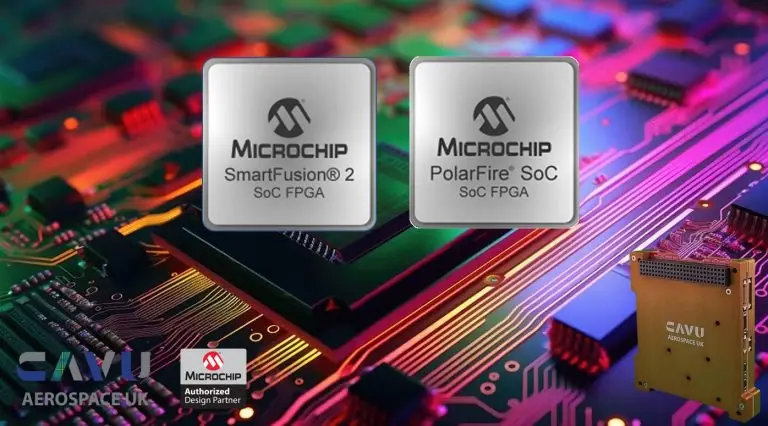
Compare OBC-104 & Cube-Polar
We offer two primary On-Board Computer platforms in the CubeSat form factor: OBC-104 and OBC-Cube-Polar. Both platforms are technically competitive in the market and are manufactured in series production to improve commercial attractiveness by reducing lead times and overall costs. Each OBC is supported by open-source software, BSPs, and a mature software ecosystem. The following comparison is intended to help mission designers select the most suitable OBC based on their mission requirements.
Feature | OBC-Cube-104 | OBC-Cube-Polar |
Platform | SmartFusion2 Flash FPGA (ARM Cortex-M3) | Microchip PolarFire SoC FPGA (Quad RISC-V + monitor core) |
Form Factor | CubeSat | CubeSat |
Target | Budget / standard CubeSat missions | Advanced & compute-intensive missions |
SW Support | Bare-metal/RTOS (via Cortex-M3) | Linux, RTOS (e.g. Linux, FreeBSD, Integrity) |
Processing Power
OBC-Cube-104
- ARM Cortex-M3 (inside SmartFusion2 FPGA fabric).
- Up to ~150 DMIPS @ ~128 MHz (max ~166 MHz).
- Suitable for typical command & data handling, housekeeping, and lightweight payload processing.
OBC-Cube-Polar
- Quad 64-bit RISC-V cores @ 660 MHz each — >4000 DMIPS total.
- Includes a monitoring core and optional soft cores.
- Orders of magnitude higher CPU performance than Cube-104.
- Designed to run full OS (e.g., Linux) for complex applications.
👉 Which suits which?
- Cube-104: Adequate for missions with basic CDH, simple payload control, ADCS demo missions, or low data-rate science.
- Cube-Polar: Best for missions requiring significant on-board data processing, complex payload control, ML/AI, real-time image processing, or advanced autonomy.
Interface Capability
OBC-Cube-104 Interfaces
- Digital I/O: ~20–60.
- ADC: 8 channels.
- Serial: CAN2.0×4, RS422×4, RS485×4, RS232×2.
- I2C×2, SPI×2.
- SpaceWire×2, optional CameraLink.
OBC-Cube-Polar Interfaces
Typical interfaces (from datasheets / catalog listings):
- UART, SPI, I2C.
- SpaceWire.
- LVDS.
- USB 2.0.
- Gigabit Ethernet (GigE).
- CAN2.0B, RS422, RS232.
- ADC (unspecified channels, but large connectivity).
- PCIe support via daughter-card/SerDes.
👉 Comparison:
- Cube-104: Strong on basic serial and legacy buses, suitable for comms & AOCS.
- Cube-Polar: Broader, higher bandwidth interfaces including USB/GigE/PCIe and more flexible payload connectivity — suitable for data-heavy instruments like imagers, LiDAR, or high-rate science.
Power Consumption
Model | Typical Power Consumption |
OBC-Cube-104 | ~1 W – 2 W |
OBC-Cube-Polar | ~1.5 W – 6 W (catalog / dependent on config) |
👉 Notes:
- Cube-104’s low power envelope makes it ideal for very power-limited missions or smaller CubeSats (1U/2U).
- Cube-Polar consumes more (higher compute cost) but still within typical CubeSat power budgets — fits missions with larger power availability (e.g., 6U+ or dedicated Earth observation).
Memory & Storage
OBC-Cube-104
- MRAM/FRAM with ECC; up to ~192 Gbit NAND Flash.
- Up to ~112 Mbit RAM + 512 KB eNVM.
OBC-Cube-Polar
- Large RAM with ECC (2 GB or 4 GB options).
- eMMC Flash (~64 GB), QSPI (~1 Gb), FRAM/MRAM, microSD slot.
- Fully modern storage suitable for large datasets.
👉 Cube-Polar is much better suited for data-intensive storage & caching (e.g., onboard preprocessing of images, science data buffering prior to downlink).
Operational & Software Support
- Cube-104: Suitable for bare-metal or lightweight RTOS (e.g., FreeRTOS). Best for well-controlled deterministic tasks.
- Cube-Polar: Supports full OS environments (Linux, Integrity, FreeBSD), enabling advanced scheduling, networking, filesystem support, and complex autonomy.
OBC-Cube-104
Best for:
- Standard CubeSat CDH (Command/Control & Housekeeping)
- AOCS & comms handling
- Low data rate research payloads
- Power-constrained missions (<2 W budget)
- Smaller form-factor CubeSats (1U/2U)
Not ideal for:
- On-board image processing
- High-rate data handling
- Full OS running
- Large science payloads
OBC-Cube-Polar
Best for:
- High-bandwidth instruments (cameras, spectrometers, LiDAR)
- Real-time image/data processing
- On-board autonomy / AI algorithms
- Scientific missions with high throughput
- Secondary payload processing
Considerations:
- Requires careful power budgeting (1.5 W to 6 W).
- Larger memory and interfaces benefit data-heavy missions.
In Brief:
✅ OBC-Cube-104 excels where simplicity, low power, and legacy interfaces are priorities.
✅ OBC-Cube-Polar excels where computing performance, modern interfaces, and advanced software ecosystems are critical.
Mission Type | Recommended OBC |
Basic CDH / house-keeping | OBC-Cube-104 |
AOCS & communication | OBC-Cube-104 / mid-range CubePolar |
Low-rate payloads | Cube-104 |
High rate cameras / EO | OBC-Cube-Polar |
Onboard processing / autonomy | OBC-Cube-Polar |
Big data storage & buffering | OBC-Cube-Polar |