
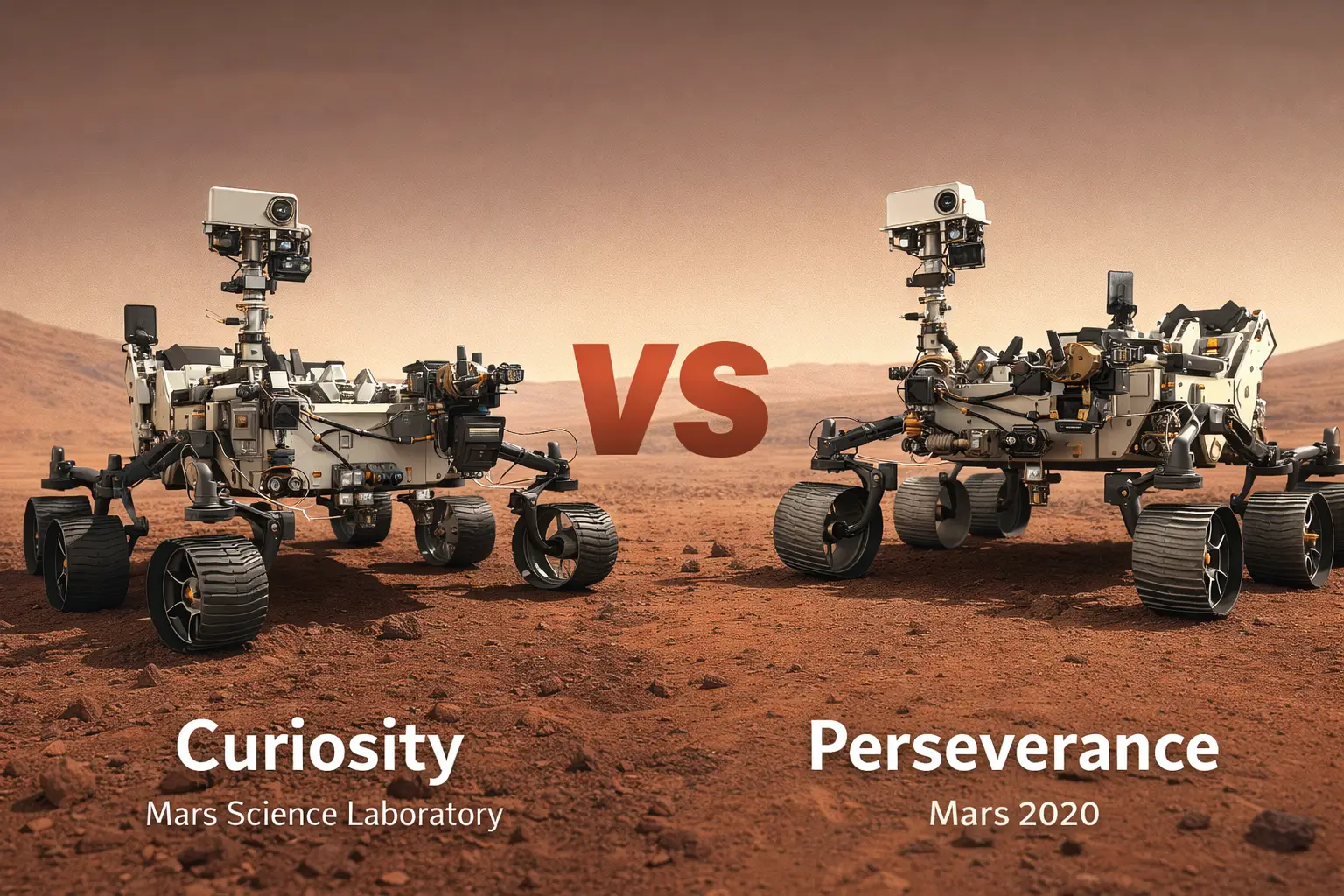
Core Processing Hardware
Curiosity
- Processor: BAE Systems RAD750 (radiation-hardened PowerPC 750 derivative).
- Clock: ~200 MHz (designed for space reliability).
- Architecture: 32-bit with real-time OS (VxWorks).
- Performance: up to ~400 MIPS typical for RAD750 on these missions.
Perseverance
- Processor: BAE Systems RAD750 (same family) — used in two Rover Compute Elements (RCE A & B).
- Clock & performance: Similar ~133–200 MHz class RAD750 baseline.
- Additional compute: A third RAD750 Vision Compute Element (VCE) with Virtex-5 FPGA for terrain-relative navigation and image processing during EDL.
Overall processing hardware on Perseverance includes more specialized co-processing (the Vision Compute Element) to enable advanced vision and autonomy compared to Curiosity’s baseline RAD750 pair.
Memory Resources
Curiosity Flash (non-volatile): 2 GB per RCE
- DRAM (volatile): 256 MB
- EEPROM: 256 kB
Perseverance
- RAD750 RCE:
- DRAM: ~128 MB reported (varies by source),
- NAND flash: ~4 GB non-volatile storage.
- Perseverance’s C&DH uses larger 4 GB flash for storing command sequences, telemetry, and science metadata, giving it roughly 2× the non-volatile storage compared to Curiosity’s 2 GB per module.
- DRAM on Perseverance is typically reported smaller than Curiosity’s (128 MB vs 256 MB) but this may be due to different reporting conventions or additional dedicated RAM on the Vision Compute Element.
Redundancy, Architecture, and Interfaces
Both rovers share heritage architecture patterns, but Perseverance expands on them:
Common Architecture Traits
- Dual RCEs: Active/backup redundant flight processors.
- Real-Time OS: VxWorks controlling scheduling, telemetry, fault management.
- Legacy interfaces: MIL-STD-1553, RS-422, SpaceWire linking to instruments and subsystems.
Perseverance Enhancements
- Vision Compute Element (VCE): A dedicated third computer with FPGA accelerator for vision algorithms (terrain-relative navigation and hazard avoidance) during landing and surface operations.
- Instrument CMD/TLM: Perseverance instruments use LVDS high-speed interfaces (e.g., ~1.94 Mbps command link, ~7.5 Mbps telemetry from SuperCam) and can connect via SpaceWire-mapped channels, supporting higher onboard science data throughput.
Telemetry & Data Throughput
While C&DH doesn’t directly define radio link speeds, it schedules and buffers telemetry based on these constraints:
Communication Rates
- Curiosity: UHF relay up to ~2 Mbps; X-band direct 800/3000 bps link.
- Perseverance: Similar ~2 Mbps UHF and X-band channels; telemetry scheduling and prioritization handled by C&DH.
Despite similar external comm rates, Perseverance’s larger memory and improved scheduling allow holding and prioritizing more data in flash while awaiting downlink opportunities.
The standout “big numbers” differences are:
- Non-volatile storage: Perseverance typically has about double the flash of Curiosity.
- Dedicated vision processing: Perseverance adds a third computing module with FPGA not present on Curiosity.
- Memory balancing: Curiosity’s DRAM is larger on paper, but Perseverance’s memory use is optimized across C&DH and vision compute tasks.
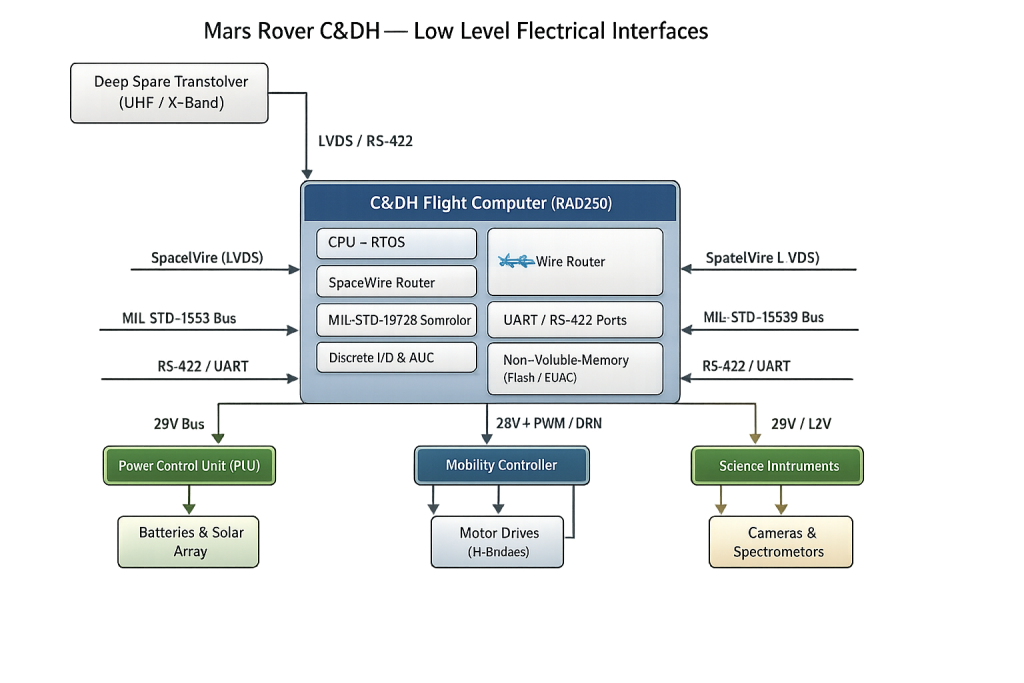
C&DH System Roles
Curiosity
- Execute flight software stored in flash
- Manage command sequences from Earth
- Prioritize and store telemetry to flash
- Perform basic hazard avoidance and health monitoring via integrated software loops
Perseverance
- Same core C&DH duties plus:
- Support Terrain-Relative Navigation preprocessing via VCE
- Execute higher autonomy sequencing (science & mobility)
- Expand interface bandwidth and data handling capacity to support more instruments and higher data volumes
Both rovers use RAD750 processors tuned for space radiation environments.
The technical upgrades in Perseverance’s C&DH are in memory scale, architectural support for co-processing (VCE), and instrument interface bandwidth, enabling more onboard autonomy and handling of larger science data loads.