
AI as a Multi-Layer Infrastructure in Space Industry
- February 3, 2026
- CAVU Aerospace UK
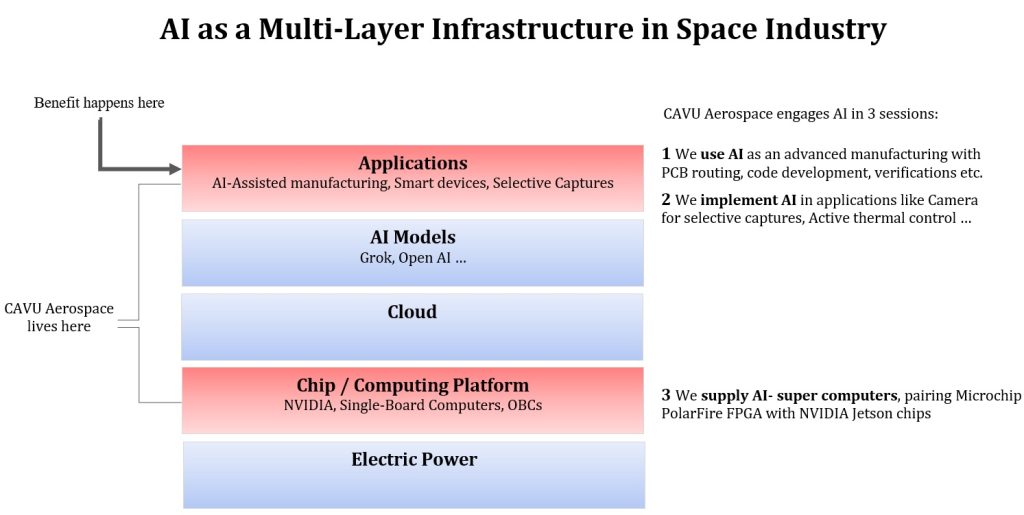
Due to fantastic improvement in AI models like ChatGPT, Grok etc in 2024/ 2025, Most people think AI is limited to models, while there are 4 other layers that needs to be in place to maximize efficiency at industry scale. Current AI boom isn’t only about flashy models or chatbots; it’s about building the foundational systems that enable AI to scale and transform industries globally. He argued this build-out of infrastructure is likely the largest in human history, with trillions of dollars in investment required and jobs created across sectors.
The Five Layers of AI
- Energy (Foundational Layer)
AI systems — especially large models and data centers — consume massive amounts of electricity. Huang stressed that power generation, energy infrastructure, cooling systems, and grid capacity are the base upon which all other layers rest. - Compute & Chips
The next layer is hardware: GPUs, AI accelerators, specialized processors, memory systems, and the semiconductor manufacturing ecosystem needed to produce them. Huang highlighted the critical competitive role of chip technology here. - Cloud & Infrastructure
This includes data centers, networking, storage, orchestration software, and distributed systems that host and operate AI workloads at scale. Huang emphasized that real-world AI doesn’t live on a laptop — it lives in the cloud. - AI Models (Intelligence Layer)
The models themselves — large language models, reasoning engines, vision systems, and other foundational AI models — sit above the infrastructure. These are the engines that learn, understand, and generate intelligence. - Applications (Economic Value Layer)
At the top are industry-specific applications that embed AI into workflows — in healthcare, finance, manufacturing, logistics, energy, and beyond. This is where the technology delivers measurable economic benefits.
Application layer is where economic benefit will happen because this is where intelligence turns into practical productivity tools and services.
Connecting the Five Layers to Space Applications
Layer 1: Energy in Space AI
Space systems — satellites, lunar bases, rovers — must balance power budgets carefully. Efficient energy generation (solar panels, nuclear power on deep missions) underpins AI workloads off Earth. AI for autonomous operations on spacecraft needs reliable and smart power management systems.
Examples in space: AI-optimized power scheduling on satellites, Martian rover power budgeting, solar array reconfiguration using AI.
Layer 2: Compute & Chips for Space
Traditional space hardware is rugged and low-power; AI requires high-performance onboard compute. This has sparked development of:
- Radiation-hardened AI accelerators
- Compact GPUs for orbital applications
- Edge AI processors for autonomous decision-making (Example: Pairing FPGAs on OBCs to NVIDIA Jetson chips like Typhoon-Edge / PolarEdge onboard computers)
AI at the edge reduces reliance on Earth-based processing — a necessity when latency is minutes to hours.
Space use cases: Onboard image analysis (e.g., identifying surface features), real-time hazard detection, satellite sensor data fusion.
Layer 3: Infrastructure & Networking
In space contexts, “infrastructure” includes:
- Ground stations
- Inter-satellite links
- Space internet constellations
- Cloud backends for mission data
AI enhances this by optimizing communication schedules, bandwidth allocation, and routing decisions.
Space infrastructure with AI: Smart network orchestration for mega-constellations (Starlink, OneWeb), autonomous traffic management in orbit.
Layer 4: AI Models for Space Tasks
AI models trained on vast observational datasets are vital for:
- Automated scientific data interpretation
- Autonomous navigation and landing
- Predictive health monitoring for spacecraft
These models must be robust, efficient, and tolerant of noisy or sparse data — common realities in space environments.
Model examples: Geological feature recognition, anomaly detection in telemetry, predictive failure forecasting.
Layer 5: Space AI Applications (Economic & Scientific Value)
This is where the AI stack delivers real value:
- Autonomous spacecraft operations
- Enhanced Earth observation analysis
- Real-time hazard avoidance
- AI-assisted space science discovery
- Selective captures in satellite camera
- Resource identification on other planets or moons
Space agencies and companies are already deploying these — for example, AI that autonomously identifies geologic formations on Mars rovers, or onboard satellite analytics that sends only insightful data back to Earth.
Benefits realized: Faster scientific insights, reduced operational costs, safer autonomous missions.