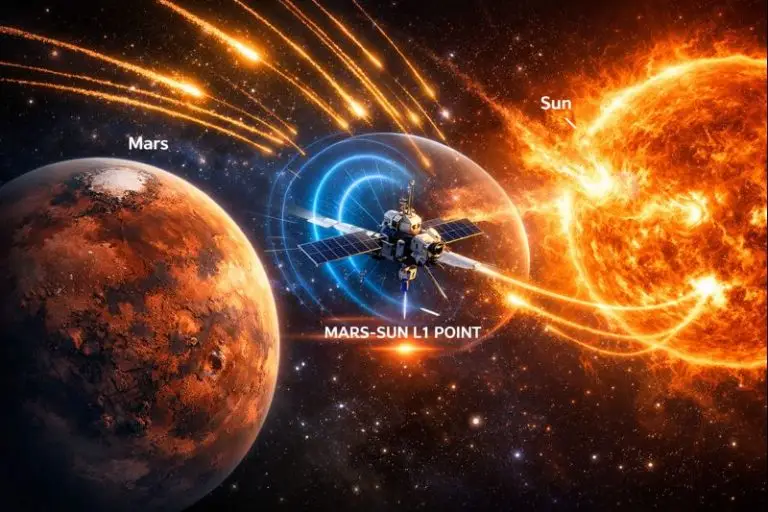
A Mars–Sun L1 Shield: Defending the Red Planet from Radiation
As humanity looks toward Mars not merely as a destination but as a future home, one invisible enemy looms larger than most: radiation. Unlike Earth, Mars lacks a strong global magnetic field and a thick atmosphere. The result is a relentless bombardment of solar radiation and cosmic rays—hostile to both human explorers and the delicate systems they depend on.
The L1 Advantage
Between the Sun and Mars lies a gravitational balance point known as the Mars–Sun L1 Lagrange point. At this location, a spacecraft can “hover” in a stable position, continuously facing the Sun while maintaining a fixed relationship with Mars. It’s an ideal vantage point for solar observation—but it could also serve a far more ambitious role.
Scientists have proposed placing a specialized spacecraft at Mars L1 to act as an early warning system—and potentially a radiation shield.
Watching the Sun, Protecting the Planet
At its simplest, an L1 spacecraft could monitor the Sun in real time, detecting solar flares and coronal mass ejections (CMEs) hours before their charged particles slam into Mars. This warning window could be lifesaving:
- Astronauts could retreat to shielded habitats
- Surface operations could pause
- Sensitive electronics could be powered down or protected
Earth already benefits from such sentinels at its own L1 point. Mars, with far less natural protection, arguably needs them even more.
Beyond Warnings: An Artificial Magnetic Shield?
The more radical—and captivating—idea is to use the L1 spacecraft to actively deflect radiation.
One concept envisions a spacecraft generating a powerful artificial magnetic field, creating a protective bubble that would divert charged solar particles around Mars, much like Earth’s magnetosphere does naturally. Rather than shielding individuals or habitats, this approach aims to protect the entire planet.
In 2017, NASA scientists explored this idea and found that even a partial magnetic shield could:
- Reduce atmospheric loss over time
- Lower radiation levels at the surface
- Help Mars slowly rebuild a thicker atmosphere
In essence, it could begin the long process of making Mars more Earth-like.
Engineering on a Planetary Scale
The challenges are immense. Generating and sustaining a magnetic field strong enough to influence solar particles across planetary distances would require:
- Advanced superconducting materials
- Massive, reliable power systems
- Long-term autonomous operation in deep space
Yet none of these challenges violate known physics. They sit at the edge of near-future engineering rather than science fiction.
A Gateway to Permanent Human Presence
Radiation is one of the biggest barriers to long-term human settlement on Mars. A spacecraft at Mars L1—whether as a sentinel, a shield, or both—offers a rare opportunity to solve that problem at the planetary level, rather than forcing every habitat, rover, and astronaut to fight the Sun alone.
More than just a spacecraft, an L1 radiation protector would be a statement: that humanity is no longer just visiting Mars, but investing in its future.
If Mars is to become a second home, perhaps its first piece of infrastructure won’t be on the ground at all—but quietly standing guard in space, between the planet and the Sun.