
Why humanity is building lunar base before going into Mars & deep space
- June 17, 2026
- CAVU Aerospace UK
We are seeing several robotic missions under development for lunar surface & mostly Moon rovers are suddenly very attractive destination for both space agencies & commercial sector. For decades, humanity’s vision of space exploration has focused on reaching Mars, establishing colonies on distant worlds, and eventually spreading throughout the Solar System & they were focusing on habitable planets. While these ambitions are inspiring, they may be premature. Before attempting large-scale expansion into deep space, humanity should first establish a permanent industrial and transportation base on the Moon. The Moon’s unique environment offers tremendous advantages that could dramatically reduce the cost, complexity, and risk of future space missions.
The Gravity Advantage
The single greatest advantage of the Moon is its low gravity. Lunar gravity is only about one-sixth that of Earth. Escaping Earth’s gravity well is one of the most expensive and technically challenging aspects of any space mission. Rockets launching from Earth must fight against Earth’s powerful gravitational pull and thick atmosphere, requiring enormous amounts of fuel.
By comparison, launching from the Moon requires far less energy. A spacecraft departing from the lunar surface needs only a fraction of the fuel required for an Earth launch. This means larger payloads can be transported with smaller vehicles, dramatically reducing costs and increasing mission flexibility.
In many ways, Earth acts as a deep valley from which every spacecraft must climb. The Moon, however, is more like a hilltop, providing a much easier starting point for journeys throughout the Solar System.
Lunar Spaceport
A permanent lunar base could evolve into humanity’s first true spaceport. Unlike Earth, the Moon has virtually no atmosphere. This eliminates aerodynamic drag during launch and allows entirely new launch technologies that are impractical on Earth. Instead of relying solely on chemical rockets, engineers could construct electromagnetic launch systems similar to magnetic levitation (maglev) railways.
A lunar maglev launch track could accelerate spacecraft over many kilometers before releasing them into space. Because there is no atmosphere to create friction or heating, vehicles could reach extremely high velocities before launch. This approach would greatly reduce the amount of onboard propellant required.
Such systems could operate repeatedly, much like trains leaving a station, making access to space far more routine than today’s rocket launches.
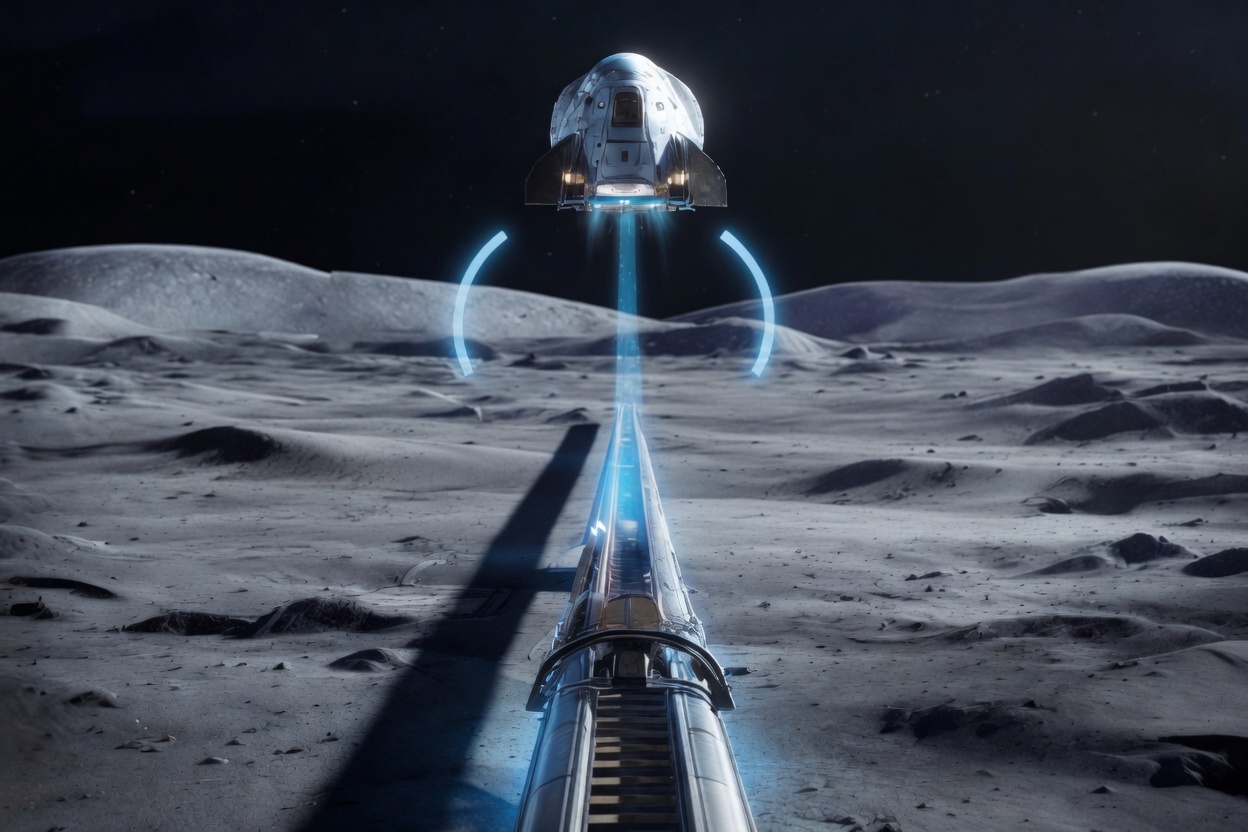
Electromagnetic Mass Drivers
The concept of a lunar mass driver has been studied for decades. A mass driver is essentially a giant electromagnetic catapult that accelerates cargo or spacecraft along a track using electric power rather than rocket fuel.
The Moon is an ideal location for such infrastructure because:
- Low gravity reduces required launch energy.
- No atmosphere minimizes drag losses.
- Abundant solar energy can power the system.
- Lunar materials can be used to construct much of the infrastructure.
A mature lunar mass-driver network could launch cargo, fuel, building materials, and even spacecraft components into orbit at a fraction of current Earth-launch costs.
Another promising concept involves rotating launch mechanisms. These systems use large spinning structures to build up velocity before releasing payloads into space.
On Earth, atmospheric forces and extreme structural requirements make such systems difficult. On the Moon, however, lower gravity and the absence of atmospheric drag make rotating launch facilities far more practical.
A lunar base could host giant centrifuge-like launch systems capable of accelerating spacecraft to significant fractions of escape velocity before their engines ignite. The result would be major fuel savings and lower transportation costs.
Launching entire spacecraft from Earth is expensive because every component must be lifted out of Earth’s gravity well.
A lunar industrial base would change this equation completely. Instead of launching finished spacecraft, Earth could send only specialized equipment and personnel. Bulk materials could be mined and processed on the Moon itself.
Potential lunar resources include:
- Oxygen extracted from lunar soil.
- Metals such as aluminium, titanium, and iron.
- Silicon for solar panels.
- Water ice near the lunar poles, which can be converted into hydrogen and oxygen rocket propellants.
Future spacecraft could be assembled, fueled, and launched directly from the Moon. This would transform the economics of space exploration.
A Fuel Depot for the Solar System
Water discovered in permanently shadowed lunar craters may become one of the most valuable resources in space.
Water can be separated into hydrogen and oxygen through electrolysis. These elements form one of the most efficient rocket propellants known.
A lunar fuel-production industry could supply spacecraft traveling to:
- Mars
- Near-Earth asteroids
- The asteroid belt
- The outer planets
Rather than carrying all fuel from Earth, missions could refuel on the Moon before continuing deeper into space. This is analogous to aircraft using airports and fuel stations rather than attempting to fly around the world without stopping.
Economic factors
A lunar transportation hub would reduce launch costs across the entire space economy.
Lower transportation costs would enable:
- Space-based solar power construction.
- Large scientific observatories.
- Asteroid mining operations.
- Manufacturing in microgravity.
- Tourism beyond Earth orbit.
- Permanent settlements throughout the Solar System.
Historically, transportation breakthroughs have always driven economic expansion. Railways transformed continents. Ports enabled global trade. Airports connected nations. A lunar spaceport could become the equivalent infrastructure for the Solar System.
Many advocates of Mars exploration envision direct missions from Earth. However, establishing a lunar base first offers significant advantages.
The Moon allows humanity to:
- Develop life-support technologies.
- Test long-duration habitation systems.
- Practice resource extraction.
- Build transportation infrastructure.
- Gain operational experience in another world.
Problems can be solved only three days from Earth rather than months away on Mars. Lessons learned on the Moon would greatly increase the likelihood of success for future Mars missions.