
OBC-Hyper-Polar with Intelligent Stepper Motor Control & Solenoid Valve Control
- July 9, 2026
- CAVU Aerospace UK
Modern satellites & spacecrafts require increasingly sophisticated electronic subsystems capable of managing payloads, controlling spacecraft mechanisms, collecting sensor data, and communicating with other onboard systems while maintaining high reliability in harsh space environments. The OBC-Hyper-Polar has been developed as a modular, high-performance On-Board Computer that addresses these challenges through an expandable architecture. Processing is based on Microchip PolarFire FPGA SoC & available in both COTS & Radiation Tolerant versions.
A key feature of the OBC-Hyper-Polar is its Potentiometer analog measure, Motor Control & Data Acquisition Add-on Card, which transforms the OBC into a comprehensive spacecraft mechanism controller capable of driving up to eight bipolar stepper motors, controlling multiple solenoid valves, acquiring high-resolution analog data, and interfacing with numerous spacecraft subsystems through industry-standard communication protocols.
This modular approach allows spacecraft designers to deploy a single computing platform for mission management while adding specialized functionality only when required.
Architecture
The OBC-Hyper-Polar consists of two major components:
- Main OBC
- Mechanism Control & Data Acquisition Add-on Card
The main OBC performs spacecraft computing, communications, data handling, and mission execution. The add-on card extends these capabilities by providing dedicated hardware for precision motor control, valve actuation, analog sensor acquisition, and additional communication interfaces.
This architecture offers several advantages:
- Reduced spacecraft wiring complexity
- Lower system mass
- Simplified integration
- Modular scalability
- Easy customization for different missions
Front and Rear Interfaces
The system provides a comprehensive set of interfaces for spacecraft integration.
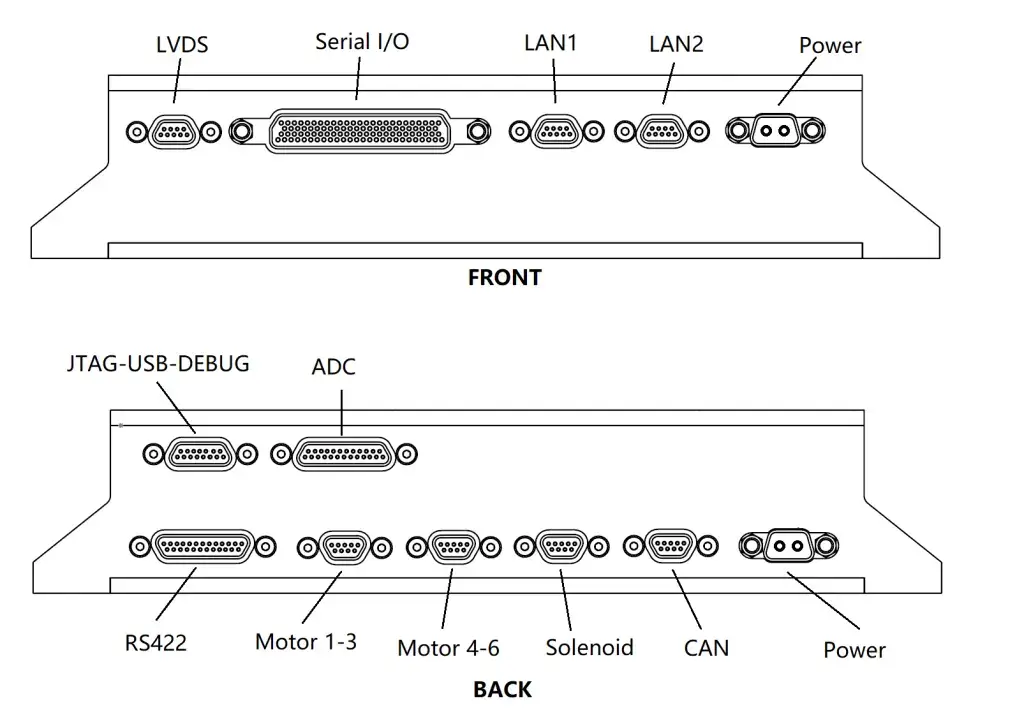
Front Panel Interfaces
As illustrated in the hardware layout:
- LVDS Interface
- High-density Serial I/O connector
- Dual Ethernet/LAN interfaces
- Power input
These interfaces provide high-speed communications, payload connectivity, and system power.
Rear Panel Interfaces
The rear panel hosts mission-specific control interfaces including:
- JTAG/USB Debug
- 16-channel ADC Interface
- RS-422 communications
- Stepper Motor outputs
- Solenoid Valve outputs
- CAN Bus
- Power connector
This separation simplifies spacecraft integration while providing convenient access for testing and development.
Bipolar Stepper Motor Controller
One of the primary capabilities of the add-on card is precision motion control.
The card can independently drive:
- Up to 8 bipolar stepper motors (Motor current rating: 250mA using the unregulated 28V power rail)
These motors may be used for:
- Optical instrument positioning
- Filter wheel mechanisms
- Antenna deployment
- Solar array deployment
- Focus mechanisms
- Valve positioning
- Precision pointing devices
- Scientific instrument actuation
Each motor channel is independently controlled, allowing simultaneous multi-axis operation.
Typical supported features include:
- Full-step operation
- Half-step operation
- Micro-stepping
- Adjustable current control
- Programmable acceleration
- Velocity profiling
- Position control
- Homing functions
- Fault detection
The dedicated motor-control hardware minimizes processor loading while ensuring smooth and accurate motion.
Solenoid Valve Control
In addition to stepper motors, the add-on card provides multiple outputs for driving:
- Latching solenoid valves
- Non-latching valves
- Pyro-safe switching (optional implementation)
- Relay-controlled actuators
- Electromechanical devices
Applications include:
- Propulsion systems
- Fluid management
- Gas regulation
- Pressure control
- Thermal management systems
- Scientific payload mechanisms
Independent control channels enable reliable sequencing and timing for mission-critical operations.
High-Resolution Data Acquisition
Monitoring spacecraft health requires accurate analog measurements. There are also usually requirements in Potentiometer analog measurements in modern spacecrafts which can be implemented in OBC. The add-on card incorporates the AD7616, a simultaneous-sampling 16-channel, 16-bit Analog-to-Digital Converter, enabling precise acquisition of sensor signals.
ADC Features
- 16 simultaneous analog input channels
- 16-bit resolution
- Simultaneous sampling
- High-speed acquisition
- Wide input voltage range
- Excellent accuracy
- Low noise performance
Typical monitored signals include:
- Voltage
- Current
- Temperature
- Pressure
- Torque sensors
- Position sensors
- Strain gauges
- Scientific instruments
The simultaneous sampling capability makes the system particularly suitable for synchronized measurements across multiple sensors.
The OBC-Hyper-Polar architecture is intended for demanding aerospace missions including
Earth Observation, GEO missions, Satellite Platforms & Propulsion Systems. The modular hardware design simplifies spacecraft integration by reducing the number of standalone electronic units.
Benefits include lower power consumption, reduced mass, smaller footprint, simplified harnessing, easier maintenance, improved reliability & flexible mission configuration. Because motor control, analog acquisition, and communications are integrated into a single expansion card, overall spacecraft architecture becomes significantly simpler than using multiple dedicated control units.