
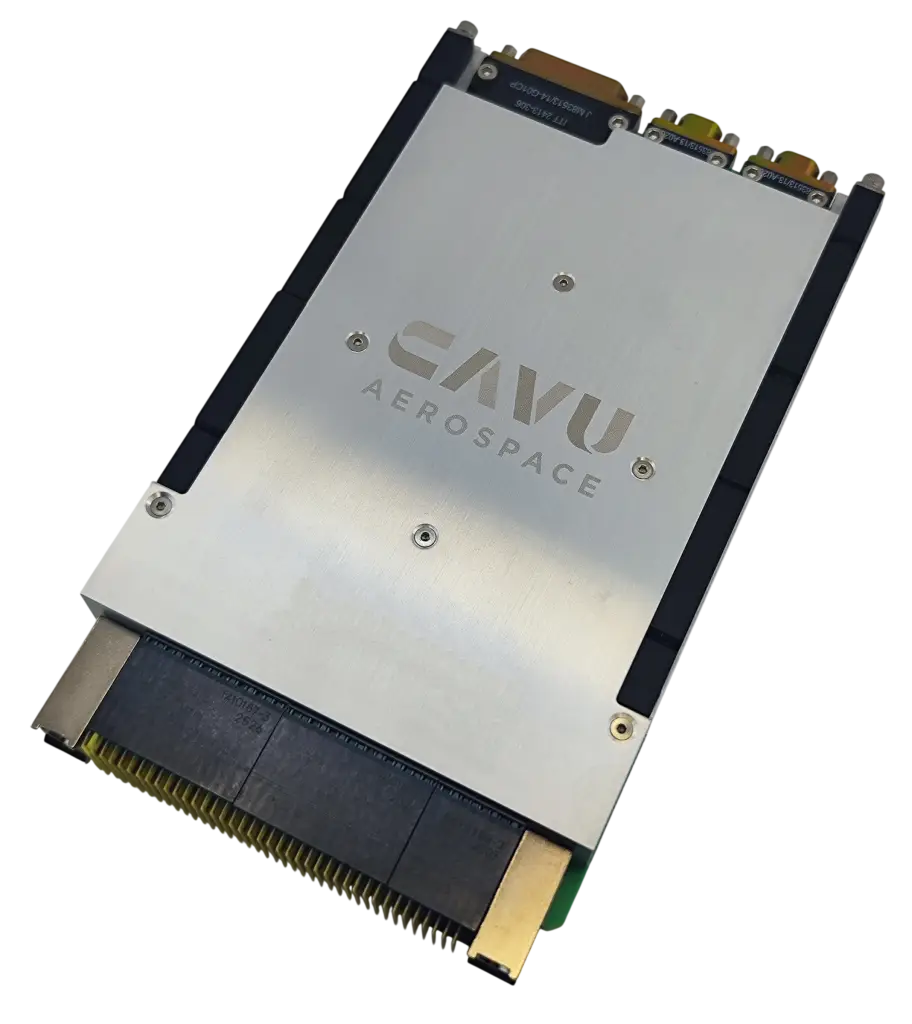
CoaXPress OnBoard Recorder

DESCRIPTION
OBR handles high data rate missions by combining high-speed CoaXPress acquisition with FPGA-based deterministic processing, a large ECC-protected burst buffer and high-throughput multi-drive storage. The philosophy is straightforward: Capture at the speed of the sensor, Buffer without losing data, Store continuously & Protect the data throughout the pipeline. Built around the Microchip PolarFire SoC, the architecture provides a flexible platform that can evolve from today’s CXP-based imaging systems toward future high-speed custom serial payload interfaces.

KEY FEATURES
- Processor: Microchip PolarFire SoC MPFS460T
- High-speed inputs: 8 × configurable SERDES
- Supported interfaces: CXP-3 / CXP-6 / CXP-12 / custom serial
- Design-point input processing: 25 Gbps
- Representative payload rate: 23.1 Gbps
- Burst buffer: 128 Gbit / 16 GB
- Total memory architecture: 144 Gbit
- Memory protection: ECC
- Sustained DDR4 bandwidth: 12.8 GB/s
- NVMe storage: 2 × U.2, PCIe Gen2 x2
- SATA storage: 4 × U.2 SATA III
- Aggregate storage write: 3.5 GB/s
- High-Capacity Mass Storage: 2 × U.2 NVMe
- Example 5-second / 25 Gbps burst: 125 Gbit / ~15.6 GB
CoaXPress
CoaXPress originated as a high-speed imaging interface and is particularly well suited to applications where large volumes of camera data need to move with predictable latency. The interface supports high-speed downstream data together with lower-speed control communication. CoaXPress can also carry power over coax in appropriate implementations. For spacecraft applications, the most interesting characteristic is its ability to provide a simple, scalable physical interface for very high-rate imaging data. With CXP-12 providing up to 12.5 Gbps per connection, multiple links can be aggregated to support substantially higher payload data rates. For a spacecraft carrying several cameras, this opens an interesting architecture.
PRODUCT DOCUMENTS
- Failure Modes, Effects, and Criticality Analysis (FMECA)
- Reliability Analysis Report
- Radiation Analysis Report
- Safety Assurance Plan
- Fault Tree Analysis (FTA)
- Single Point Failure Analysis (SPFA)
- Worst Case Analysis (WCA)
- Derating Analysis Report
- Availability Analysis Report
- Mechanical Analysis Report
- Maintainability Analysis Report
- Fault Detection, Isolation, and Recovery (FDIR)
- Qualification Test Plan (QTP)
- Environmental Test Reports, TVAC, Vib.
- EMC/EMI Test Report
- Radiation Test Report
- Operational Risk Assessment (ORA)
- Critical Items List (CIL)
- Materials, Processes, and Mechanical Parts List (MPMPL)
- Product Assurance Plan (PAP)
- Configuration Item Data List (CIDL)
- End Item Data Package (EIDP)
- As-Built Configuration List (ABCL)