High-Precision Optical Compensation Mechanism for Dual-Environment Camera Calibration
- March 14, 2026
- CAVU Aerospace UK
Modern space imaging systems must operate reliably in both atmospheric test environments and the vacuum of space. One of the major engineering challenges in high-performance cameras is maintaining optical focus and alignment across these environments, as the optical path and mechanical structures behave differently under vacuum conditions.
We have developed a high-precision mechanical compensation mechanism that allows fine optical adjustments with 20-micron steps while preserving a fully modular electronics architecture.
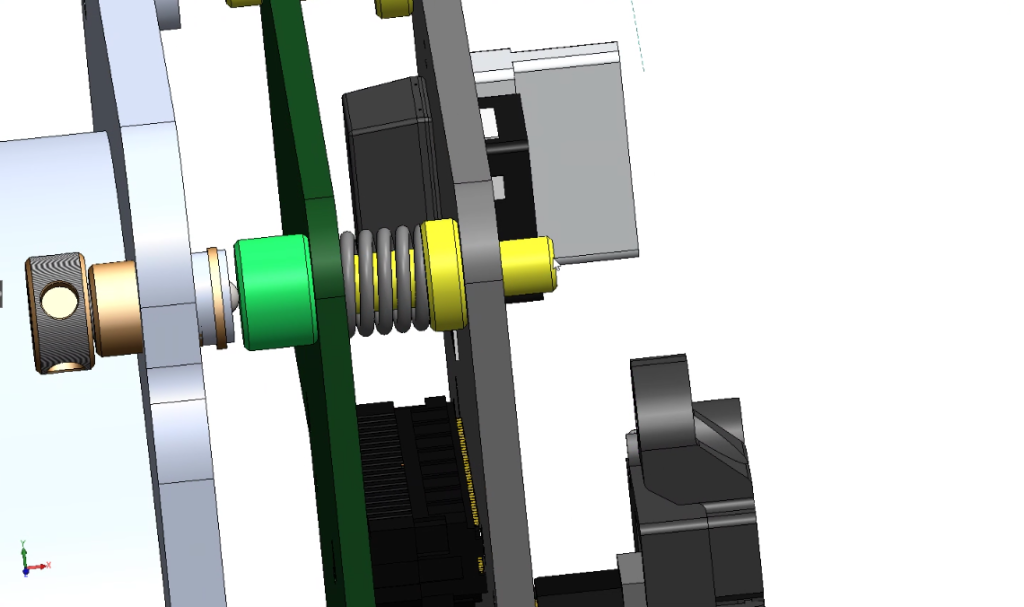
To support modularity and serviceability, the imaging system separates the sensor board and the Command & Data Handling board by approximately 6 mm.
This modular design provides several advantages:
- Independent development and testing of electronics subsystems
- Simplified integration and replacement of modules
- Improved thermal and mechanical isolation between boards
- Scalability across different camera configurations
However, this architecture introduces an additional mechanical challenge: maintaining precise optical alignment despite small structural variations between environments.
Optical Shift Between Atmospheric and Vacuum Conditions
Optical assemblies behave differently in air and vacuum due to several factors:
- Material outgassing and structural relaxation
- Thermal expansion differences
- Refractive index change when air is removed
- Mechanical preload variations
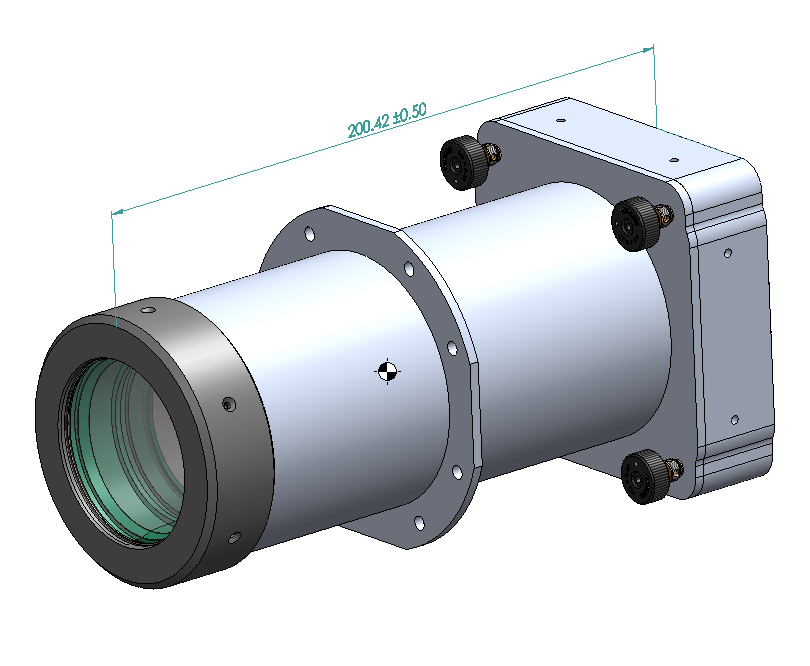
For the LDU345 class space-grade camera, analysis and testing show that an optical displacement of approximately 230 µm can shift the system from optimal focus.
To ensure the camera performs optimally in both ground testing (air) and operational space conditions (vacuum), a precise compensation mechanism was required.
High-Precision Adjustment Mechanism
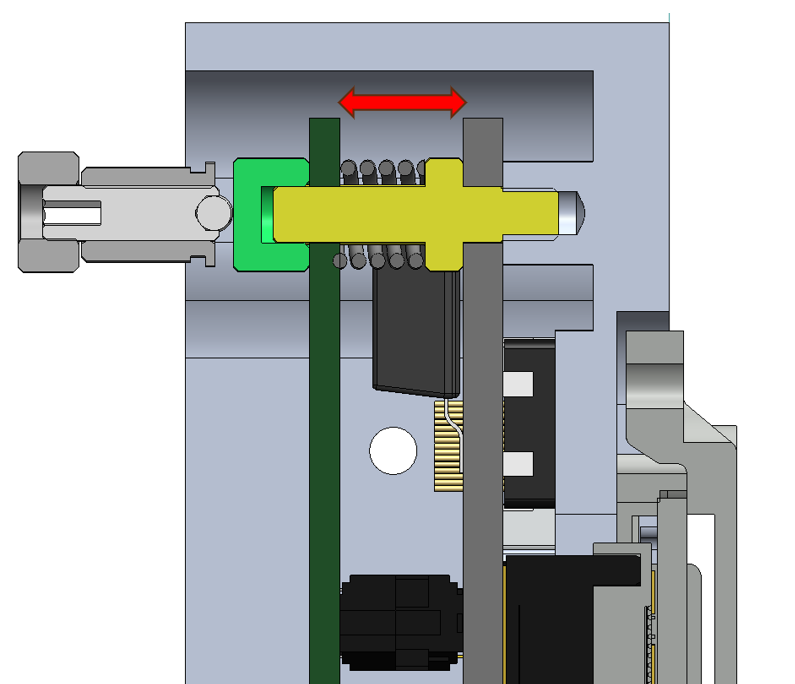
To address this challenge, we implemented a flexure-assisted precision screw adjustment system, illustrated in the design figure.
Key features include:
Ultra-Fine Adjustment Resolution
The adjustment screw incorporates a high-precision head with 20 µm incremental displacement per turn step, enabling extremely fine optical positioning. This allows engineers to compensate for the required ~230 µm optical shift with controlled, repeatable adjustments.
Flexure-Supported Motion
The system uses flexible mechanical elements (flexures) rather than conventional sliding components. This provides:
- Zero backlash
- High repeatability
- No particle generation
- Improved reliability in vacuum environments
Flexure-based motion is widely used in space mechanisms and precision optical systems because it eliminates friction and wear.
Controlled Optical Translation
The mechanism translates the optical assembly along the optical axis, enabling precise focus adjustment between the two environmental states. As shown in the diagram, the bidirectional displacement allows tuning in both directions to achieve optimal focus.
Manufacturing Advantages
This technique provides several manufacturing and operational benefits:
- Dual-Environment Calibration
The camera can be calibrated in atmospheric test conditions and then finely adjusted for vacuum operation without redesigning the optical stack.
- Repeatable Precision Alignment
The 29 µm resolution screw adjustment ensures predictable, repeatable alignment during production.
- Reduced Optical Re-Engineering
Instead of redesigning optics to compensate for environment changes, the mechanism allows mechanical compensation, significantly reducing development complexity.
- Space-Qualified Mechanical Concept
The use of flexure-based precision adjustment improves reliability by eliminating:
- backlash
- lubrication issues
- particulate generation
These characteristics are highly desirable for spaceflight hardware.
- Modular System Compatibility
The solution works seamlessly with the 6 mm modular electronics spacing, preserving system flexibility while maintaining optical performance.
By integrating ultra-fine mechanical adjustment with modular electronics architecture, this design enables the LDU345 camera platform to maintain optimal optical performance across different environmental conditions.
This precision mechanism demonstrates how advanced mechanical design can complement optical engineering, enabling robust, adaptable imaging systems suitable for modern space missions.
The precision flexure-based optical adjustment mechanism developed at CAVU Aerospace represents a significant advancement in space camera manufacturing.
By enabling micron-level optical compensation between atmospheric and vacuum environments, the system delivers:
- reliable focus stability
- modular system architecture
- high repeatability in production
- compatibility with demanding space environments
This approach highlights how precision mechanical engineering can provide elegant solutions to complex optical challenges in space instrumentation.