
Camera Link Frame Grabbing with OBC-Cube-Polar
- September 13, 2026
- CAVU Aerospace UK
Modern spacecraft increasingly rely on high-resolution cameras for Earth observation, navigation, inspection, scientific experiments and situational awareness. But capturing image data from a high-performance camera is only the first step. The spacecraft computer must also receive, buffer, process and transfer that data efficiently without creating a bottleneck in the onboard data-handling architecture.
OBC-Cube-Polar with a dedicated Camera Link interface as peripheral or add-on card, connected through Samtec B2B connector enabling the onboard computer to operate as a Camera Link frame-grabber and image-data acquisition platform for the Raptor Photonics Hawk 1920 camera & others. The result is a compact & budget-friendly architecture in which the camera can send its high-speed image stream directly into the spacecraft’s onboard computing system.
The architecture can be summarised as:
Raptor Hawk 1920 → Camera Link → OBC-Cube-Polar Camera Link Add-On → FPGA/Frame Grabber → Memory → OBC Processing → Spacecraft System
Instead of requiring a conventional PC-based frame-grabber, the Camera Link interface is integrated into the spacecraft computer architecture. This is particularly useful for space applications where size, mass, power consumption and system integration are important considerations. The OBC becomes more than a general-purpose computer: it also acts as the interface between the spacecraft camera and the onboard data-processing chain.
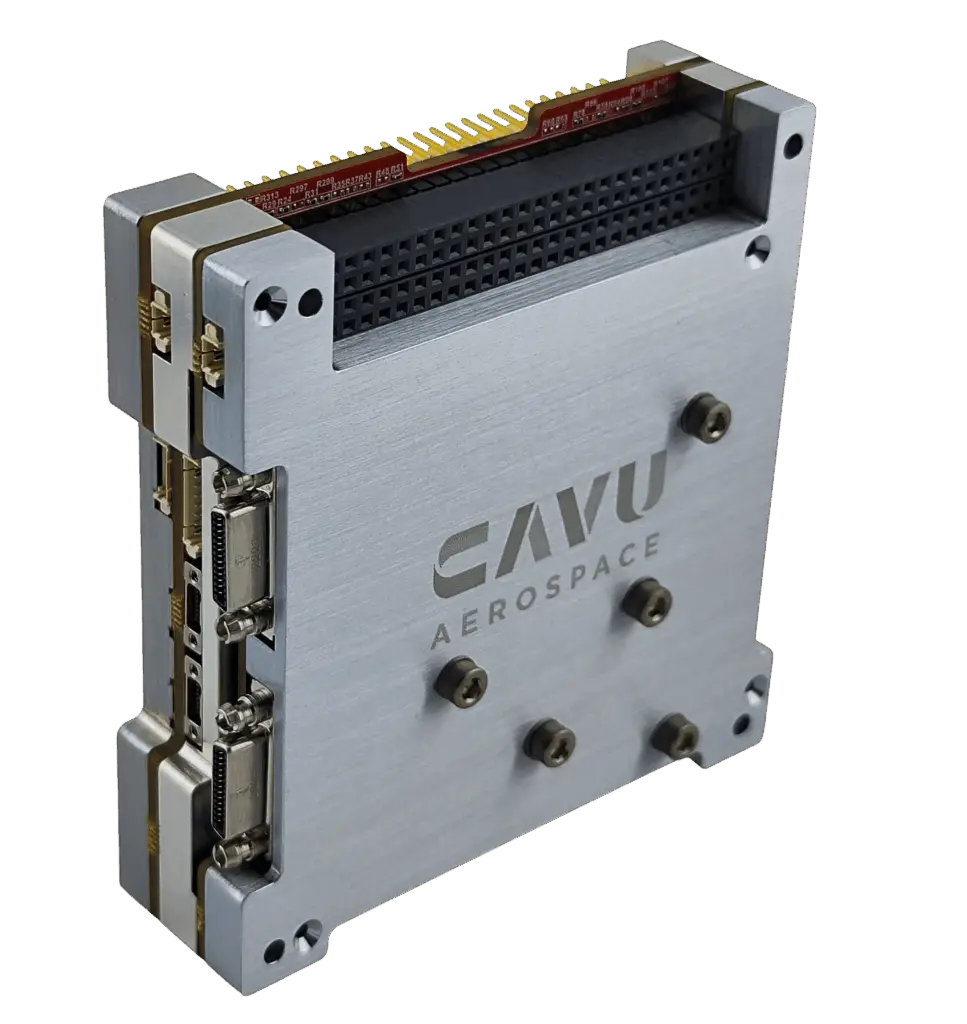
Raptor Hawk 1920- Double CameraLink
The Hawk 1920 from Raptor Photonics is a ruggedised CMOS camera designed for applications including airborne, space, surveillance and scientific imaging. The camera provides a 1944 × 1472 pixel image format with a 4.5 μm pixel pitch and global-shutter progressive-scan operation. Raptor specifies operation at up to 50 Hz full-frame.
For the monochrome Camera Link version, the camera provides 1944 × 1472 resolution, 4.5 μm pixels, 12-bit output, Camera Link Base interface, up to 50 Hz full-frame operation, Global shutter & Trigger input/output capability. This combination makes the camera capable of generating a substantial continuous stream of image data.
Camera Link is specifically designed to provide a standardised interface between a digital camera and a frame grabber. It defines the high-speed image-data path as well as camera timing, serial communication and control signals. The frame grabber is responsible for receiving the incoming camera data and making the image available to the host processing system.
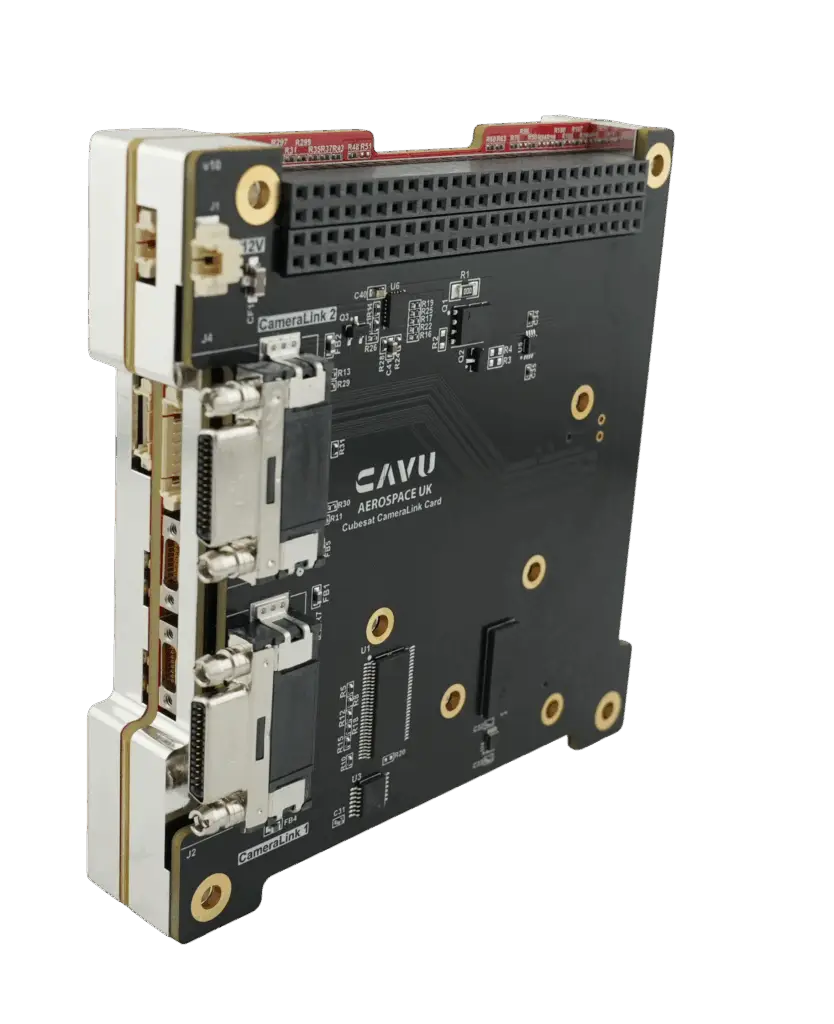
OBC-Cube-Polar is based on the Microchip PolarFire SoC FPGA, providing a combination of programmable FPGA resources and processor-based computing within a compact CubeSat-oriented onboard computer. For the camera application, CAVU Aerospace developed an add-on Camera Link interface card.
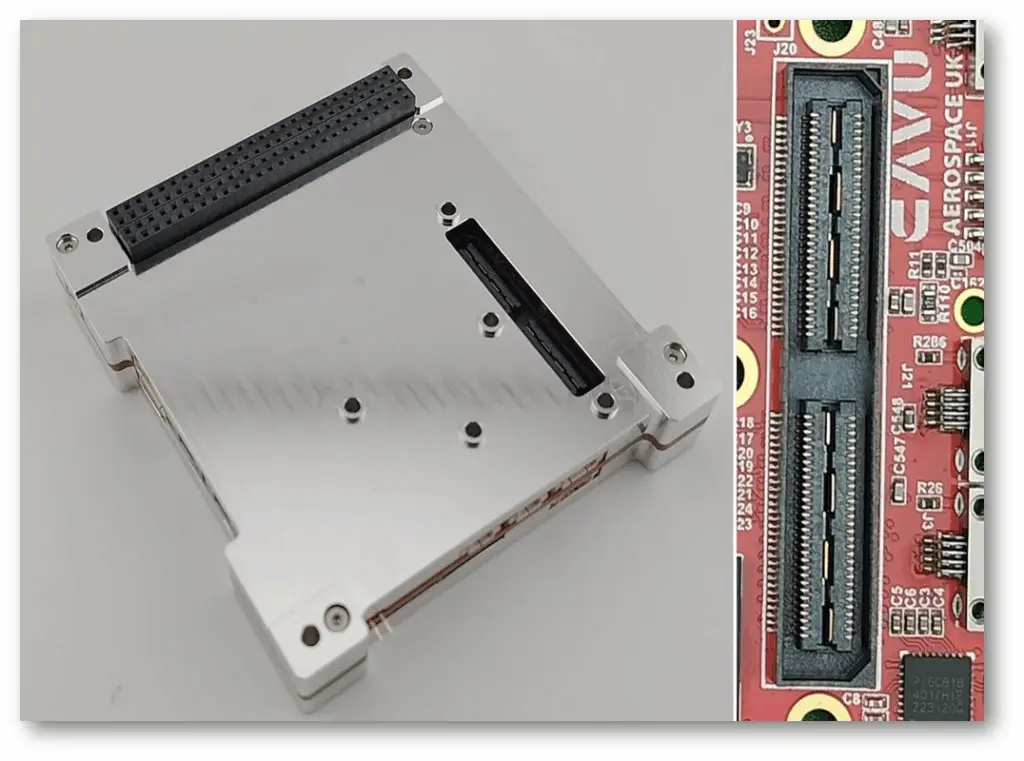
The add-on card provides the dedicated hardware required to interface with the Raptor camera while integrating with the OBC’s processing and memory architecture.
High-Speed Image Acquisition & FPGA-Based Data Capture
One of the important considerations is the amount of data produced by the camera. At 1944 × 1472 pixels, 12-bit pixel depth and 50 frames per second, the raw pixel data rate is approximately 1944 × 1472 × 12 × 50 / 8 ≈ 214 MB/s
before considering protocol and implementation overheads. This is a substantial continuous data stream for a small spacecraft. The Hawk 1920 uses Camera Link Base, whose theoretical maximum payload throughput is approximately 255 MB/s at the commonly specified 85 MHz limit. This makes efficient hardware-level acquisition particularly important. The OBC therefore needs to capture the incoming stream continuously without losing pixels or frames while simultaneously making the data available to the onboard processing system.
The key advantage of using the PolarFire SoC FPGA as part of the OBC architecture is that the Camera Link acquisition process can be handled close to the hardware interface. Rather than receiving every pixel through a conventional software interface, the FPGA can perform the deterministic, high-speed acquisition function. A simplified data path is:
Camera Link → FPGA acquisition logic → buffering → memory → processor
The FPGA handles the time-critical interface and data movement, while the processor can concentrate on higher-level tasks such as Image processing, Feature extraction, data compression, Camera control, Mission algorithms, Data management, Telemetry & Payload control. This creates a much more efficient architecture than attempting to handle a high-rate camera stream entirely through processor software.
Another important element is buffer management. The camera produces data at a relatively constant rate, while the processor may not always be ready to consume the data at exactly the same instantaneous rate. The frame-grabber architecture can therefore provide buffering between the Camera Link interface and the OBC memory system. This allows an entire image frame, or portions of the image stream, to be transferred into memory before being processed by the CPU or FPGA processing pipeline. For spacecraft applications, this also provides flexibility in deciding what happens to the image data after acquisition.
The OBC-Cube-Polar Camera Link implementation demonstrates how a conventional camera interface can be transformed into an integrated spacecraft data-processing capability. By combining the Raptor Hawk 1920, a dedicated Camera Link frame-grabber add-on card and the PolarFire SoC-based OBC-Cube-Polar, CAVU Aerospace provides a compact architecture capable of bringing high-rate camera data directly into the spacecraft’s onboard computing environment. The result is a straightforward but powerful concept:
The camera does not need its own computer. The OBC becomes the camera’s high-speed acquisition and processing platform. For future Earth-observation, inspection, navigation and scientific missions, this architecture provides a foundation for moving from raw image acquisition to intelligent onboard vision. Camera → Capture → Compute → Decide. That is where an onboard computer becomes more than a computer — it becomes an integral part of the spacecraft’s imaging system.