
A Unified Avionics Platform (OBC-Hyper-Polar & TCU) for Complex Space Missions in GEO
- July 6, 2026
- CAVU Aerospace UK
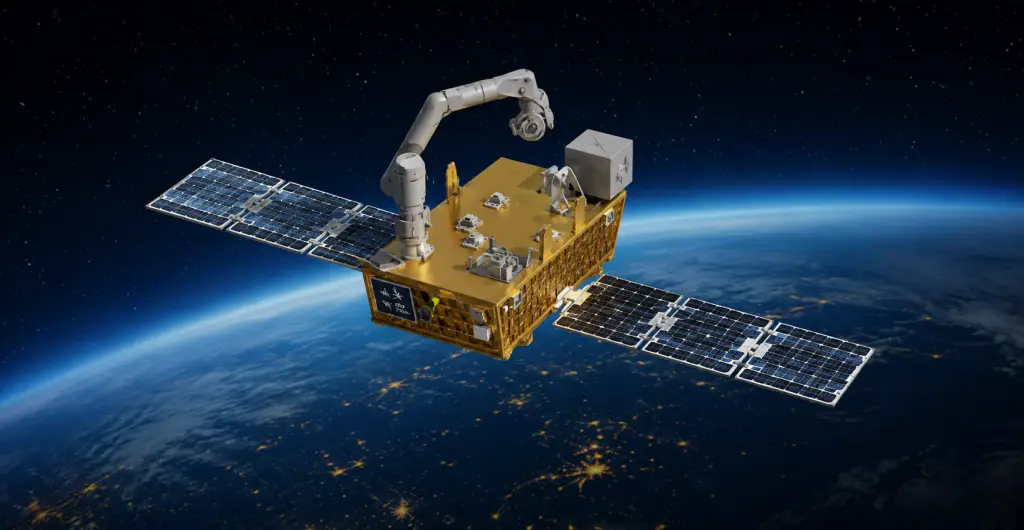
Modern orbital servicing spacecraft are expected to perform increasingly sophisticated operations, from deploying mechanisms and manipulating payloads to monitoring hundreds of sensors while maintaining exceptional reliability. Traditionally, these functions require multiple independent electronic units, increasing spacecraft mass, wiring complexity, integration effort, and overall mission risk.
To address these challenges, we have developed an integrated avionics architecture consisting of two tightly coupled companion boards:
- OBC-Hyper-Polar – A high-performance On-Board Computer
- TCU – A dedicated actuator and sensor interface controller
Together, these computers provide a complete control and data acquisition solution capable of driving spacecraft mechanisms while simultaneously monitoring extensive spacecraft telemetry.
System Overview
The architecture is designed around a clear separation of responsibilities.
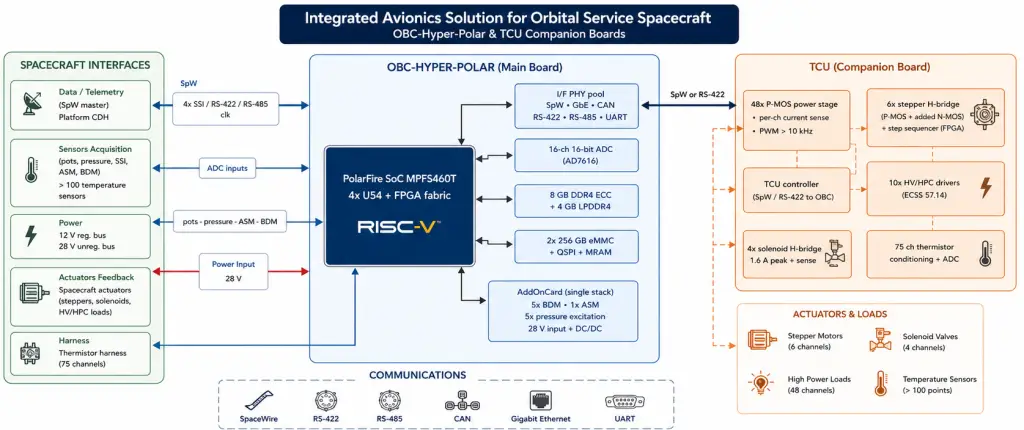
The OBC-Hyper-Polar serves as the spacecraft’s central computing platform, executing flight software, guidance and control algorithms, mission management, communications, and data handling.
The TCU acts as an intelligent distributed I/O subsystem responsible for:
- Stepper motor control
- Solenoid valve actuation
- High-voltage load switching
- Temperature acquisition
- Analog sensor conditioning
- Current monitoring
- Real-time actuator management
This modular approach allows the flight computer to focus on mission-level decision making while the TCU performs deterministic real-time hardware control.
High-Performance OBC-Hyper-Polar
At the core of the system is the PolarFire® SoC MPFS460T, combining:
- Quad-core 64-bit RISC-V processors
- FPGA fabric for deterministic hardware acceleration
- High reliability suitable for embedded aerospace applications
The OBC integrates:
- Multi-protocol communication interfaces
- SpaceWire
- Gigabit Ethernet
- CAN
- RS-422
- RS-485
- UART
- High-speed data acquisition
- 16-channel 16-bit ADC
- High-capacity memory
- 8 GB DDR4 ECC
- 4 GB LPDDR4
- Dual 256 GB eMMC storage
- Radiation-oriented memory
- MRAM
- Dedicated Spacecraft Interfaces
- Multiple BDM interfaces
- ASM interfaces
- Pressure acquisition
- 28 V power input with DC/DC conversion
This combination enables the OBC to manage mission software, payload interfaces, spacecraft communications, and health monitoring simultaneously.
Intelligent Thermal & Control Unit
The companion TCU extends the OBC by providing comprehensive spacecraft I/O capabilities.
Stepper Motor Control
Many orbital servicing missions rely on precision mechanisms including:
- Capture systems
- Docking interfaces
- Instrument positioning
- Valve actuation
- Deployable structures
The TCU supports:
- 6 independent stepper motor H-bridges
- PMOS and NMOS power stages
- FPGA-based step sequence generation
- Deterministic motion control
- High positioning accuracy
Using FPGA-generated stepping sequences minimizes processor loading while ensuring highly repeatable motor operation.
Solenoid Valve Control
Fluid management systems frequently require reliable valve actuation.
The TCU includes:
- 4 high-current solenoid H-bridges
- Approximately 1.6 A peak drive capability
- Current sensing for health monitoring
- Fast and reliable valve operation
These outputs are suitable for:
- Propellant valves
- Pneumatic systems
- Release mechanisms
- Latching actuators
High-Power Switching
Orbital servicing spacecraft often operate numerous auxiliary loads.
The TCU integrates:
- 48 PMOS power output stages
- Individual current sensing
- PWM capability
- Approximately 10 A switching capability per channel
Typical loads include:
- Heaters
- Lamps
- Deployment devices
- Auxiliary electronics
- Custom spacecraft payloads
Per-channel current monitoring enables advanced fault detection and power management.
Extensive Temperature Monitoring
Thermal management is one of the most critical aspects of spacecraft operation.
Our architecture supports more than 100 temperature measurement points, making it suitable for thermally demanding servicing spacecraft.
The TCU provides:
- Approximately 75 thermistor conditioning channels
- Dedicated signal conditioning
- Integrated ADC acquisition
Combined with the OBC analog acquisition resources, the platform comfortably supports monitoring temperatures across:
- Battery packs
- Electronics
- Propulsion systems
- Payloads
- Mechanisms
- Structural elements
The high sensor count provides engineers with comprehensive thermal visibility throughout the spacecraft.
Comprehensive Sensor Acquisition
Beyond temperature sensing, the system acquires a wide variety of spacecraft telemetry including:
- Pressure sensors
- Potentiometers
- Angular position sensors
- Analog housekeeping signals
- BDM interfaces
- ASM interfaces
- SSI sensors
- Additional analog inputs
These signals are routed through dedicated conditioning circuits before acquisition by the OBC.
The design supports multiple communication standards commonly used in spacecraft:
- SpaceWire
- RS-422
- RS-485
- CAN
- Gigabit Ethernet
- UART
The OBC communicates with the TCU through a robust serial interface (SpaceWire or RS-422), allowing the TCU to operate as an intelligent remote controller while maintaining deterministic communication with the flight computer.
Simplified Spacecraft Integration
Instead of distributing numerous dedicated electronic modules throughout the spacecraft, this architecture consolidates major spacecraft control functions into two tightly integrated companion boards.
Benefits include:
- Reduced harness complexity
- Lower system mass
- Simplified integration
- Improved maintainability
- Reduced power consumption
- Lower development cost
- Increased reliability
- Easier verification and testing
The modular separation also enables the TCU to be reused across multiple spacecraft programs with minimal software modifications.