
Autonomous Spaceflights, Future of Space Exploration Depends on Intelligent Onboard Computers
- August 16, 2026
- CAVU Aerospace UK
The next revolution in space exploration will not simply be about building more spacecraft. It will be about building spacecraft that remove human involvement, think, adapt, and operate independently of Earth.
For decades, space missions have relied on a fundamental operating model: spacecraft collect data, transmit it to Earth, wait for ground operators to analyse the information, and then execute the commands they receive. This approach has enabled extraordinary achievements, from Earth observation and satellite communications to planetary exploration and human spaceflight. However, as humanity prepares to operate thousands of satellites, coordinate autonomous spacecraft, explore distant planets, and develop the foundations of asteroid mining, this traditional model faces a fundamental limitation. Earth cannot remain the decision-making centre for every spacecraft, every manoeuvre, and every operational problem. The future requires spacecraft with significantly greater onboard intelligence: systems capable of understanding their own condition, interpreting their environment, identifying anomalies, planning activities, and making operational decisions without waiting for instructions from Earth. This is where AI-enabled computing or super intelligent computing, advanced onboard processing, and autonomous flight computers become essential.
OnBoard Computers are getting even more important part of space flights with current trends. This means demand for more reliability, improved system performance & more intelligent operations.
Waiting for Earth Is No Longer Needed
We have seen Martian Movie & Mark’s frustrating communication between Mars & Earth. Now imagine your spacecraft is in Asteroid belt or beyond, waiting for command! Consider the distance between Earth and Mars. Depending on their relative positions in their orbits, a radio signal travelling one way between the two planets can take approximately 3 to 22 minutes. A command-and-response exchange can therefore take several minutes to more than 40 minutes, even before accounting for processing, communication scheduling, and operational delays. For spacecraft operating near asteroids, distant moons, or other deep-space destinations, communication delays and interruptions can make continuous ground supervision impractical. Imagine a spacecraft approaching an asteroid. Its navigation cameras detect an unexpected change in the object’s rotation, its trajectory estimate shifts, or an obstacle appears in the planned approach path. In a traditional operating model, the spacecraft transmits data to Earth, mission operators analyse the situation, engineers determine the appropriate response, and a new command is transmitted back. By the time the command arrives, the situation may have changed.
An autonomous spacecraft, by contrast, could process its navigation data onboard, estimate its changing state, evaluate predefined safety constraints, and adjust its trajectory within seconds or milliseconds, depending on the task and computing architecture. The spacecraft does not need to wait for Earth to make every decision. NASA’s autonomous navigation research and its work on event-driven spacecraft operations demonstrate the importance of this direction: onboard systems can use sensor data to identify changing conditions and respond without requiring a new ground command for every event.
The Next Challenge: Scaling Space Operations
We have seen super cool videos from mission control when Curiosity or Mars 2020 was landing on the Mars! or the day Cassini was approaching Saturn at Christmas day. Now imagine if you have hundreds of missions that need such organization for mission control! That’s simply not possible for scaling space flights.
The challenge is no longer limited to making one spacecraft operate autonomously. It is about making entire space missions and fleets of spacecraft manageable at scale. As launch costs decline and commercial space capabilities expand, we can expect increasingly large numbers of satellites, servicing vehicles, robotic explorers, communications platforms, and specialised spacecraft to operate simultaneously. Manually managing each spacecraft through continuous human intervention would create an enormous operational burden. Every mission requires engineering oversight, telemetry analysis, anomaly investigation, command planning, communications scheduling, and operational decision-making. When the number of spacecrafts increases, the workload can grow substantially unless more of these activities are automated and performed onboard. Autonomy offers a different model!
Instead of having operators continuously control individual spacecraft, mission teams can define objectives, constraints, priorities, and safety requirements. Intelligent onboard systems then execute routine activities, respond to changing conditions, and report important events to Earth. Human operators remain essential, but their role changes from continuously controlling spacecraft to supervising missions, setting objectives, reviewing exceptions, and making strategic decisions. We should not need one human operator for every spacecraft. We need intelligent spacecraft that allow teams of operators to supervise entire fleets.
OBC on Super Intelligent Spacecrafts
An autonomous spacecraft needs more than a powerful processor or an AI model. It requires a coordinated onboard architecture combining sensing, computing, software, control, and fault management.
- Understand its own state- A spacecraft must continuously assess its operational condition using telemetry from its power systems, thermal sensors, navigation instruments, propulsion systems, communications interfaces, and other subsystems. By combining this information, onboard software can determine whether the spacecraft is operating normally, approaching a limit, or experiencing an unexpected condition. This capability provides the foundation for autonomous health monitoring and intelligent mission management.
- Detect and diagnose problems- Spacecraft operate in environments where radiation, thermal cycling, component degradation, and unexpected events can affect system performance. An intelligent onboard computer can monitor telemetry, detect unusual behaviour, correlate measurements across multiple subsystems, and identify potential faults.
Rather than simply reporting an error, the system could determine which subsystem is affected, estimate the severity of the problem, and recommend or initiate an approved response. For example, a spacecraft could detect an abnormal temperature rise, identify the likely cause, reduce the load on an affected subsystem, and activate a safe operating mode while notifying mission control. This is the evolution from basic fault detection towards onboard diagnosis, prognosis, and autonomous fault management.
- Make decisions in real time- Autonomous flight requires decisions to be made at the speed of the mission, not at the speed of communications with Earth. During orbital rendezvous, docking, precision landing, or robotic manipulation, a spacecraft may need to interpret sensor data and adjust its behaviour continuously. AI-assisted perception, sensor fusion, trajectory estimation, guidance algorithms, and real-time optimisation can help spacecraft respond to changing conditions. However, critical flight functions must be engineered for predictable behaviour. AI should complement established guidance, navigation, control, and safety systems, with appropriate verification, fault containment, and deterministic fallback mechanisms. The objective is not simply to install AI onboard. It is to build a spacecraft capable of making the right decisions within clearly defined operational and safety boundaries.
- Plan and optimise its mission- An autonomous spacecraft should be able to do more than react to faults. It should also optimise its activities. Depending on its mission and authorisation, onboard software could prioritise scientific observations, manage energy consumption, schedule communications, coordinate payload operations, and select tasks based on changing environmental conditions. For an Earth-observation satellite, this could mean recognising an important event and prioritising the collection of additional imagery. For a deep-space probe, it could mean selecting the most valuable scientific observations while balancing power, thermal constraints, onboard storage, and opportunities to transmit data. For a fleet of spacecraft, autonomous planning could distribute tasks between vehicles and allow the mission to continue even if one spacecraft becomes unavailable.
- Cooperate with other spacecrafts- The next generation of space operations will increasingly involve multiple spacecraft working together. Satellite constellations, autonomous servicing vehicles, distributed scientific missions, and future orbital infrastructure will need to exchange information and coordinate activities. With suitable onboard computing, communications, and autonomy software, spacecraft could share their status, allocate tasks, coordinate manoeuvres, and adapt to the failure or unavailability of another vehicle. This transforms a collection of individually operated satellites into a coordinated autonomous system.
All requirements can be taken care on OnBoard Computers. Autonomous operations depend on the close integration of advanced computing hardware and intelligent software. The onboard computer is no longer simply a device that executes commands received from Earth. It is becoming the central computing platform through which a spacecraft perceives its environment, manages its systems, processes sensor data, and executes its mission. This creates new requirements for space-grade computing architectures.
High-performance processing: Real-time image processing, navigation, object recognition, and autonomous planning can demand substantially more computing power than conventional spacecraft housekeeping.
AI acceleration: Dedicated AI accelerators, GPUs, and vector-processing capabilities can support machine-learning inference and complex perception workloads, where the mission requires them. Typhoon-Edge is one of the examples to have Radiation tolerant PolarFire FPGA as master for sake of reliability paired with NVIDIA GPUs for supercomputing.
Real-time control: Critical flight functions need predictable execution times, controlled resource usage, and robust interfaces with sensors and actuators.
Radiation tolerance and reliability: Spacecraft computers must be designed for their mission’s radiation environment, with appropriate protection, fault detection, memory integrity, and recovery mechanisms.
High-speed interfaces: Cameras, navigation sensors, scientific instruments, storage systems, and other onboard processors can generate substantial data volumes that must be moved and processed efficiently.
Software flexibility: Mission teams need computing platforms that can support the appropriate combination of real-time software, operating systems, device drivers, AI applications, and mission-specific algorithms.
The most capable architecture will not necessarily be the computer with the highest headline AI performance. It will be the architecture that delivers the required intelligence, reliability, power efficiency, and operational safety within the spacecraft’s constraints.
Case: Autonomous Spacecrafts for Asteroid Mining
The importance of onboard intelligence becomes even greater when we look beyond conventional satellite operations.
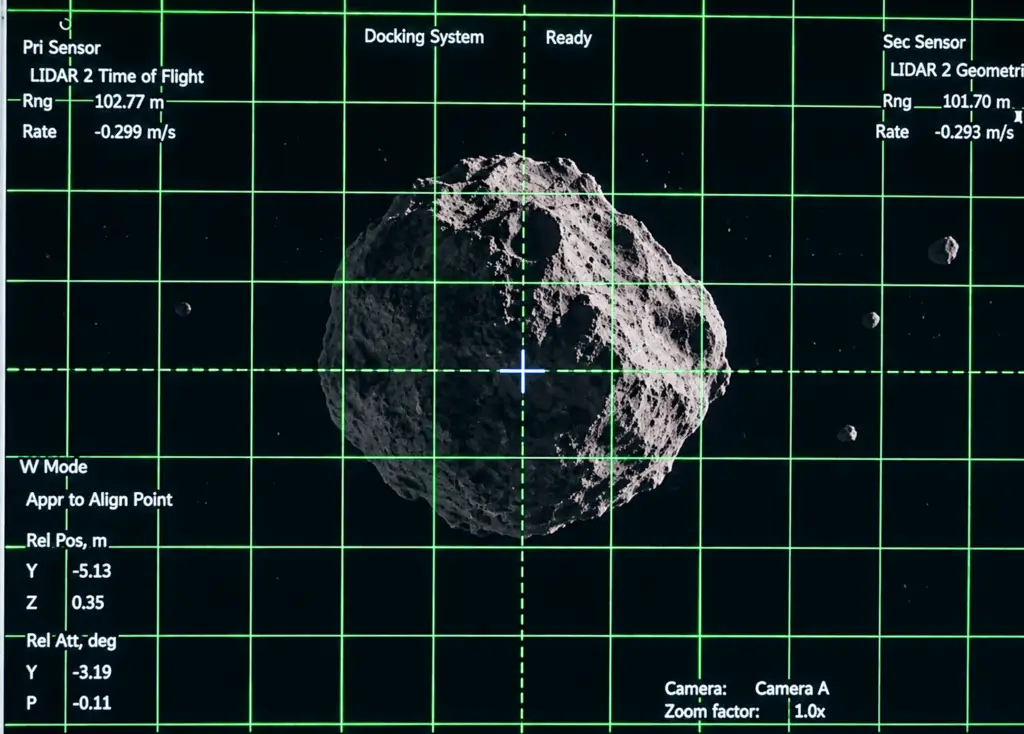
Autonomous rendezvous and docking- Servicing spacecraft, cargo vehicles, and future orbital infrastructure must be capable of determining relative position and velocity, recognising their targets, and performing precise manoeuvres. Intelligent onboard computing can support real-time perception, trajectory planning, collision avoidance, and fault response during these complex operations.
Robotic exploration of the Moon and Mars- Robotic explorers cannot rely on continuous real-time control from Earth. They need to interpret their surroundings, identify hazards, plan movements, and manage resources locally. Greater autonomy can allow exploration systems to cover more ground, respond to unexpected terrain, and carry out more scientific work with fewer ground interventions.
Asteroid exploration and mining- Future asteroid missions may require spacecraft to map irregular surfaces, identify promising material deposits, navigate around rotating bodies, coordinate robotic equipment, and manage extraction or material-handling operations. These are dynamic tasks in which waiting for instructions from Earth may be inefficient or unsafe.
An intelligent spacecraft could combine optical and other sensor measurements, estimate its position relative to the asteroid, plan local operations, and coordinate robotic systems within approved mission constraints. The computing challenge becomes even greater if several spacecraft and robotic platforms must cooperate around the same object.
Deep-space scientific missions- A spacecraft exploring the outer Solar System may encounter transient scientific phenomena, unexpected environmental conditions, or opportunities that were not anticipated before launch. An autonomous onboard system could recognise scientifically significant events, adjust observation priorities, preserve valuable data, and continue operating during communication interruptions. This can increase the scientific return from missions that are expensive, difficult to reach, and impossible to supervise continuously.
No More Human in Mission Control
When we scale space flights, the objective should be to eliminate the need for humans to approve every routine action, not to eliminate human responsibility for mission outcomes. No more busy mission controls full of people talking to each other & several people consulting behind each station. Spacecraft should operate within carefully engineered boundaries. Critical manoeuvres, high-risk actions, and irreversible operations may require additional checks, independent safety monitoring, or explicit authorisation, depending on the mission.
A robust autonomous architecture should also know when it cannot make a reliable decision. If sensor measurements become inconsistent, confidence falls below an acceptable threshold, or a fault exceeds its permitted response envelope, the system should transition to an appropriate safe state and request assistance when communications permit. This is particularly important when AI is used in safety-critical functions. Advanced machine learning can provide powerful perception and decision support, but its outputs must be integrated into a verifiable system with clear limits and predictable failure responses. The long-term vision is not uncontrolled artificial intelligence in space. It is reliable, bounded autonomy that allows spacecraft to accomplish more while keeping mission operators informed and in control of overall objectives.
We have to develop onboard computers and edge-computing platforms for satellites, launch vehicles, and advanced space applications & that’s what we did. Our focus is to provide the processing capability, interfaces, and computing flexibility needed to support increasingly sophisticated onboard software and autonomous mission operations. We keep reliability on components selection, software, recovery plans plus making easier software development using NVIDIA development ecosystem. As spacecraft become more intelligent, their computers must do more than manage traditional command and data handling. They must support demanding combinations of real-time control, sensor processing, high-speed communications, fault management, and AI-enabled applications.
Our computing platforms, including the PolarFire SoC-based OBC family and advanced edge-computing architectures combining space-oriented control processing with high-performance AI computing, are designed to support this evolution. Depending on mission requirements, such architectures can bring together reliable spacecraft management, FPGA-based processing, high-speed interfaces, and accelerated onboard computing within a single integrated system. Typhoon-Edge & PolarEdge are flight proven computing platforms developed for different applications in different form factors to pick up demand of scaled futuristic space flights.