
High-Speed CoaXPress On-Board Recorder
- September 21, 2026
- CAVU Aerospace UK
Modern Earth observation, astronomy, planetary exploration and space-surveillance missions are generating more data than ever before. High-resolution optical cameras, hyperspectral instruments, multi-sensor payloads and high-frame-rate imaging systems can produce data streams that quickly reach tens of gigabits per second. Moving this data from a payload into a spacecraft computer is only the first challenge. The spacecraft must then buffer, manage, protect and permanently store that data despite limited downlink opportunities and the demanding environment of space.
CAVU Aerospace has developed a high-speed On-Board Recorder (OBR) architecture around the Microchip PolarFire SoC MPFS460T-1FCG1152I, combining FPGA-based deterministic data acquisition with a large ECC-protected burst buffer and high-capacity NVMe/SATA mass storage. The result is a recorder designed for payloads where data rate, burst capacity, storage bandwidth and reliability all matter simultaneously.
The OBR architecture is built around three fundamental stages Ingest → Burst Buffer → Mass Storage. This is diagram of that mission which was an integrated solution of OBC & other OBCs. https://obr.cavuaerospace.uk/
This approach allows the recorder to absorb very high instantaneous payload data rates while continuously transferring data to non-volatile storage. Rather than requiring the mass-storage system to absorb every instantaneous peak directly, the FPGA and high-speed memory subsystem act as an intelligent data reservoir. For a representative 25 Gbps design point, the system can accommodate a 5-second burst equivalent to 125 Gbit, or approximately 15.6 GB of raw data before considering protocol and system overheads. The 16 GB-class burst-buffer architecture therefore provides meaningful margin, while continuous write-through to mass storage prevents the memory from remaining occupied indefinitely.
8 High-Speed CoaXPress Inputs
At the front end of the recorder are eight configurable high-speed SERDES inputs. These interfaces can be configured for CoaXPress CXP-3, CoaXPress CXP-6, CoaXPress CXP-12 & Custom high-speed serial protocols.
CoaXPress is particularly attractive for high-performance imaging because it was designed specifically for transferring high-speed image and video data. CoaXPress 2.0 supports data rates up to 12.5 Gbps per connection, with multiple coaxial connections capable of scaling the aggregate bandwidth. This makes the interface particularly suitable for payloads incorporating high-resolution cameras where conventional spacecraft interfaces may become a bottleneck.
The eight-channel architecture also provides significant flexibility. A mission may use a small number of channels at lower CXP rates, or distribute data across multiple CXP-12 connections for substantially higher aggregate throughput. The recorder’s architecture is designed around a 25 Gbps worst-case data-processing point, providing headroom over a representative 23.1 Gbps raw payload data rate. This margin is important in real systems because the engineering challenge is not simply achieving the nominal data rate. The architecture must also accommodate buffering, packetisation, protocol overhead, memory arbitration, storage traffic and transient variations in the incoming data stream.
PolarFire FPGA-Based Data Acquisition
At these data rates, the recorder cannot rely exclusively on software running on a conventional processor. The PolarFire SoC combines a substantial FPGA fabric with an embedded RISC-V processor subsystem, allowing CAVU to divide the system into two complementary domains.
FPGA fabric: The FPGA handles the deterministic, high-speed data path:
CoaXPress / serial inputs → SERDES → protocol handling → packet/data processing → buffering → storage interfaces
This architecture allows data to be processed at line rate without requiring every byte to pass through a general-purpose CPU.
The embedded processor provides the system-management layer. It can be used for Recorder configuration, Payload communication, File-system management, Storage monitoring, Health monitoring, Telemetry, Fault management, Data-transfer control, System diagnostics & Mission-specific application software.
Microchip’s MPFS460T provides up to 461K logic elements, 20 high-speed SERDES lanes capable of up to 12.5 Gbps, and PCIe Gen2 endpoint/root-port capability. It also integrates a quad-core 64-bit RISC-V application processor subsystem. This combination is particularly useful for an OBR because the same device can provide both the deterministic data plane and the intelligent control plane.
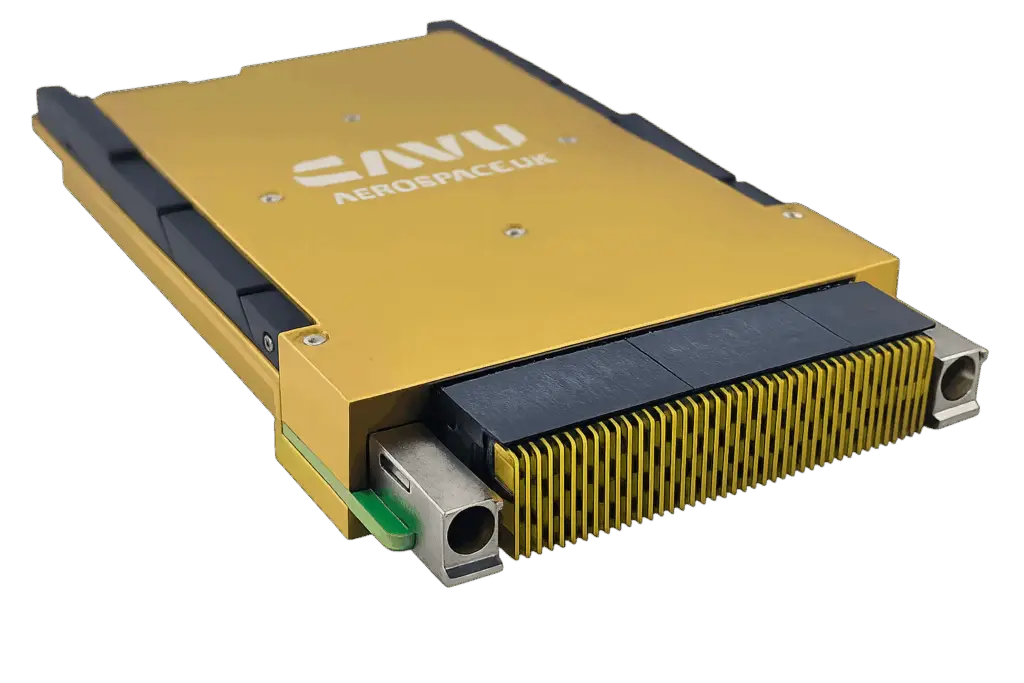
16 GB ECC Burst Buffer
One of the most important elements of a high-speed recorder is its burst memory. The CAVU architecture incorporates a 128 Gbit (16 GB) DDR4 data buffer with ECC, within a total memory architecture of approximately 144 Gbit. The buffer provides approximately 12.8 GB/s sustained memory bandwidth. A camera may operate continuously at a moderate data rate and then suddenly produce a high-speed burst when:
- an observation begins;
- a target enters the field of view;
- a high-frame-rate sequence is triggered;
- multiple sensors operate simultaneously;
- a spacecraft manoeuvre enables a short observation window.
The recorder must absorb these peaks without dropping data. For example: 25 Gbps × 5 seconds = 125 Gbit. That corresponds to approximately: 15.6 GB of raw data. A 16 GB-class buffer therefore provides the capacity to absorb this representative five-second burst, while simultaneous write-through to mass storage means that the recorder does not have to wait until the burst has finished before beginning the permanent storage process. This creates a pipeline rather than a single storage event.
High-speed acquisition → ECC DDR4 buffer → continuous storage
High-Capacity Mass Storage
The burst buffer provides speed. The mass-storage subsystem provides persistence. The OBR incorporates: 2 × U.2 NVMe
Each NVMe drive is connected through PCIe Gen2 x2, providing approximately 0.8 GB/s per drive for a combined NVMe contribution of approximately 1.6 GB/s 4 × U.2 SATA III
The recorder also supports: 4 × U.2 SATA III drives with approximately: ~0.5 GB/s per drive or approximately: ~2.0 GB/s aggregate across the four SATA devices.
The resulting architecture provides approximately: 3.5 GB/s aggregate sustained storage write bandwidth. This is an important characteristic of the design. The recorder is not dependent on a single high-capacity storage device. Instead, multiple storage devices can operate as a coordinated mass-storage subsystem.
The key architectural concept is that capture and storage happen simultaneously. Consider a payload producing approximately 23.1 Gbps of raw data. The data enters through the high-speed serial interfaces and is immediately handled by the FPGA data path. The data is then transferred into the ECC-protected DDR4 burst buffer. From there, the storage engine continuously writes data to the NVMe and SATA devices. Conceptually:
Payload / Camera
↓
8 × High-Speed SERDES Inputs
↓
CoaXPress / Custom Protocol Processing
↓
FPGA Data Pipeline
↓
128 Gbit / 16 GB ECC DDR4 Burst Buffer
↓
Storage Controller
↓
2 × NVMe + 4 × SATA
↓
Multi-Terabyte Mission Data Archive
This architecture allows the recorder to separate the instantaneous data-generation rate from the long-term storage process. That distinction becomes increasingly important as spacecraft payloads move toward higher-resolution sensors and larger data products.
Advantage of CoaXPress for Space Imaging
CoaXPress technology is an open asymmetric, high-speed, point-to-point open serial communication standard. It provides a state-of-the-art method for connecting high-performance, high-resolution cameras to high-speed capture cards via standard, off-the-shelf 75Ω coaxial cables. This cost-effective solution enables the transmission of data, video and still images; camera control and triggering; and up to 13W of power to be delivered via a single cable of up to 100m in length with a standard BNC, micro-BNC or HD-BNC connectors. The data rates are scalable for multiple cables and are only limited by the number of cables that can be accommodated in your design.
Microchip Ref: https://www.microchip.com/en-us/products/interface-networking-connectivity/coaxpress/coaxpress-technology
CoaXPress originated as a high-speed imaging interface and is particularly well suited to applications where large volumes of camera data need to move with predictable latency. The interface supports high-speed downstream data together with lower-speed control communication. CoaXPress can also carry power over coax in appropriate implementations. For spacecraft applications, the most interesting characteristic is its ability to provide a simple, scalable physical interface for very high-rate imaging data. With CXP-12 providing up to 12.5 Gbps per connection, multiple links can be aggregated to support substantially higher payload data rates. For a spacecraft carrying several cameras, this opens an interesting architecture:
Camera 1 → CXP
Camera 2 → CXP
…
Camera N → CXP
all converging on a dedicated high-speed OBR rather than placing the complete high-speed acquisition burden on the spacecraft’s main flight computer.
A dedicated OBR can provide an important architectural separation between the spacecraft platform and the payload. The spacecraft’s main computer can concentrate on Guidance, Navigation & Control, spacecraft management, power, communications, attitude control & platform telemetry.
While the OBR concentrates on high-speed payload acquisition, image/data buffering, data integrity, file generation, mass storage & payload data management.
The recorder can therefore become a dedicated payload data infrastructure layer between the sensor and the spacecraft communication system. This architecture is particularly attractive for Earth observation and scientific missions where the amount of data generated during an observation can be substantially larger than the amount that can immediately be transmitted to ground.
Built for High-Data-Rate Missions
The combination of eight configurable high-speed inputs, FPGA-based processing, ECC-protected DDR4 buffering and multi-drive NVMe/SATA storage creates an OBR architecture aimed at the next generation of data-intensive space missions.
Key features:
- Processor: Microchip PolarFire SoC MPFS460T
- High-speed inputs: 8 × configurable SERDES
- Supported interfaces: CXP-3 / CXP-6 / CXP-12 / custom serial
- Design-point input processing: 25 Gbps
- Representative payload rate: 23.1 Gbps
- Burst buffer: 128 Gbit / 16 GB
- Total memory architecture: 144 Gbit
- Memory protection: ECC
- Sustained DDR4 bandwidth: 12.8 GB/s
- NVMe storage: 2 × U.2, PCIe Gen2 x2
- SATA storage: 4 × U.2 SATA III
- Aggregate storage write: 3.5 GB/s
- High-Capacity Mass Storage: 2 × U.2 NVMe
- Example 5-second / 25 Gbps burst: 125 Gbit / ~15.6 GB
Mass Storage:
- 2× U.2 NVMe (PCIe Gen2 x2 each, ~0.8 GB/s per drive)
- 4× U.2 SATA III (~0.5 GB/s per drive)
- Aggregate sustained write: ~3.5 GB/s
OBR handles high data rate missions by combining high-speed CoaXPress acquisition with FPGA-based deterministic processing, a large ECC-protected burst buffer and high-throughput multi-drive storage. The philosophy is straightforward: Capture at the speed of the sensor, Buffer without losing data, Store continuously & Protect the data throughout the pipeline. Built around the Microchip PolarFire SoC, the architecture provides a flexible platform that can evolve from today’s CXP-based imaging systems toward future high-speed custom serial payload interfaces.
For missions where the most valuable spacecraft resource is not only power or mass, but the ability to preserve every bit of information collected in orbit, a high-performance On-Board Recorder can become a critical part of the payload architecture.