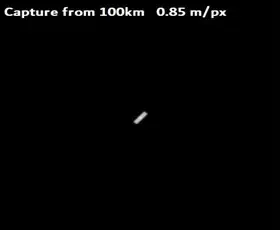
Why Satellites Are Not Detected in Orion Captures; Case: CAVU LDU 51MP 200FPS Camera for Space Surveillance Applications
- April 20, 2026
- CAVU Aerospace UK
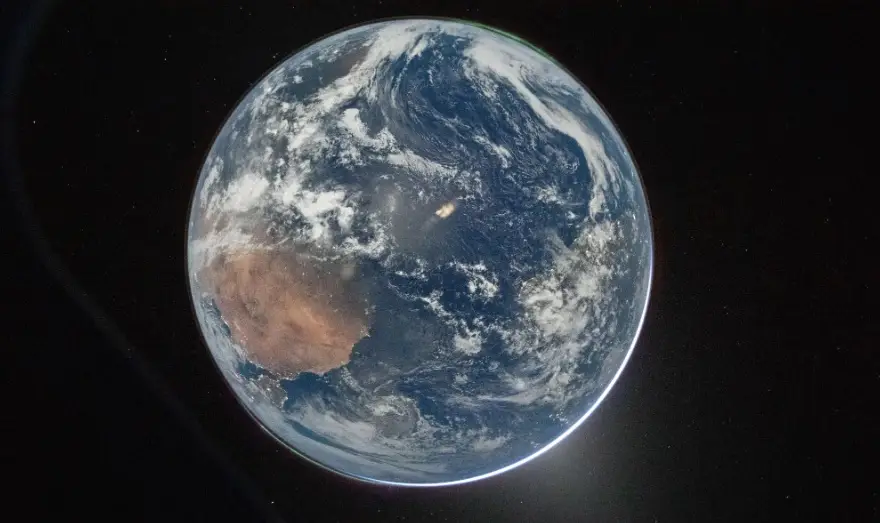
Credit: NASA
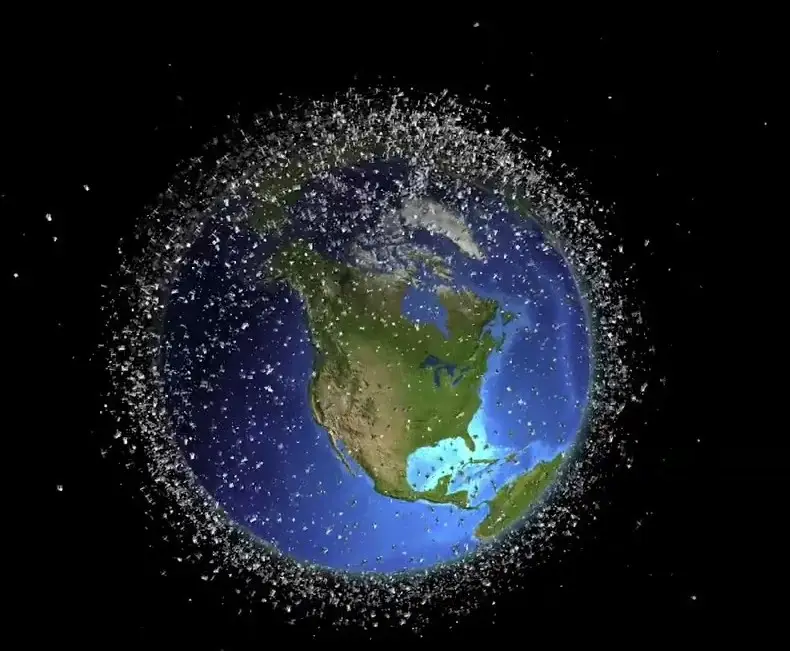
With recent images shared from Artemis II, we got wide pictures showing whole planet in a frame. But no satellite or spacecraft was detected with a single pixel of images. In this article we are estimating minimum size visible objects in space! For this we take into account a flight proven camera built for debris detection & self-defence applications. The C&DH for this camera with 51 million pixels & 200 frames per second is managing huge amount of data.
CAVU LDU 4651 is 51 MP camera with 8424 × 6032 pixels in image sensor. If we consider 22∘ as field of view, Angular pixel scale would be: 0.384 rad
Pixel angular size: 9.4 arcsec/pixel
If we’re capturing from 60,000 km from the earth to have entire planet in view, GSD will be 2,736 m/pixel which means objects like ISS with 109m will be only 0.040 pixels. It’s Completely sub-resolution or motion blur invisible.
ISS angular size at 60,000 km would be 1.83×10⁻⁶ rad.
Given ISS orbital speed around 7.66 km/s, Angular velocity would be 1.28×10⁻⁴ rad/s which is equivalent to 2.8 pixels/s.
For high-speed captures like 30 frames per second, this would be 0.093 pixels/frame.
To be able to see an object in LEO orbit, for example 400 km, with a camera 51 MP, 8424 × 6032 pixels image sensor, considering 22∘ as field of view & with super-fast captures like 200 FPS, for 1 pixel with manageable motion blur the object has to be 2.7 km long.
If we include motion with orbital speed near 7.66 km/s, Angular speed of 2.8 pixels/s, Motion per frame at 200 fps will be 0.014 pixels/frame. Motion blur is negligible.
Practical detection threshold is 5 pixel which means moving object has to be minimum 13.5 km to be visible from 60,000 km.
Nowadays several start-ups are talking about massive orbital data centres or space-based solar power plants with in-orbit manufacturing capabilities which means 13.5 km is not a big number.
To conclude, for CAVU LDU 4651 satellite camera with 51 MP sensor & 200 FPS, if consider 22 degree field of view and 1 pixel as minimum visible for stationary target & 5 pixel as minimum visible for moving targets, for captures from 60,000 km, here are Minimum visible targets:
- Minimum stationary visible size: 2.7 km
- Minimum moving visible size: 13.5 km
For captures from GEO orbit, 37,000 km. here are Minimum visible targets:
- Minimum stationary visible size: 1.7 km
- Minimum moving visible size: 8.3 km
For captures from 800 km. here are Minimum visible targets:
- Minimum stationary visible size: 18 m
- Minimum moving visible size: 90 m
Of course, for imaging from LEO for space surveillance systems with smaller field of view like 2-3 degree, camera can detect much smaller objects. For example for a space surveillance camera with 51 MP & 200 FPS with 2.1 degree field of view in 600 km orbit, ISS captures will have more than 100 pixels & any object around few meter length is detectable.