
VxWorks Capability on OBC PolarFire Platforms
- May 12, 2026
- CAVU Aerospace UK
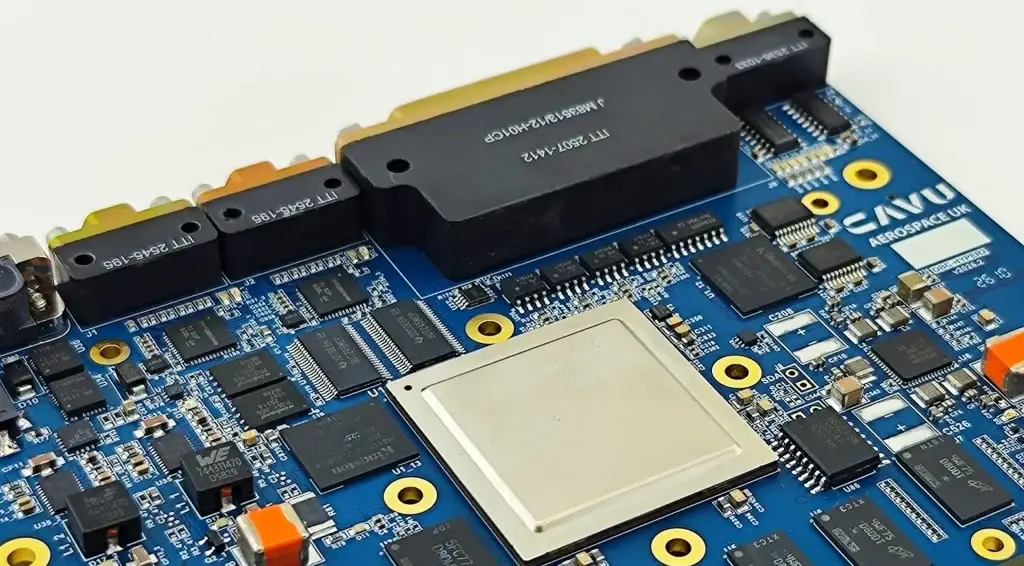
The increasing complexity of modern spacecraft missions is driving demand for onboard computing platforms capable of deterministic real-time performance, radiation resilience, AI acceleration, and long-duration reliability. CAVU Aerospace UK’s PolarFire® SoC–based OBC family addresses these challenges by combining Microchip’s flash-based RISC-V FPGA technology with robust software ecosystem support, including Wind River’s VxWorks RTOS.
We develop a family of space-grade onboard computers based on Microchip PolarFire SoC including:
- OBC-Cube-Polar, Only in COTS version
- Hyper-Polar, In COTS & different Tiers of Radiation Tolerant versions
- PF-VPX OBC, SOSA aligned
- Polar Edge &
- Typhoon Edge
All OBCs are centred around the deterministic and SEU-immune Microchip PolarFire SoC architecture.
VxWorks has long been one of the most trusted real-time operating systems in aerospace and defense applications & CAVU as sub-system supplier is asked quite often from NASA/ ESA to provide VxWorks BSP support along with C&DH solutions. It is widely used in:
- Satellites,
- Launch Vehicles,
- Deep-Space Probes,
- Avionics Systems,
- Autonomous Spacecraft,
- Robotic Missions.
The RTOS is specifically valued for:
- deterministic scheduling,
- hard real-time performance,
- modular architecture,
- safety-critical certification pathways,
- multicore scalability,
- high reliability under mission-critical conditions.
For modern spacecraft missions involving high-rate sensor processing, onboard autonomy, AI-assisted operations, and complex payload management, VxWorks provides a mature and flight-proven software foundation.
OBC-Polar + VxWorks Architecture
The OBC-Polar integrates:
- Microchip PolarFire SoC FPGA,
- quad-core 64-bit RISC-V processor subsystem,
- FPGA fabric for deterministic hardware acceleration,
- ECC-protected DDR memory,
- radiation-tolerant nonvolatile memories,
- SpaceWire and high-speed serial interfaces.
The platform supports:
- Linux,
- FreeRTOS,
- INTEGRITY,
- FreeBSD,
- Ubuntu,
- Yocto,
- and VxWorks.
CAVU Aerospace additionally provides Board Support Packages and low-level platform enablement for customers deploying VxWorks on PolarFire SoC–based OBC architectures.
Key VxWorks Capabilities on OBC-Polar
Deterministic Real-Time Processing
Satellite command and data handling systems require predictable timing behavior for:
- ADCS control loops,
- telemetry handling,
- propulsion sequencing,
- payload synchronization,
- fault management,
- communication protocols.
VxWorks provides deterministic scheduling with low interrupt latency, enabling reliable execution of mission-critical tasks under heavy system load.
This is especially important on PolarFire SoC platforms where:
- FPGA logic,
- DMA engines,
- SpaceWire interfaces,
- and multicore RISC-V processing
must operate synchronously with minimal jitter.
Multicore RISC-V Support
The Microchip PolarFire SoC architecture integrates:
with FPGA fabric acceleration.
VxWorks enables:
- SMP (Symmetric Multiprocessing),
- AMP partitioning,
- core affinity management,
- deterministic task allocation.
This allows mission architects to dedicate processing domains such as:
- payload processing,
- communications,
- AI inference,
- platform housekeeping,
- FDIR execution,
- guidance and navigation.
FPGA + RTOS Co-Processing
One of the major strengths of the PolarFire architecture is tight integration between:
- RTOS software,
- FPGA hardware acceleration,
- deterministic I/O pipelines.
The flash-based FPGA fabric enables:
- CameraLink frame grabbing,
- SpaceWire packet routing,
- SERDES processing,
- image pre-processing,
- AI acceleration,
- custom DSP functions,
- protocol conversion.
Meanwhile VxWorks manages:
- real-time orchestration,
- memory protection,
- driver services,
- scheduling,
- telemetry routing,
- payload supervision.
This hybrid hardware/software architecture is highly attractive for:
- Earth observation,
- hyperspectral imaging,
- SAR payloads,
- autonomous spacecraft,
- edge AI missions.
Radiation-Tolerant Software Platform
The PolarFire SoC platform is especially suited for space because of its:
- flash-based FPGA architecture,
- ZeroFIT SEU immunity,
- latch-up immunity,
- ECC-protected memories,
- radiation-tolerant memory options.
Compared to SRAM-based FPGA systems requiring continuous configuration scrubbing, PolarFire provides inherently stable FPGA configuration memory. This significantly reduces software overhead and improves mission reliability.
When combined with VxWorks:
- watchdog supervision,
- health monitoring,
- partitioned fault handling,
- memory protection,
- and recovery logic
can be implemented in a highly deterministic manner.
SpaceWire and High-Speed Payload Support
CAVU PolarFire OBC platforms provide extensive interface support including:
- SpaceWire,
- Gigabit Ethernet,
- PCIe,
- CAN,
- RS422/485,
- CameraLink,
- JESD204,
- SATA,
- custom SERDES interfaces.
VxWorks BSP support enables customers to develop:
- payload controllers,
- spacecraft buses,
- image acquisition systems,
- onboard routers,
- protocol bridges,
- edge computing payloads
with deterministic interface handling.
This is particularly important for:
- high-rate imaging payloads,
- onboard compression,
- autonomous data selection,
- AI-assisted mission operations.
AI and Edge Computing Missions
CAVU Aerospace’s:
combine PolarFire SoC devices with NVIDIA Jetson Orin processors for onboard AI processing.
In these architectures, VxWorks can operate as:
- the deterministic supervisory RTOS,
- payload orchestration layer,
- spacecraft command processor,
- health management system,
- secure communications controller.
Meanwhile AI workloads execute on dedicated acceleration hardware.
This separation between:
- deterministic spacecraft control,
- and high-throughput AI computation
is increasingly important for next-generation autonomous satellites.
Typical VxWorks Use Cases on OBC-Polar
Command & Data Handling
- spacecraft state management,
- telemetry collection,
- command decoding,
- subsystem coordination.
ADCS Control
- reaction wheel control,
- sensor fusion,
- star tracker interfaces,
- closed-loop stabilization.
Payload Controllers
- hyperspectral cameras,
- radar payloads,
- lidar systems,
- optical communications.
Launch Vehicle Avionics
- deterministic sequencing,
- propulsion control,
- sensor aggregation.
Autonomous Missions
- onboard decision making,
- AI task management,
- event-driven mission planning.
BSP and Software Enablement
CAVU Aerospace supports customers through:
- VxWorks BSP development,
- low-level bootloader integration,
- peripheral driver support,
- FPGA/RTOS integration,
- interface enablement,
- payload software adaptation.
This allows mission developers to focus on:
- flight software,
- payload algorithms,
- mission operations
rather than low-level hardware bring-up.
The availability of a VxWorks BSP on a PolarFire SoC OBC platform significantly reduces:
- development risk,
- software integration effort,
- mission qualification timelines.
Strategic Advantage of PolarFire + VxWorks
The combination of:
- PolarFire SoC flash FPGA technology,
- deterministic RISC-V multicore processing,
- VxWorks real-time operating system,
- radiation-tolerant architecture,
- FPGA acceleration,
- AI edge capability
creates a highly differentiated onboard computing platform for:
- CubeSats,
- small satellites,
- launch vehicles,
- defense spacecraft,
- autonomous space systems.
Unlike conventional COTS embedded platforms, the OBC-Polar family provides a balance between:
- high processing capability,
- low power consumption,
- deterministic real-time operation,
- and radiation resilience.