Using the Doppler Effect to Monitor Cassini’s Orbital Insertion
- March 11, 2026
- CAVU Aerospace UK
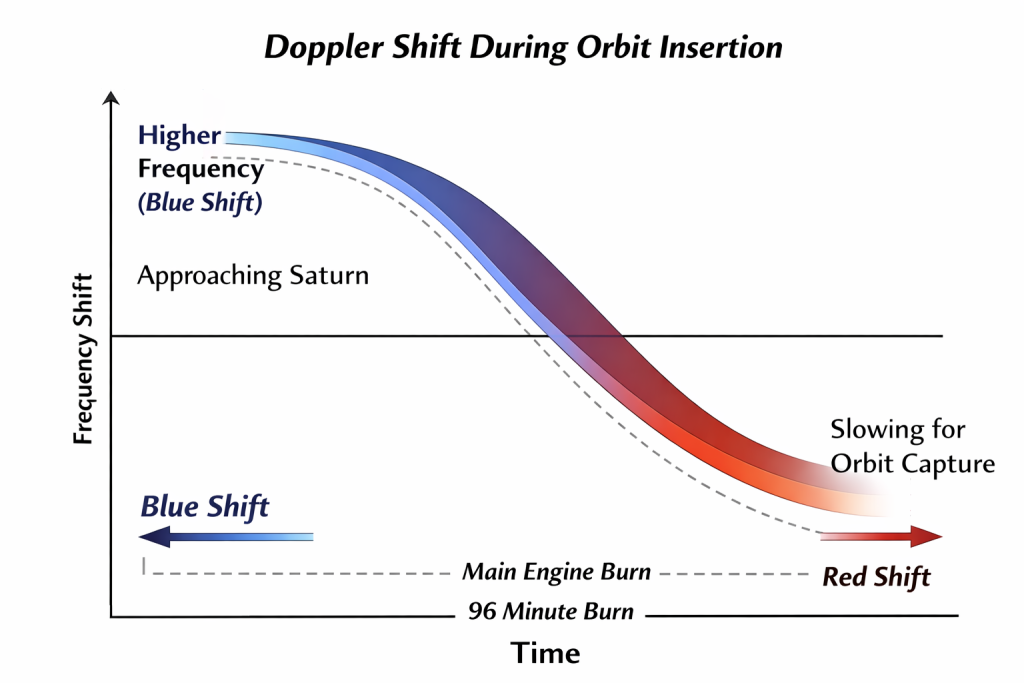
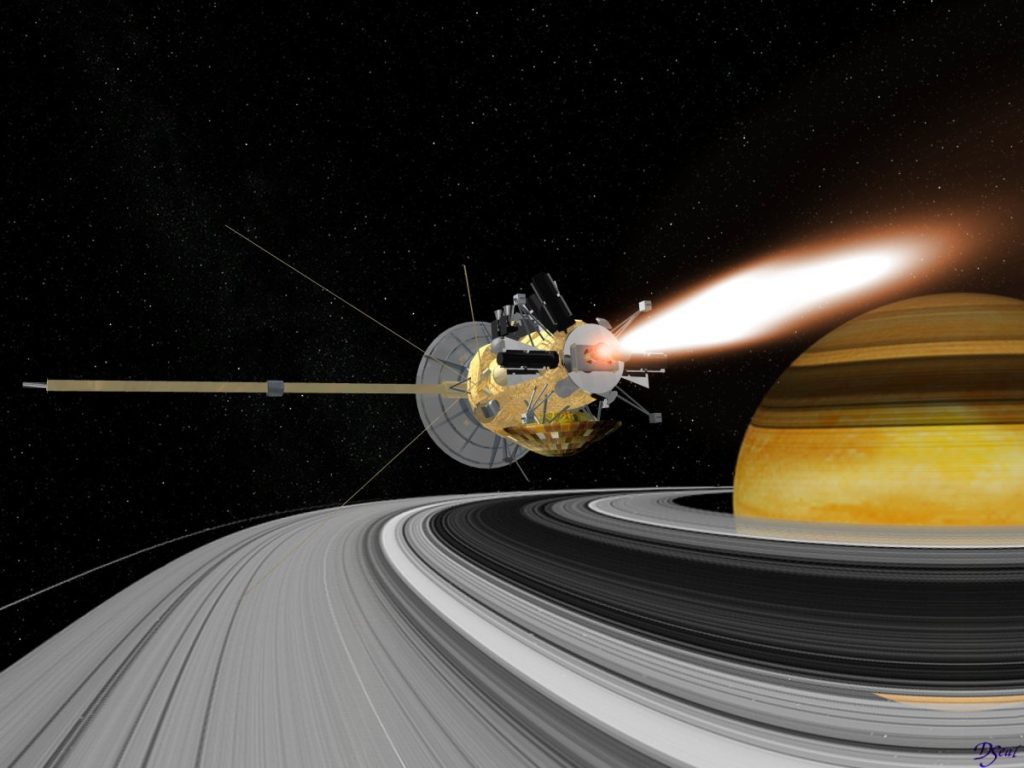
When Cassini approached Saturn in 2004, one of the most critical phases was Saturn Orbit Insertion (SOI)—the precise maneuver where the spacecraft had to slow down enough to be captured by Saturn’s gravity. Even small errors could result in Cassini flying past Saturn instead of entering orbit. To monitor this, JPL relied heavily on radio communications and the Doppler effect.
What is the Doppler Effect?
The Doppler effect is a shift in frequency of a wave when the source moves relative to an observer. In the case of spacecraft:
- If Cassini moves toward Earth, the frequency of its radio signal increases.
- If Cassini moves away from Earth, the frequency decreases.
By precisely measuring these shifts, engineers can determine the spacecraft’s velocity along the line of sight with incredible accuracy—down to millimeters per second.
How JPL Used Doppler to Track Speed
- Radio Signals from Cassini: Cassini continuously transmitted a radio carrier signal to Earth at a known frequency.
- Deep Space Network (DSN) Tracking: NASA’s Deep Space Network (DSN) antennas received these signals. DSN stations are capable of detecting tiny changes in frequency, caused by Cassini’s motion relative to Earth.
- Calculating Line-of-Sight Velocity:
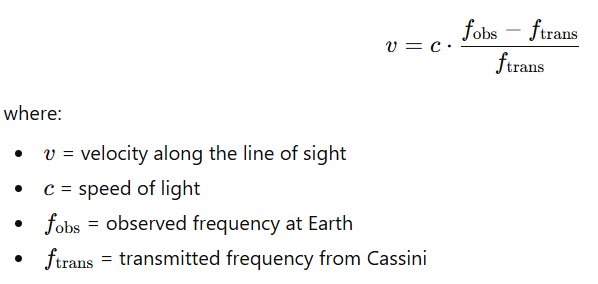
This measurement tells JPL how fast Cassini is slowing down as it fires its main engine to enter Saturn orbit.
Real-Time Monitoring During Orbit Insertion
During SOI:
- Cassini fired its main engine for about 96 minutes to reduce its speed sufficiently for Saturn to capture it.
- Engineers monitored the Doppler shift in real time. A frequency shift consistent with the planned velocity change indicated that the burn was proceeding correctly.
- Any deviations could be analyzed, and contingency maneuvers could be prepared if necessary.
This approach is critical because Saturn is 1.2 billion kilometers from Earth, so visual tracking is impossible. Doppler tracking provides precise velocity information without needing to see the spacecraft.
Beyond Velocity: Orbit Verification
After the burn, JPL combined Doppler measurements with:
- Range measurements (time delay of the signal)
- Trajectory models based on gravitational influences from Saturn and its moons
This allowed confirmation that Cassini had entered the intended elliptical orbit around Saturn, ready for its multi-year mission.
The Doppler effect is an elegant tool that turns a simple radio signal into a high-precision speedometer across billions of kilometers. By continuously monitoring the tiny shifts in frequency from Cassini’s transmissions, JPL engineers ensured the spacecraft slowed down precisely enough to be captured by Saturn, marking one of the most critical achievements in interplanetary navigation.