
Thermal Control and Pointing Stability in Satellite Camera Systems
- May 4, 2026
- CAVU Aerospace UK
Spaceborne imaging systems operate in one of the most unforgiving environments imaginable. Unlike terrestrial cameras, satellite cameras must maintain precision performance amid extreme thermal variations, vacuum conditions, and constant radiation exposure. Two design aspects become especially critical in achieving high-quality imaging: thermal control and mechanical pointing stability, often enabled through multi-axis gimbal systems.
In orbit, satellites experience rapid and severe temperature swings. When exposed to direct solar radiation, surfaces can heat up to over +120 °C, while shaded areas may drop below −150 °C. There is no atmospheric convection to dissipate heat—only radiation governs thermal exchange.
For imaging payloads, especially optical and infrared cameras, this presents several issues:
- Detector sensitivity drift: Image sensors (CCD/CMOS or infrared detectors) are highly temperature-dependent. Variations can change responsivity, noise characteristics, and calibration.
- Optical distortion: Thermal expansion or contraction alters lens alignment and focal length, degrading image sharpness.
- Electronic instability: Supporting electronics such as amplifiers and ADCs require stable temperatures to maintain signal integrity.
Because of these sensitivities, most high-performance space cameras must operate within a tight thermal band, often within ±0.5-1°C.
A Thermal Control Unit (TCU) is responsible for maintaining this narrow temperature range. It typically integrates both passive and active thermal management strategies:
Passive Methods
- Multi-layer insulation (MLI) to reduce radiative heat transfer
- Radiators to dissipate excess heat into space
- Thermal coatings to control absorptivity/emissivity
Active Methods
- Heaters (resistive elements) to prevent overcooling
- Thermoelectric coolers (TECs) for precise detector temperature control
- Heat pipes or loop heat pipes to transport heat efficiently
- Closed-loop control systems using temperature sensors and feedback algorithms
For high-end Earth observation or scientific missions, TCUs often employ fine thermal regulation loops, ensuring detector stability at milli-Kelvin levels for optimal radiometric accuracy.
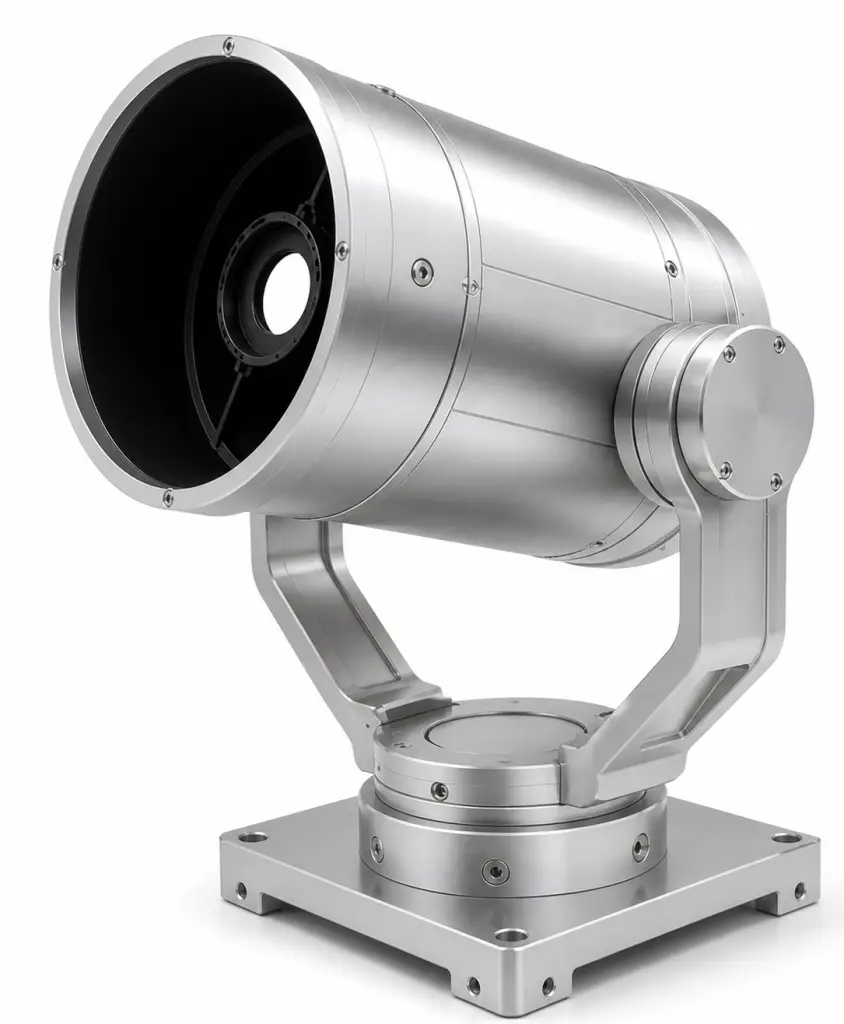
Importance of Thermal Stability for Imaging Performance
Thermal control directly impacts several key imaging parameters:
- Signal-to-noise ratio (SNR): Lower and stable temperatures reduce thermal noise in detectors
- Radiometric calibration: Consistent temperature ensures repeatable measurements across time
- Geometric accuracy: Prevents optical misalignment due to structural expansion
- Long-term reliability: Minimizes thermal fatigue in materials and electronics
For infrared imaging systems, thermal control is even more critical, as detectors may need to operate at cryogenic temperatures to function at all.
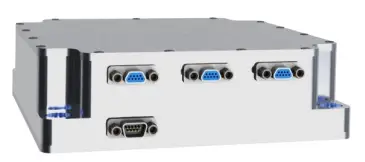
Multi-Axis Gimbal Systems and Line-of-Sight Stability
Even with perfect thermal control, imaging quality can degrade if the camera’s pointing is unstable. Satellites constantly experience:
- Micro-vibrations from reaction wheels
- Structural flexing
- Attitude disturbances
To address this, many advanced imaging systems use multi-axis gimbals.
A gimbal is a mechanical system that allows rotation about one or more axes. In satellite cameras:
- Two-axis or three-axis gimbals decouple the camera’s line of sight from spacecraft motion
- They provide fine pointing control independent of the satellite’s attitude
- They enable target tracking and image stabilization
Benefits for Imaging are:
- Improved spatial resolution: Reduces motion blur and jitter
- Extended exposure capability: Enables longer integration times
- Flexible targeting: Allows off-nadir imaging and dynamic scene tracking
- Enhanced mission performance: Particularly useful in reconnaissance, Earth observation, and astronomy
Thermal and mechanical systems are deeply interconnected:
- Thermal gradients can induce structural deformation, affecting gimbal alignment
- Actuators in gimbals generate heat, which must be managed to avoid disturbing the camera
- Material selection (e.g., low coefficient of thermal expansion composites) helps maintain alignment
An effective design ensures that thermal control does not interfere with pointing stability—and vice versa.
High-performance satellite imaging is fundamentally dependent on two pillars: thermal stability and precise pointing control. Thermal Control Units ensure that detectors and optics operate within strict temperature limits, preserving radiometric and geometric accuracy. Meanwhile, multi-axis gimbal systems isolate the imaging line of sight from spacecraft disturbances, enabling sharp, stable images.
Together, these technologies allow modern space cameras to achieve extraordinary performance—whether mapping Earth in fine detail, monitoring climate change, or exploring distant planets.