
Technical Advantage: Driving Lead Times to a Minimum
Showcase: Automated PCB Routing Techniques in OBC Design
- September 7, 2026
- CAVU Aerospace UK
Quick delivery time is not just about procurement planning. There’s a technical advantage in design & production phase enable us to offer minimum lead time in OBC manufacturing. CAVU has standard products like OBC-Cube-Polar, Thermal Control Unit, OBC-Hyper-Polar which take advantage of modular design to have standard main board with bespoke peripheral boards. GPUs building local network of CAVU Aerospace, outperforms a building full of designers & this is main advantage to drive delivery lead times (even for bespoke boards) to absolute minimum possible. In this article, we’re show casing one of the most time-consuming tasks in design phase to show AI capability in our own local AI can effectively help to reach minimum delivery times.
Designing an advanced OnBoard Computer for spacecraft is not simply a matter of placing components on a PCB and connecting them together. As processing performance, interfaces and system complexity increase, PCB design has become one of the most time-consuming stages of OBC development.
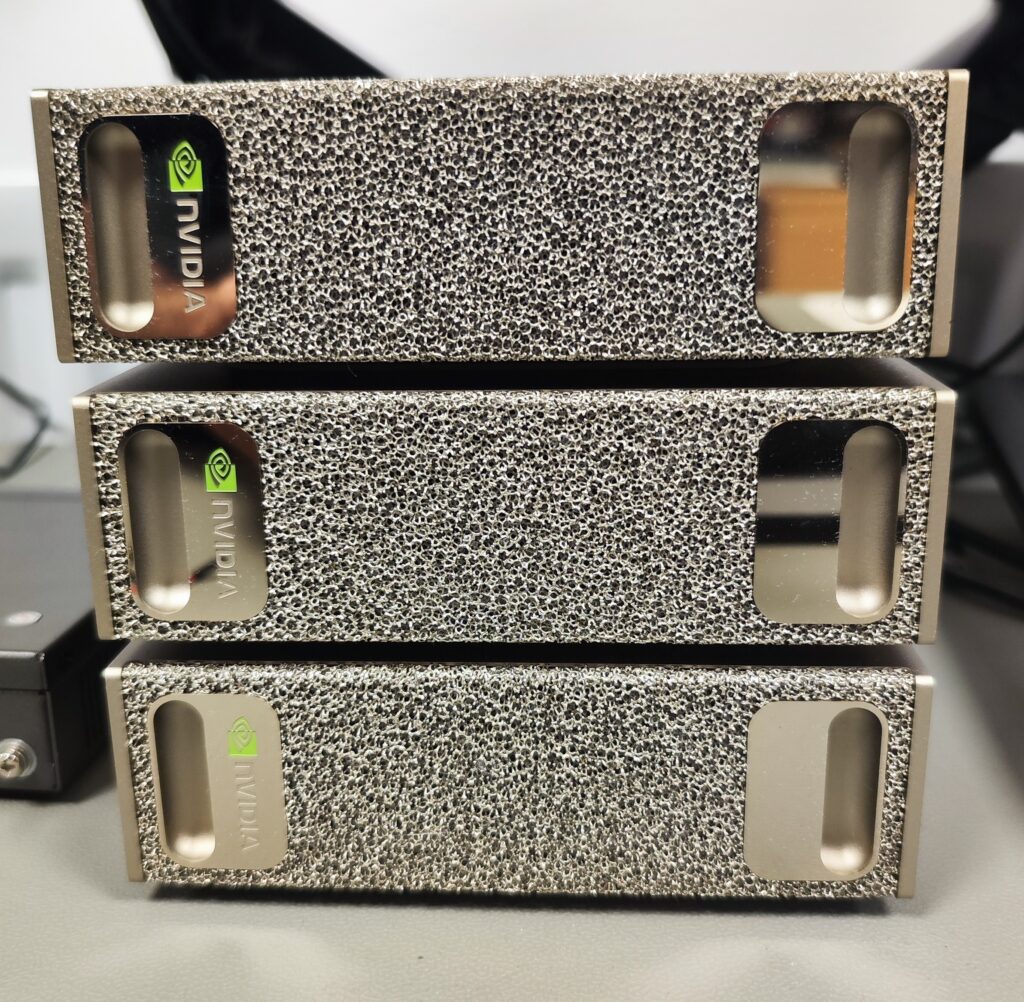
At CAVU Aerospace, our OBC designs for most of products can incorporate 22+ PCB layers and thousands of pin-to-pin connections within a compact area like 96 × 96 mm board. Routing these connections while satisfying signal-integrity, power-distribution, thermal, mechanical and manufacturing requirements presents a significant engineering challenge. To address this challenge, CAVU Aerospace is utilizing and continuously training its own GPUs for local AI network to assist automated PCB routing. It’s been designed specifically around the requirements of high-density space electronics & GPUs are trained better every single day how to do the job better, faster & more reliable.
The difference made by using AI-assisted PCB routing is so huge, compared to difference between using CAD or paper design.
Modern spacecraft computers must provide increasingly high levels of processing capability and connectivity while remaining extremely compact, reliable and power efficient.
An OBC may simultaneously contain High-performance FPGA or SoC devices, High-speed memory interfaces, Multiple communication interfaces, Power-management circuitry, High-speed differential signals, Clock and timing networks, Spacecraft I/O interfaces with several peripheral components & Redundant or safety-critical functions. All of these functions need to be interconnected within a limited PCB area.
For a board measuring only 96 × 96 mm, having thousands of pin to pin connections across more than 22 layers creates a highly constrained routing problem. Traditionally, much of this work relies on experienced PCB designers manually determining routing paths, layer assignments, vias and signal transitions. As board complexity increases, the number of possible routing combinations grows dramatically, making the process increasingly time-consuming. This can ultimately affect one of the most important factors in the space industry: delivery time.
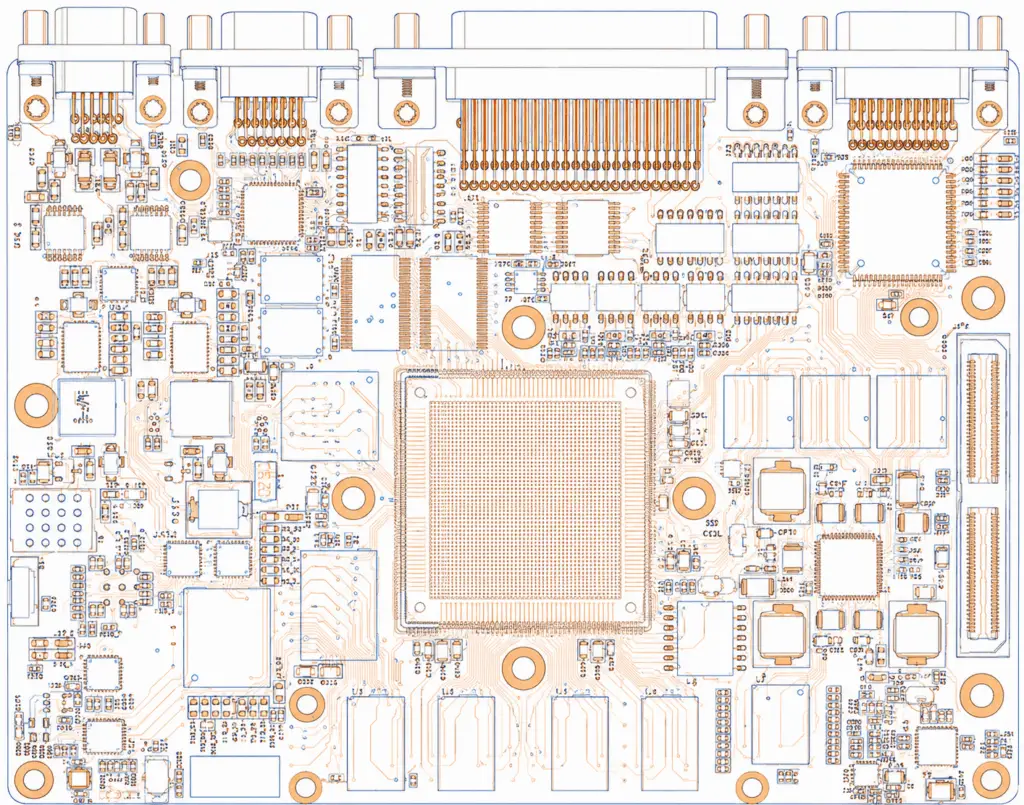
Moving Towards AI-Assisted PCB Routing via local GPUs
CAVU Aerospace is addressing this challenge through the development of own GPUs with local trained AI-assisted PCB routing techniques. Rather than treating PCB routing as a purely manual engineering task, our approach aims to use computational intelligence to analyse the board architecture, identify routing constraints and rapidly explore possible connection paths. The objective is not simply to automate drawing tracks.
The technology is being developed to help address the much broader optimisation problem involved in high-density PCB design:
Thousands of connections → multiple possible routing solutions → constrained board area → optimised PCB architecture.
By automating repetitive and computationally intensive parts of the routing process, engineers can focus more of their time on architecture, signal integrity, thermal design, verification and system-level optimisation.
OBC-Cube-Polar: A Case
One example of the type of hardware benefiting from this approach is OBC-Cube-Polar, one of CAVU Aerospace’s best-selling onboard computers. OBC-Cube-Polar is designed based on Microchip PolarFire SoC FPGA and is targeted at CubeSat and other small-spacecraft applications. Its compact architecture requires a high-density PCB design in which a large number of components and electrical connections must coexist within a constrained mechanical envelope. The design process can be viewed through several stages:
PCB layer architecture → automated routing → finished PCB → assembled electronics → complete OBC
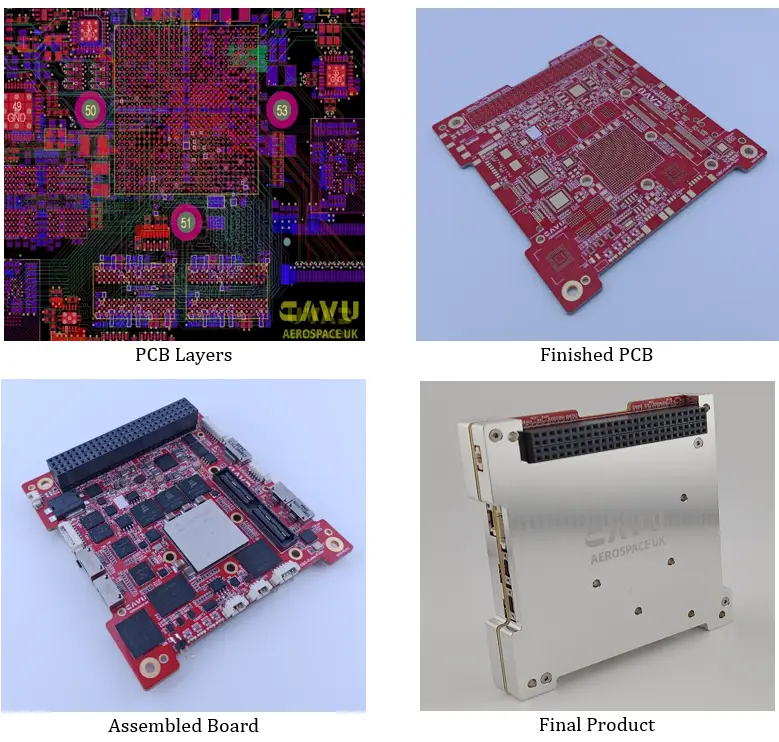
The complexity of a high-density OBC PCB is difficult to appreciate from the finished product alone. A compact board may contain thousands of individual connections, with each connection requiring an appropriate physical path through the PCB stack-up.
The routing system needs to consider factors such as Available routing channels, Layer utilisation, Via placement, Differential-pair constraints, High-speed signal paths, Power and ground distribution & more.
At CAVU Aerospace, our goal is to combine AI-assisted design automation with engineering expertise rather than replace engineering judgement. The AI system can rapidly evaluate routing possibilities and perform repetitive tasks that would otherwise require significant designer time. Engineers remain responsible for defining the architecture, constraints, priorities and final verification. Good news is more projects you do, better you trained your AI & your GPUs performance get better & better. So, every time you’re delivering a project, making your next mission easier, quicker & more reliable.
This capability has enabled us to deliver all projects on-time or ahead of schedule. Our delayed deliveries since Mid-2023 is absolute zero. This means faster development for clients lab at EM stage & more efficient spending.
We encourage all partners, clients & competitors to try develop own SPU network to improve overall system development & achieve more in same time. The future of spacecraft electronics will not only depend on better processors and FPGAs. It will also depend on our ability to design increasingly complex electronics faster.