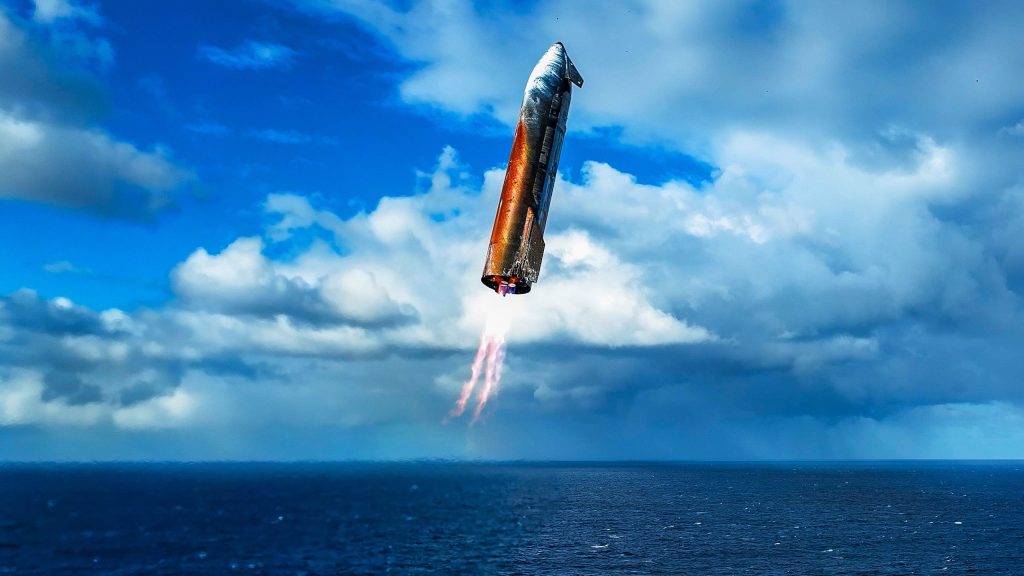
How Starship’s Full Reusability Reduces Space Launch Costs by 100x
- January 30, 2026
- CAVU Aerospace UK
SpaceX has revolutionized space launch technology by developing commercial space sector with its Falcon 9 rocket and its upcoming Starship system. Both rockets are designed for orbital launches, but their payload capabilities, reusability, and economies of scale differ dramatically. These factors will fundamentally change the cost of access to space, satellite design, and the scale of space missions.
Falcon 9, Partially Reusable
Falcon 9 is SpaceX’s reusable two-stage rocket, operational since 2010. Its key payload specifications are:
- Payload to Low Earth Orbit (LEO): ~22,800 kg (fully reusable), up to 30,300 kg
- Payload fairing dimensions: 5.2 m diameter × 13.1 m height
- Launch cost: Approximately $67–70 million per launch (partially reusable)
Satellites must fit within the 5.2 m diameter fairing. Large satellites may need to be split into smaller modules or use deployable structures. Falcon 9 can launch multiple small satellites per flight, ideal for CubeSats or shared rides.
Starship Set to Slash the Cost of Access to Space
Fully reusable Starship (Expected 2026) has several integrated flight tests & set the unbelievable records. It’s designed for large payloads and deep-space missions. Its key specifications:
- Payload to LEO: ~100,000–150,000 kg (fully reusable)
- Payload fairing dimensions: ~9 m diameter × 18–20 m height
- Launch cost: Targeted around 30 million per launch, depending on mission and reusability. 100 times cheaper than Falcon 9!
It can carry giant satellites, space telescopes, and entire satellite constellations in a single launch. Its 9 m diameter fairing allows wider spacecraft and simplifies design.
A major reason Starship can reduce the cost of space access is full rocket reusability. Just to understand how massive is this, we compare this to a non-Reusable airliner. A reusable rocket is like a commercial aircraft flown hundreds of times—the fixed cost is spread over many launches, allowing much cheaper “tickets”.
If aircraft costing $200 Million & not-reusable, tickets costs could be over $1 Million! Sounds ridiculously high, but in space industry we were paying this cost to access space & this is no longer a case, thanks to Starship!
With capabilities like orbital refuelling (expected to be demonstrated before 2030) and an enormous payload dimensions, this vehicle is poised to expand humanity’s consciousness of the universe, pave the way for a multiplanetary life, and strengthen our dominance on Earth.