Spaceflight Harnesses Muscle Memory
- November 25, 2026
- CAVU Aerospace UK
Engineering, estimation & supply of harness especially for flight modules is hidden part of space computing, especially with computers with power drivers where connectors & cables are extremely expensive. Bad decisions may end up with harness more expensive than OBC itself. If you buy long cables & then at integration stage you end up cutting a lot of long cables, it will be waste of money. So, this is tricky part of space project management.
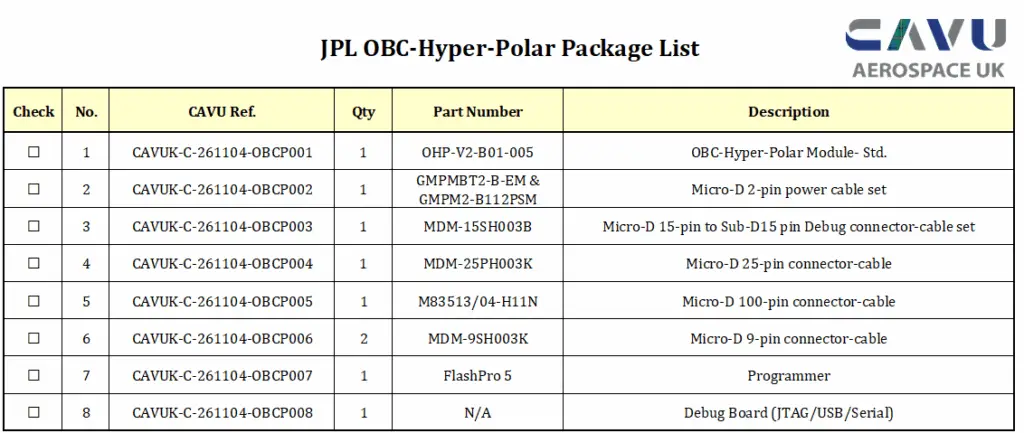
In CAVU aerospace, when we supply EDU or EM (engineering module), we supply everything end-user needs for development in the lab, including mate cables, programmer, debug boards etc. but for flight modules, especially for power drivers, we’re talking about expensive connectors & mate cables. If you make simple estimation & buy 3m long cables & then at integration your technician cut excess length, you’re wasting money. Knowhow, experience, tools & technicians with muscle memory makes a big difference here. In this article we have an example of computer for a GEO vehicle spacecraft with high-power drivers up to 5,000W. Connectors for such case is over $3,000 & cables are over $40 per meter. With 10+ connectors, some with 40+ pins, its about huge saving potential. We usually quote with a formulated spreadsheets to enable end-user to see breakdown of the costs for cables, connectors, backshells for every single harness with details like part numbers, manufacturers etc. We offer this & let end-user decide how to proceed with procurement of harness. With engagement of end-user & proper estimation on length of cables, we save a lot of wire cut at integration & do the job without any broken schedule.
In spacecraft and launch-vehicle projects, engineering teams naturally focus on the major hardware: the flight computer, power electronics, sensors, actuators, communications equipment and payload. Harnesses can appear to be a relatively simple part of the system. They are not.
For flight hardware, harness design, estimation, procurement and assembly can become a significant engineering and financial challenge. A poor decision made early in a project—particularly buying cables with excessive length or selecting the wrong connector configuration—can result in thousands of dollars of unnecessary material cost and, even more importantly, create integration problems later. In some cases, the harness can become surprisingly way more expensive compared with the electronics it connects. This is particularly true for high-power space systems where connectors, backshells, contacts and custom cables are expensive, specialised components.
At CAVU Aerospace, we have developed what we call “muscle memory” in flight-unit harness engineering: the accumulated practical knowledge of engineers and technicians skill who have repeatedly dealt with flight hardware, connectors, cable routing, integration constraints and procurement realities. That experience can make a substantial difference.
EM / EDU
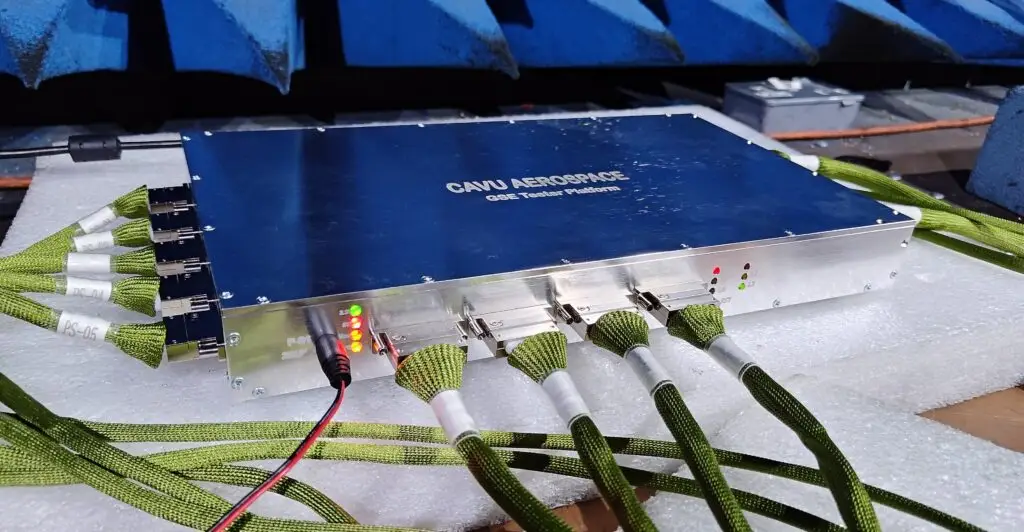
When CAVU Aerospace supplies an Engineering Model, our objective is to provide the customer with everything required to develop and test the system in the laboratory.
That can include:
- Mate cables
- Programming cables
- Debug boards
- Development interfaces
- Engineering harnesses
- Breakout hardware
- Test equipment interfaces
- Other accessories required for laboratory development
For an EM, flexibility is often more important than minimising every gram, millimeter or dollar. The situation changes considerably when moving towards a Flight Model. Flight hardware frequently uses specialised space-qualified connectors, environmental backshells, custom cables and carefully controlled cable lengths. The harness is no longer simply an accessory—it becomes part of the flight configuration. This is where engineering judgement becomes particularly valuable.
A Three-Meter Cable Can Be an Expensive Mistake
Imagine that an engineering team needs a cable between a flight computer and another subsystem. The exact final routing has not yet been established, so a simple solution might be: “Let’s order 3 metres. We can cut it down during integration.”
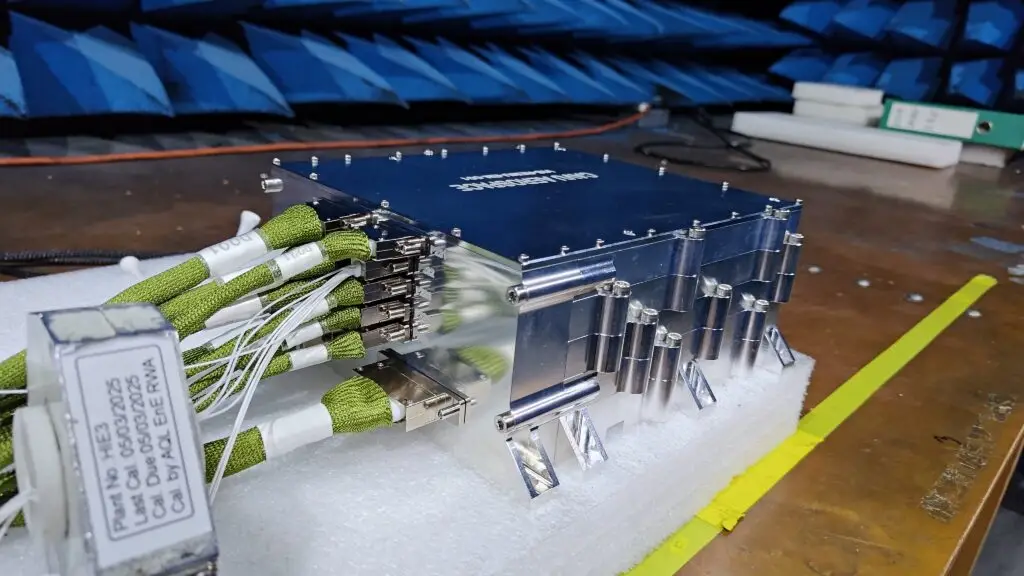
For ordinary commercial electronics, that might be perfectly reasonable. For space hardware with 10+ connectors, each 25, 51 or 100 pins with cables costing $40 per meter, it can be an extremely expensive decision. A flight harness may contain specialised connectors costing thousands of dollars, custom backshells, expensive contacts and individually manufactured cables. If the cable is ordered too long and subsequently shortened during spacecraft integration, the unused cable is not necessarily the only wasted material.
Depending on the design, shortening the cable may require re-termination, replacement contacts, rework of backshells, additional inspection, additional continuity testing, additional workmanship, broken schedule or potentially new procurement if a connector or cable assembly cannot be reworked. And if the cable has already been manufactured as a custom flight assembly, the original assembly may simply become unusable. The result is that a seemingly conservative decision at the beginning of the project can become a significant cost later.
Estimating the Harness before Integration
Harness engineering therefore starts long before the technician begins assembling wires. It starts with estimation & breakdowns. The engineering team needs to understand:
- Which connectors are required?
- Which mating connectors or cables are required?
- What cable type and gauge are required?
- How many conductors are needed?
- What is the realistic routing length?
- What additional length is required for service loops and integration?
- Which components are standard catalogue items?
- Which items are custom?
- What are the supplier minimum quantities?
- What are the relevant quantity price breaks?
- Which parts need to be procured early because of lead time?
- What will the final flight configuration actually require?
This is where experience & muscle memory matters. A spreadsheet can outperform hundreds of hours estimating. Experience determines whether the assumptions behind that spreadsheet make sense.
Case Study: High-Power Flight Computer Harnessing for GEO Vehicle
Consider a CAVU Aerospace computer used for a GEO mission with high-power drivers nearly 5,000 W drive power. The system requires multiple specialised connectors and cable assemblies to drive solenoids, actuators, stepper motors, heaters. Some connectors carry large numbers of conductors with large pins with 20+ Amp capacity per pin, while the power interfaces require appropriately sized conductors and specialised contacts. In one example, the harness material estimate includes:
- Multiple 25-pin high-power/environmental connectors
- Dedicated 2-pin power connectors
- Power contacts
- 20 AWG heater wire
- 12 AWG power wire
- 51-position custom thermistor cables
- 9-position data cables
- 15-position Ethernet cables
- 25-position channel cables
- Multiple specialised backshells and sealing components
The estimated saving for one set in this configuration is approximately $40,000.
There is an understandable engineering instinct to purchase extra cable. It feels safer.
If the final routing is uncertain, buying 3 metres instead of 1.5 metres appears to provide flexibility. But flexibility has a price. When you are talking about $40+ per meter cables & connectors $4,000+, it cost a lot. For specialised flight harnesses, the material cost can be dominated by the connectors and custom assemblies rather than simply the raw wire.
The objective therefore should not be: “Buy the longest cable so we cannot run short.”
The objective should be: “Engineer the correct configuration with sufficient integration margin.”
That distinction can save significant amounts of money.
Harness Engineering with Muscle Memory
A proper approach combines engineering calculation with practical manufacturing experience. We have engineers, technicians, tooling and established processes that have repeatedly dealt with flight-unit hardware. This creates competitive & open offers with detailed break-down to end-user.
For flight harness work, CAVU Aerospace prepares detailed costing spreadsheets so that the customer can understand exactly what is being proposed. We can break the estimate down into individual components, including:
- Part number
- Manufacturer
- Description
- Quantity
- Unit price
- Applied quantity break
- Cable length
- Line cost
- Total material cost
This allows the end user to see exactly where the money is going. It also makes procurement decisions transparent. For example, the customer can see the difference between purchasing individual components, taking advantage of supplier quantity breaks, selecting different cable lengths, or procuring complete harness assemblies. The customer remains in control of the procurement strategy. Collaboration of supplier & end-user at estimation stage really matters.
The real value of good harness engineering is not simply reducing the material quotation. It is reducing surprises during integration. A well-engineered harness should arrive at the integration campaign with the correct Connector configuration, Cable lengths, Pinout, Wire gauge, Backshell configuration, Routing allowance, Identification, Termination & Testing requirements.
The integration team should not be discovering that a cable is 1.5 metres too long—or, worse, 300 mm too short—when the flight computer is already installed. Every hour spent solving a preventable harness problem during spacecraft integration can become disproportionately expensive. The integration schedule is usually much more valuable than the cable itself.
Our objective is to combine Engineering + Procurement + Manufacturing + Integration Experience into one solution. The result can be a harness that is competitive not because the individual components are necessarily the cheapest available, but because the overall configuration has been properly engineered.
Flight Harness muscle memory is about the right cable length, the right connector from right manufacturer, the right backshell, the right quantity to fit in best price break of suppliers, the right procurement strategy, the right amount of integration margin. and, importantly, the right level of documentation and traceability. It’s about having all of the above with no surprise & shortcoming at integration stage & no broken schedule.