Right Surface Coating for Aluminium Onboard Computer Chassis in Space!
- July 16, 2026
- CAVU Aerospace UK
The mechanical enclosure of an Onboard Computer or camera is much more than a protective housing. In spacecraft engineering, the chassis becomes an integral part of the thermal management system, structural load path, electrical grounding architecture, contamination control strategy, and corrosion protection. Consequently, selecting the appropriate surface treatment is an important system engineering decision rather than a cosmetic preference.
OBC or Camera products are manufactured from aerospace-grade AL6061-T6 or AL7075-T6 aluminium alloy with thickness from 2.5 to 4.75 mm, providing an excellent balance of mechanical strength, low mass, machinability, thermal conductivity, and space heritage. Depending on the mission requirements, the chassis may be supplied with several surface treatment options, including:
- Full Alodine (Chromate Conversion Coating)
- Full Anodized
- Hybrid configuration with Alodine on internal surfaces and Anodizing on external surfaces
- Other customer-specified coatings where required
Each option offers distinct advantages and trade-offs. This article explains these differences to assist spacecraft system engineers in selecting the most suitable configuration for their mission.
AL6061-T6 has become one of the most widely used structural materials in spacecraft because it offers high strength-to-weight ratio, excellent machinability for precision aerospace components, good thermal conductivity for electronic cooling, stable mechanical properties over a wide temperature range, excellent compatibility with space-qualified surface treatments & extensive flight heritage across LEO, MEO, GEO and deep-space missions. While the alloy itself possesses good corrosion resistance, additional surface treatment is almost always recommended to improve durability, electrical performance, thermal characteristics, and environmental compatibility.
Alodine (Chromate Conversion Coating)
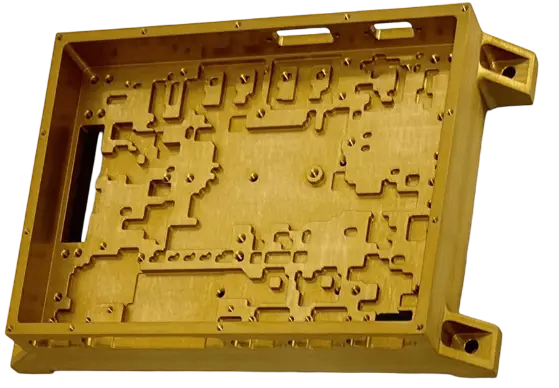
Alodine, also known as Chem Film or Chromate Conversion Coating, is one of the most common finishes for spacecraft electronic assemblies. Instead of forming a thick oxide layer, Alodine creates a very thin chemical conversion coating that preserves the conductivity of the aluminum surface while providing corrosion protection.
Typical characteristics include excellent electrical conductivity, very low contact resistance, minimal dimensional change, good corrosion resistance, excellent grounding performance, suitable for EMI shielding & good paint adhesion if additional coating is required. Because the coating thickness is typically less than a few micrometres, precision-machined interfaces remain dimensionally accurate.
Advantages are best electrical bonding between structural parts, excellent chassis grounding, ideal for EMI/EMC performance, easy assembly with conductive interfaces & no significant dimensional growth.
The appearance is generally gold or light yellow and is less resistant to scratching than anodized surfaces. For visible spacecraft panels, some customers prefer anodizing for improved cosmetic durability.
Anodized Aluminium
Anodizing is an electrochemical process that produces a thick aluminum oxide layer on the surface. Unlike Alodine, anodizing forms a hard ceramic-like coating that substantially improves wear resistance and surface durability. Two types are commonly encountered: clear (Natural) Anodize & black Anodize.
Black anodizing is frequently selected for spacecraft & specially for camera because it offers useful thermal-radiative characteristics while providing a professional appearance.
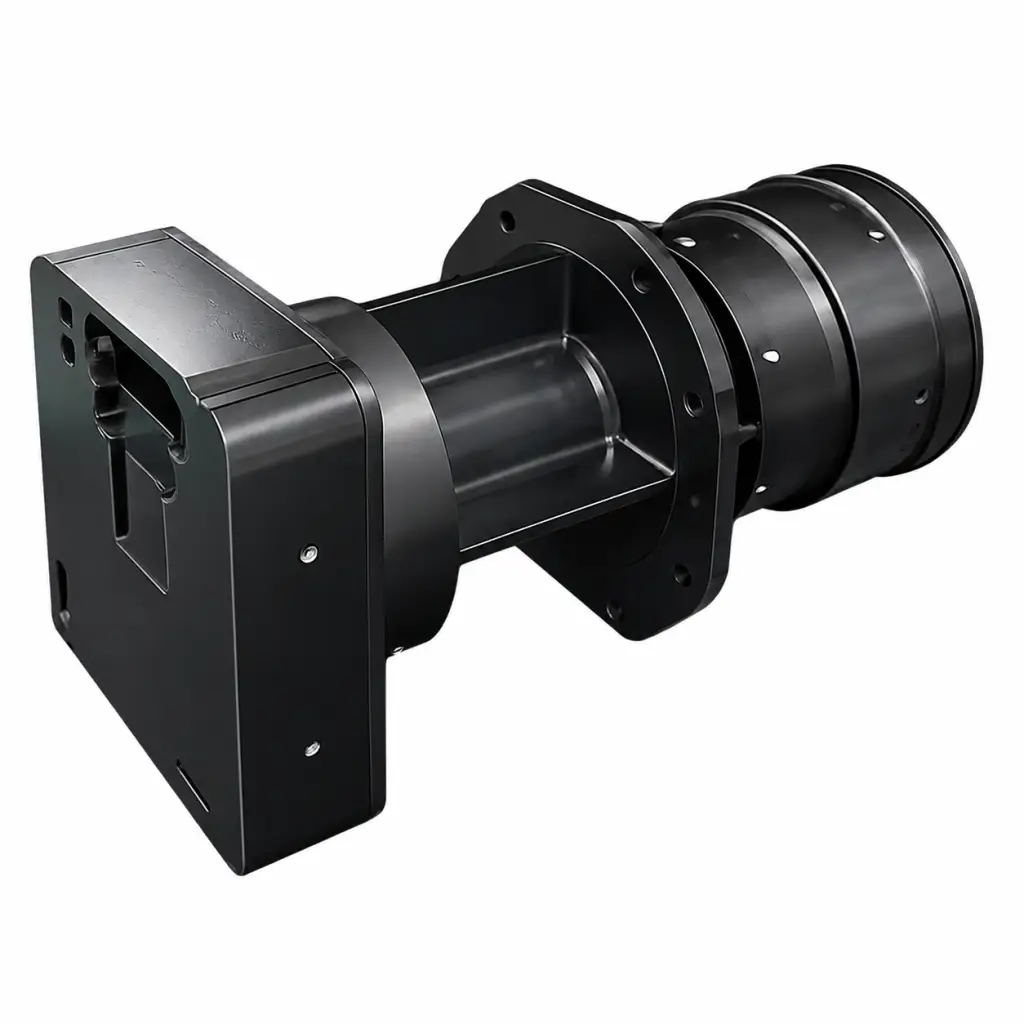
Advantages are excellent wear resistance, hard surface, good scratch resistance, improved corrosion protection, attractive appearance & good thermal emissivity (particularly black anodize).
The oxide layer is electrically insulating. For this reason, electrical grounding requires dedicated bonding locations & fastener interfaces may require masking or conductive inserts. Contact resistance is also much higher than Alodine surfaces.
System engineers should therefore carefully evaluate electrical grounding and bonding requirements before selecting full anodizing.
Hybrid Configuration (Internal Alodine, External Anodize)
Many spacecraft manufacturers adopt a hybrid solution that combines the advantages of both treatments. In this configuration internal structural interfaces are finished with Alodine (Usually light golden colour) & external visible surfaces are anodized (Usually black or dark golden colour).
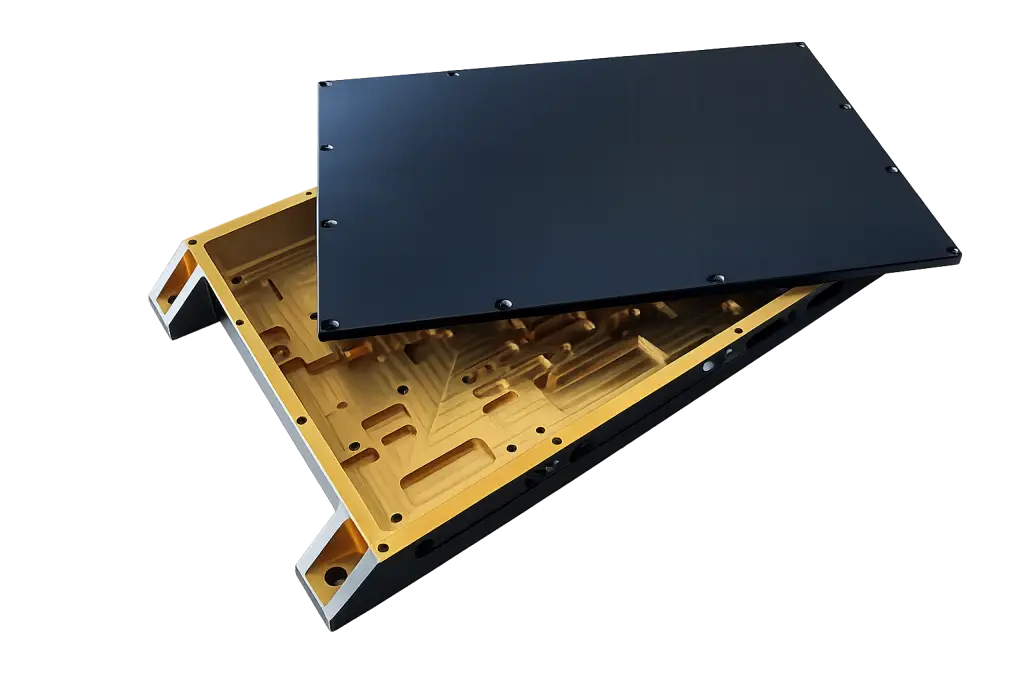
This arrangement provides:
- Excellent internal electrical grounding
- Reliable EMI shielding
- Low contact resistance between mating components
- Durable external finish
- Improved scratch resistance
- Better handling during spacecraft integration
- Attractive appearance for customer acceptance
This has become one of the most common configurations for modern spacecraft avionics.
Surface finish directly influences the thermal behaviour of spacecraft hardware. In orbit, heat transfer occurs primarily through radiation rather than convection. The emissivity and solar absorptivity of the enclosure therefore become important design parameters. Different coatings exhibit different thermal optical properties.
Alodine- Typically provides moderate emissivity and relatively low solar absorptivity. It is often selected when conductive interfaces are more important than maximizing radiative heat rejection.
Black Anodize- Provides significantly higher emissivity, making it attractive for components intended to radiate internal heat into space.
This can improve passive thermal management, although the complete thermal design must also consider spacecraft orientation, radiator locations, orbital environment, solar loading, multilayer insulation (MLI) & neighbouring equipment in platform.
Thermal coating selection should therefore always be performed as part of the spacecraft thermal analysis rather than considered independently.
Electrical Bonding and EMI Performance
For high-speed digital electronics, electrical bonding between chassis components is essential. An onboard computer may contain interfaces such as SpaceWire, Ethernet, CAN, RS-422/RS-485, PCIe, LVDS & High-speed camera interfaces. Maintaining low-impedance electrical paths helps reduce electromagnetic interference (EMI), improve electromagnetic compatibility (EMC), and provide effective shielding against external electromagnetic environments.
Because Alodine remains electrically conductive, it is generally preferred wherever chassis-to-chassis bonding is critical. If anodized surfaces are used, conductive bonding paths should be intentionally designed using masked areas, bonding straps, conductive washers, or dedicated grounding features.
Corrosion Protection
Although spacecraft operate in vacuum after launch, corrosion protection remains important during manufacturing, transportation, long-term storage, cleanroom integration, launch campaign, marine transportations & Humid launch-site environments. Both Alodine and anodizing provide excellent corrosion resistance, although anodizing generally offers superior mechanical durability against handling damage.
Mechanical Durability
Launch campaigns involve repeated handling, integration, removal, inspections and transportation. For missions with extensive integration activity, anodized external surfaces generally maintain their appearance better due to their higher hardness and scratch resistance. Internal structural interfaces, however, often benefit more from conductive Alodine finishes.
Contamination and Cleanliness
Space-qualified surface treatments must also satisfy contamination requirements. Properly processed Alodine and anodized coatings exhibit low outgassing, vacuum compatibility, good long-term stability & compatibility with spacecraft cleaning processes. Where particularly stringent contamination control is required—such as for optical payloads, infrared instruments, or high-sensitivity detectors—additional cleanliness procedures and material screening may be applied during manufacturing.
Typical Mission Recommendations
|
Mission Requirement |
Recommended Finish |
|
Maximum electrical conductivity |
Full Alodine |
|
Highest wear resistance |
Full Anodize |
|
Best cosmetic appearance |
Full Anodize |
|
Maximum EMI grounding |
Full Alodine |
|
Passive thermal radiation |
Black Anodize |
|
Balanced electrical and mechanical performance |
Internal Alodine + External Anodize |
|
Most spacecraft avionics applications |
Internal Alodine + External Anodize |
Custom Configurations
Every spacecraft has unique mechanical, electrical, thermal, and contamination requirements. For this reason, CAVU Aerospace offers flexible surface finish options for its onboard computers. Customers considering system engineering constraints, may specify full Alodine conversion coating, full clear anodizing, full black anodizing, internal Alodine with external anodizing, customer-defined masking for electrical bonding points & custom thermal coatings or mission-specific surface treatments where required. This flexibility allows the OBC to integrate seamlessly into the spacecraft’s structural, thermal, and electrical architecture.