
Reliable On-Board Computer Performance in Extreme Space Temperatures
- May 30, 2026
- CAVU Aerospace UK
The Challenge of High-Temperature Electronics in Space Applications & Our Solutions
Modern spacecraft rely heavily on On-Board Computers to perform mission-critical functions including command and data handling, attitude control, payload management, communication scheduling, and fault management. As the central processing unit of a spacecraft, OBC reliability directly influences mission success. Every OBC undergoes a rigorous environmental qualification campaign before delivery. These tests include Electromagnetic Compatibility, Vibration, Shock, Thermal Vacuum (TVAC) & Functional and Performance Verification
The objective is straightforward: ensure that the system performs reliably throughout the harsh conditions encountered during launch and operation in space. While mechanical and environmental testing often validates the hardware design, one of the most challenging areas remains high-temperature performance.
Why Temperature Matters in Electronic Systems
Electronic devices are inherently sensitive to temperature variations. As semiconductor junction temperatures increase, several physical effects begin to influence system behavior:
- Increased leakage currents within integrated circuits
- Reduced timing margins in high-speed digital interfaces
- Changes in oscillator stability and clock accuracy
- Variations in power supply performance
- Memory retention and data integrity concerns
- Increased susceptibility to single-event and transient effects
Even when operating within component specifications, cumulative thermal effects can expose marginal design conditions that remain hidden during room-temperature testing. For spaceborne OBCs, where systems may experience significant temperature excursions, identifying these issues before launch is essential.
Industry Trends Toward High-Temperature Electronics
Recognizing these challenges, organizations such as NASA and other leading space agencies have invested heavily in the development of wide-bandgap semiconductor technologies, particularly Silicon Carbide (SiC) and Gallium Nitride (GaN).
Silicon Carbide devices offer several advantages:
- Operation at significantly higher junction temperatures
- Reduced leakage currents
- Improved thermal conductivity
- Enhanced radiation tolerance in certain applications
- Greater reliability in extreme environments
These technologies are particularly attractive for future deep-space missions, planetary exploration systems, high-power electronics, and environments where conventional silicon-based devices face performance limitations.
However, despite the promise of SiC technologies, the majority of today’s space-qualified digital processing systems and OBCs continue to be based on conventional silicon electronics. As a result, system designers must still address the thermal behavior of complex electronic assemblies through robust engineering practices.
Detecting Thermal-Induced Performance Issues & Our Solutions
Thermal-related performance anomalies are occasionally identified during qualification campaigns, particularly during elevated-temperature testing phases. Examples can include:
- Unexpected software execution timing variations
- Communication interface instabilities
- Processor performance degradation
- Sensor data inconsistencies
- Intermittent subsystem behavior that only manifests at elevated temperatures
Importantly, these issues are often not hardware failures. Instead, they may result from subtle interactions between hardware characteristics and software assumptions made during development.
Traditional functional testing may not reveal such behaviour because the system operates correctly under nominal laboratory conditions. High-Reliability Boot & Recovery Architecture works done by CAVU embedded team are:
- Dual-QSPI redundant U-Boot boot architecture
- Automatic fallback between primary and backup boot sources
- Redundant Linux root filesystem architecture on eMMC
- Automatic rollback to backup Linux partition after boot failures
- Recovery support for corrupted boot images and root filesystems
- FPGA fabric-assisted Linux boot watchdog with automatic system recovery on boot hang or startup failure
- High-reliability embedded boot and recovery architecture for PolarFire SoC
High-Temperature Stress Screening as a Solution
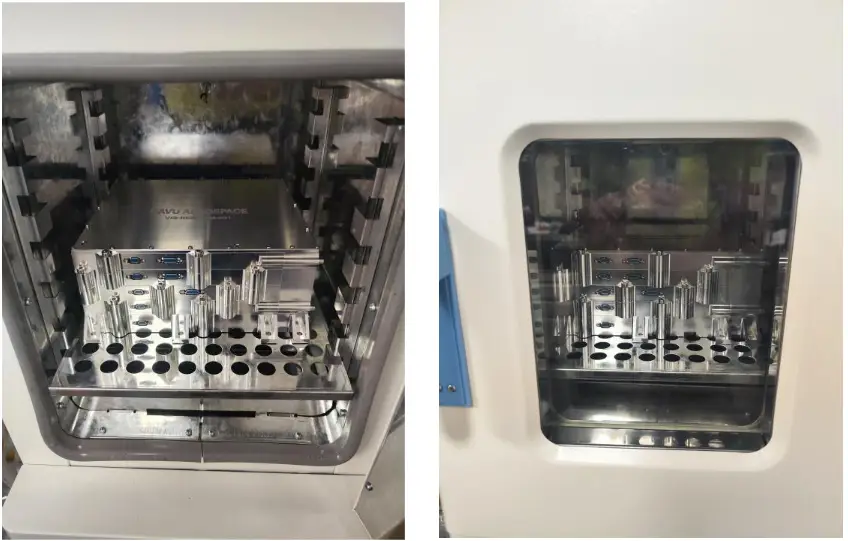
To address this challenge, CAVU Aerospace employs High-Temperature Stress Screening (HSS) during software development and system qualification. HSS intentionally exercises the OBC under elevated thermal conditions while running representative operational software loads. This approach allows engineers to evaluate system behavior under conditions that more closely resemble worst-case mission environments. Benefits of HSS include:
- Early identification of temperature-sensitive software behavior
- Validation of processor timing margins
- Verification of communication robustness
- Detection of latent integration issues
- Increased confidence in mission readiness
By integrating thermal stress screening into the development cycle rather than treating it solely as a qualification activity, issues can be identified and corrected long before flight acceptance.
Space system reliability cannot be achieved through hardware testing alone. Modern spacecraft are increasingly software-driven, making software robustness equally important. Our approach combines:
- Environmental qualification testing
- Thermal vacuum verification
- High-temperature stress screening
- Continuous software validation
- Root-cause analysis and corrective action
This integrated methodology ensures that both the hardware platform and the software stack remain reliable across the full operational temperature range.