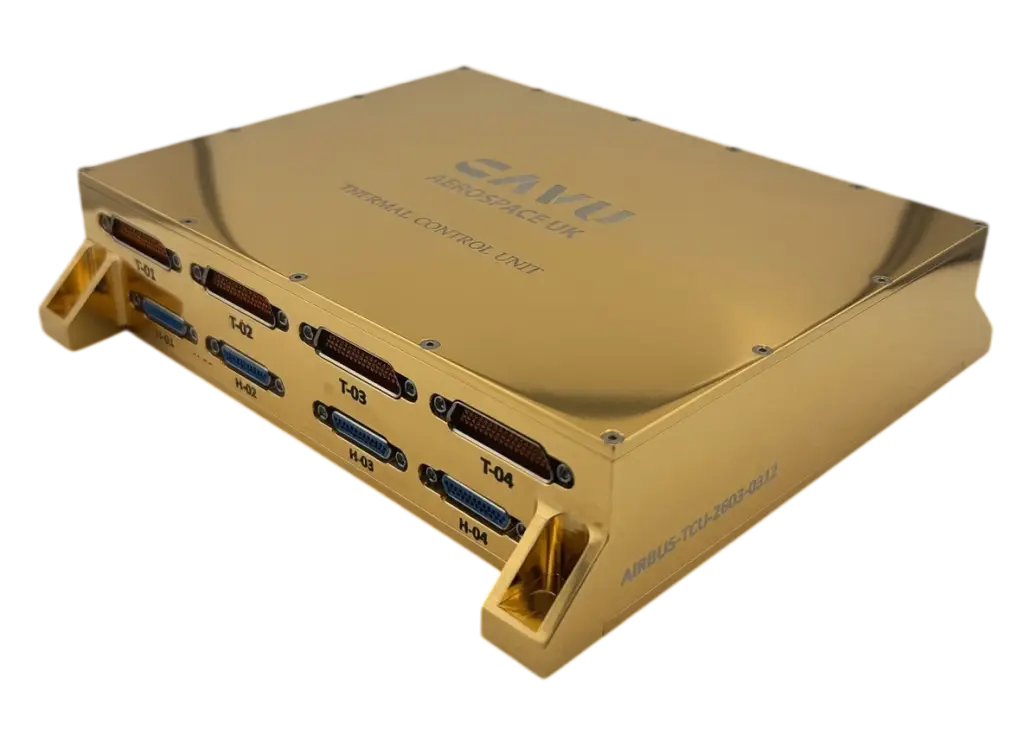
Radiation-Tolerant Thermal Control Unit (TCU-RT)
- July 13, 2026
- CAVU Aerospace UK
As satellites become increasingly sophisticated and mission lifetimes continue to extend, spacecraft thermal control systems are expected to do far more than regulate temperature. Modern missions require electronics capable of maintaining precise thermal control while surviving harsh radiation environments, autonomously detecting faults, protecting spacecraft hardware, and continuing operation without immediate ground intervention.
Radiation-Tolerant Thermal Control Unit is next-generation thermal management system combining high-density temperature acquisition, intelligent heater control, comprehensive Fault Detection, Isolation and Recovery (FDIR), and radiation-tolerant electronics within a compact space-qualified architecture.
Designed entirely from qualified space-grade components, the TCU-RT represents a new generation of spacecraft thermal controllers engineered for reliability, autonomy and mission resilience.
The TCU-RT has been specifically engineered for operation in demanding radiation environments encountered in Low Earth Orbit (LEO), Medium Earth Orbit (MEO), Geostationary Earth Orbit (GEO), lunar missions and deep-space exploration.
The unit is designed to withstand:
- 100 krad Total Ionizing Dose (TID)
- Single Event Effect (SEE) immunity up to 86 MeV·cm²/mg
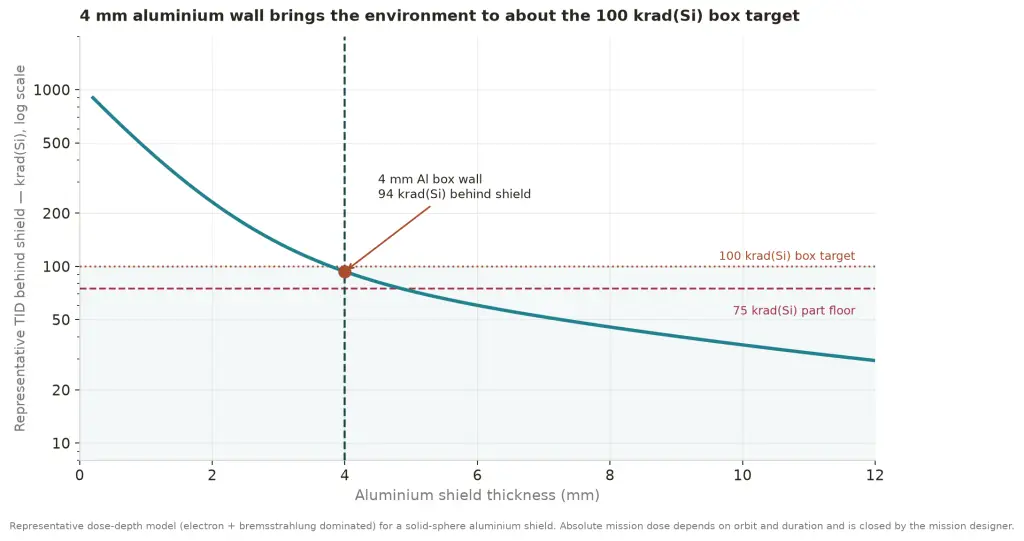
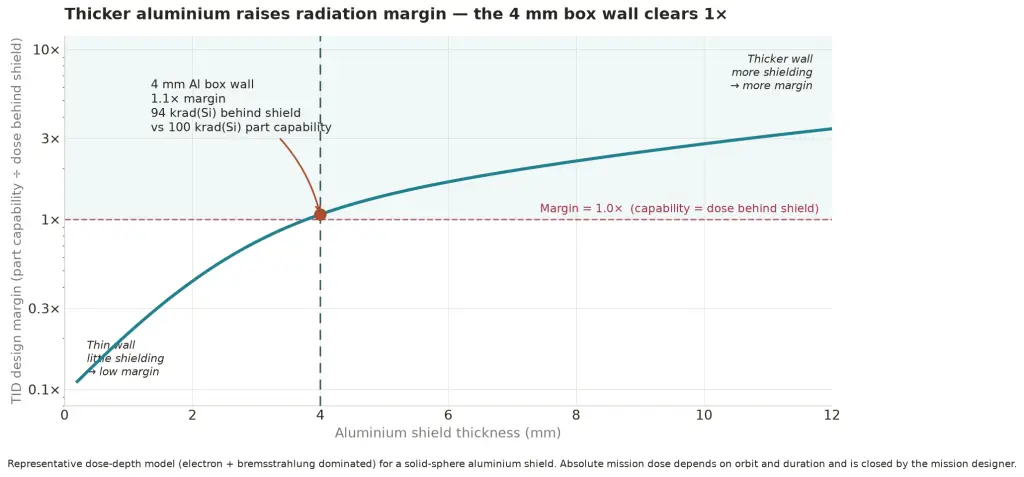
Unlike conventional commercial thermal controllers, the TCU-RT has been designed using an exclusively space-grade component selection strategy. Every primary flight component satisfies a minimum 75 krad Low Dose Rate (LDR) qualification, while many critical devices substantially exceed the overall system radiation requirement. The radiation figures are based on qualified component data for the flight configuration, with mission-specific shielding analysis and radiation design margin remaining dependent on spacecraft orbit and mission duration.
To further improve radiation resilience, the complete electronics assembly is housed inside a 4 mm aluminium enclosure, providing inherent attenuation of the incident radiation environment before particles reach the electronic assemblies. This shielding contributes additional system-level radiation margin while maintaining a compact mechanical design.
Radiation tolerance is achieved not through shielding alone but through careful architectural design and the selection of proven radiation-qualified components.
The heart of the controller is a Vorago VA41630 radiation-hardened Arm Cortex-M4 processor, qualified beyond 200 krad TID with latch-up immunity exceeding 110 MeV·cm²/mg. Precision temperature measurements are performed using Renesas ISL73148SEH 14-bit SAR converters qualified to 75 krad with immunity against SEL, SEFI and SEB up to 86 MeV·cm²/mg.
Temperature channel expansion is implemented using Front-grade RHD8544 radiation-hardened analog multiplexers qualified beyond 1 Mrad (Si)—providing more than ten times the radiation tolerance required by the overall system target. System memory is implemented using 3D PLUS MNEMOSYNE MRAM, providing greater than 100 krad tolerance together with embedded Error Correcting Code (ECC), eliminating the radiation vulnerability associated with conventional NOR Flash boot devices.
Communication interfaces are equally robust, employing radiation-qualified CAN-FD transceivers, space-rated RS-422 interfaces, radiation-certified Ethernet PHY devices, and radiation-qualified power management components throughout the power distribution architecture.
High-Density Thermal Management
The TCU-RT integrates temperature acquisition, heater control and spacecraft housekeeping into a compact two-board assembly designed to minimise spacecraft mass, volume and power consumption.
The controller provides:
- Up to 110 temperature sensor inputs (128 multiplexed acquisition positions)
- 48 independently controlled PWM heater outputs
- Support for NTC thermistors, RTDs and integrated temperature sensors
- High-resolution 14-bit SAR temperature acquisition
- Reading accuracy of ±0.5°C
- Mission-configurable thermal setpoints and control deadbands
- Bus voltage variants for 28 V and 50 V spacecraft power systems
The flexible analogue front-end enables different sensor technologies to coexist within the same spacecraft, allowing a single controller architecture to support diverse thermal monitoring requirements without hardware redesign.
Fault-Tolerant Precision Acquisition
The temperature acquisition subsystem represents one of the most critical functions of any spacecraft thermal controller. The TCU-RT has therefore been architected around redundancy, isolation and graceful degradation.
The acquisition chain employs two independent 14-bit SAR converters, each operating within separate fault domains. Four radiation-hardened analogue multiplexers expand the available sensor inputs to 128 channels while maintaining complete electrical isolation between acquisition banks.
Cross-strapped converter inputs permit continued operation following a single converter failure, allowing the controller to continue acquiring critical spacecraft temperatures in a degraded operating mode rather than suffering complete loss of functionality.
The RTD measurement architecture further improves radiation robustness by keeping multiplexer resistance outside the excitation reference path. Consequently, any radiation-induced variation in switch on-resistance does not degrade the accuracy of ratiometric RTD measurements.
Preserving Accuracy in Radiation Environments
High-resolution converters alone cannot guarantee measurement accuracy throughout a long-duration space mission. The TCU-RT therefore employs a complete error-budget approach to thermal measurement.
The specified ±0.5°C reading accuracy is maintained through careful management of:
- Sensor tolerances
- Voltage reference stability
- Multiplexer leakage
- Excitation current drift
- Cable resistance
- Thermal gradients
- Calibration uncertainty
- Radiation-induced parameter drift
Oversampling techniques improve effective resolution where appropriate, but overall measurement accuracy is achieved through ratiometric sensing, analogue front-end optimisation, precision calibration and careful control of systematic errors rather than digital filtering alone.
This approach ensures stable thermal measurements throughout the specified radiation environment while maintaining compatibility with multiple spacecraft sensor technologies.
Comprehensive Fault Detection, Isolation and Recovery (FDIR)
Reliability in orbit depends not only on preventing failures but also on identifying and recovering from them autonomously. The TCU-RT incorporates a comprehensive multi-layered Fault Detection, Isolation and Recovery (FDIR) architecture that continuously supervises the health of the controller, acquisition electronics, heater drivers, communication interfaces and power distribution system.
Power Protection
Electrical faults such as over-voltage, over-current and short-circuit conditions are continuously monitored. Dedicated protection circuitry isolates abnormal conditions before damage can propagate through the spacecraft electrical system, while autonomous recovery logic restores normal operation once safe operating conditions have returned.
Processor Supervision
The radiation-hardened processor is monitored by independent hardware watchdog timers capable of detecting software lock-up, execution anomalies and processor stalls. When abnormal behaviour is detected, the controller automatically performs a controlled restart without requiring intervention from the spacecraft computer.
Radiation-Induced Memory Protection
Radiation-induced bit upsets are mitigated using embedded ECC and Error Detection and Correction (EDAC) mechanisms within the MRAM architecture. The use of radiation-tolerant MRAM removes the dependence on conventional NOR Flash boot memory, eliminating one of the most common radiation-related failure mechanisms found in embedded systems.
Communication Integrity
Command and telemetry interfaces continuously verify communication integrity using CRC validation, protocol diagnostics and interface supervision. Should communication faults occur, redundant interfaces and recovery procedures maintain spacecraft command capability while preventing corrupted commands from affecting heater operation.
Intelligent Sensor Validation
Measured temperatures are continuously checked against expected operating limits, historical trends and mission-specific plausibility criteria. Suspect sensor readings can be isolated while maintaining operation using redundant measurements where available.
Deterministic Heater Safety
The heater control architecture has been specifically designed to guarantee safe operation under fault conditions. PWM generation is implemented using a radiation-tolerant non-volatile FPGA operating independently from the main processor. The FPGA supervises watchdog status, protected update registers, heater-bank interlocks and deterministic heater enable logic.
If processor resets, watchdog events or invalid commands occur, all heater outputs are forced into a deterministic safe OFF state through independent hardware logic, preventing uncontrolled spacecraft heating even during severe system faults.
Modern Spacecraft Interfaces
The TCU-RT integrates seamlessly with contemporary spacecraft avionics through multiple communication interfaces including:
- CAN
- RS-422
- Optional MIL-STD-1553
- 10/100 Ethernet via a radiation-certified Ethernet PHY
Independent housekeeping acquisition continuously monitors bus voltage, current consumption and heater current, providing detailed health information for spacecraft monitoring while remaining electrically separate from the precision temperature acquisition chain.
Despite integrating more than one hundred temperature channels and forty-eight independent heater outputs, the controller remains exceptionally compact.
Mechanical characteristics include:
- Dimensions: 170 × 180 × 40 mm
- Mass: 1.2 kg
- Electronics power consumption: 3–6 W (excluding heater load)
- Operating temperature: −40°C to +85°C
The modular two-board architecture combines acquisition electronics with a dedicated heater driver board, simplifying spacecraft integration while supporting future product variants and mission-specific customisation.
The Radiation-Tolerant Thermal Control Unit embodies CAVU Aerospace UK’s philosophy of designing spacecraft electronics for mission resilience rather than minimum compliance.
By combining:
- 100 krad Total Ionizing Dose capability
- SEE immunity to 86 MeV·cm²/mg
- Radiation-qualified space-grade components
- Dual fault-domain precision acquisition
- Hardware-enforced heater safety
- ECC-protected MRAM architecture
- Radiation-hardened communications
- Autonomous multi-layered FDIR
- Cross-strapped redundant acquisition paths
- Deterministic safe-state recovery
the TCU-RT provides spacecraft manufacturers with a dependable thermal management platform capable of maintaining accurate thermal control even in the presence of radiation events, hardware failures and software anomalies.
Designed for scientific, commercial, defence and deep-space missions, the TCU-RT delivers the reliability, autonomy and precision demanded by the next generation of space exploration.