
PWM vs Linear Control in Satellite Thermal Control
- February 19, 2026
- CAVU Aerospace UK
At Cavu Aerospace UK, we have developed and manufactured advanced Thermal Control Units (TCUs) for satellite subsystems. Our current flight-qualified design utilizes high-efficiency Pulse Width Modulation (PWM) control and has successfully demonstrated excellent Electromagnetic Compatibility (EMC) performance.
For certain mission profiles—particularly ultra-sensitive payloads—we have been requested to develop an ultra-low-noise thermal control system based on linear regulation. This article provides a detailed technical comparison between PWM and linear control approaches in spaceborne thermal systems.
1. Thermal Control in Satellite Systems
Satellite subsystems—including star trackers, optical payloads, RF front-ends, detectors, atomic clocks, and precision oscillators—require tight thermal stability. Thermal control units typically regulate:
- Heater elements
- Thermoelectric coolers (TECs)
- Resistive thermal straps
- Active radiator panels
The control method directly affects:
- Electrical efficiency
- Thermal stability
- Electromagnetic emissions
- Mass and volume
- System reliability
The two primary power control architectures are:
- PWM (Switching) Control
- Linear (Analog) Control
2. Pulse Width Modulation Control
PWM regulates output power by switching a transistor fully ON and OFF at a defined frequency. The duty cycle (percentage of ON time) determines average delivered power.
The switching device operates in:
- Saturation (fully ON)
- Cut-off (fully OFF)
This minimizes power dissipation in the control element.
Advantages of PWM Control
High Electrical Efficiency
- Switching devices dissipate minimal heat.
- Ideal for power-limited spacecraft.
- Reduced internal TCU thermal load.
Compact Design
- Smaller heatsinks required.
- Lower mass.
- High power density.
Scalable Power Architecture
- Easily adapted for multi-channel heater systems.
- Well-suited for distributed satellite architectures.
Excellent Demonstrated EMC (with Proper Design)
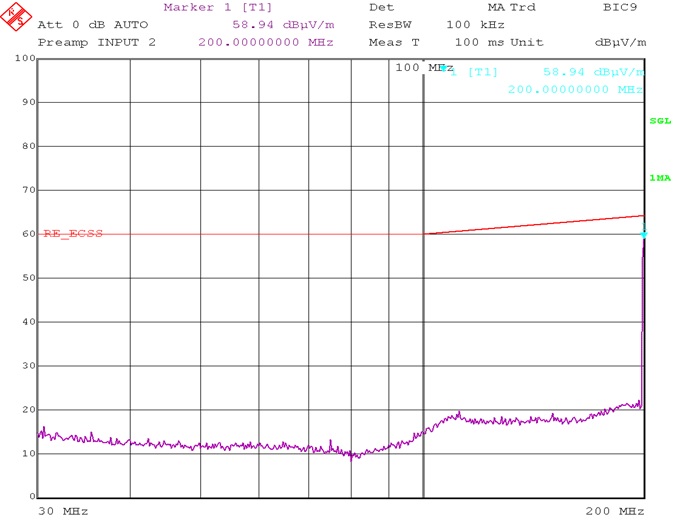
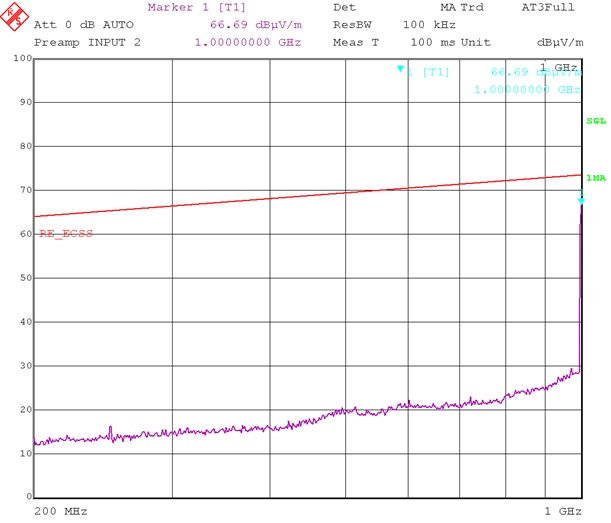
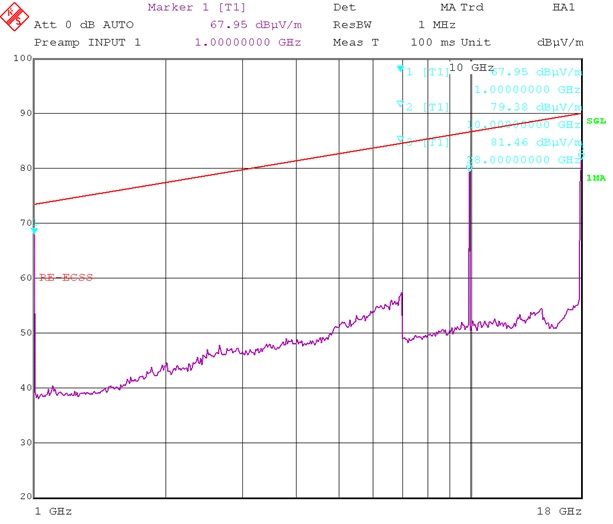
our PWM TCU has achieved strong EMC performance through:
- Controlled edge rates
- Shielded layouts
- Optimized grounding strategy
- Proper LC filtering
- Controlled switching frequency selection
TCU Base Version With PWM, Radiated Emissions
Challenges of PWM Control
Despite excellent engineering mitigation, PWM inherently introduces:
Conducted Emissions
Switching edges generate:
- Harmonics
- Broadband spectral components
- Bus ripple
Radiated Emissions
High dV/dt and dI/dt edges create:
- Magnetic field radiation
- Loop coupling
Micro-Vibration (in sensitive payloads)
Current ripple in heater loops can induce:
- Mechanical strain
- Micro-disturbances in ultra-precise optical systems
Interaction with Sensitive Payloads
Ultra-low noise instruments (e.g., optical sensors, RF front-ends, precision timing devices) may require:
- Near-zero electrical ripple
- No switching harmonics
- Ultra-clean supply rails
In these cases, PWM—even when compliant—may not be optimal.
3. Linear Control System
A linear controller regulates power by operating the pass transistor in its linear region rather than switching. Instead of pulsing, the transistor behaves like a variable resistor.The output current is continuous and smooth.
Advantages of Linear Control
Ultra-Low Electrical Noise
- No switching frequency
- No harmonics
- No fast edges
- Minimal conducted and radiated emissions
This makes linear control ideal for:
- Star trackers
- Optical payloads
- Low-noise RF systems
- Precision metrology instruments
- Quantum or atomic reference payloads
Zero Ripple Output
Heater current is continuous:
- No periodic thermal cycling
- No electrical ripple
- Extremely stable temperature control
Superior EMI/EMC Performance
Linear systems are inherently quiet:
- Reduced filtering requirements
- Simplified EMC compliance
- Lower risk of coupling into sensitive analog chains
Challenges of Linear Control
Reduced Efficiency
Increased System Size
To manage dissipation:
- Larger heatsinks
- Increased thermal mass
- More mechanical structure
- Potential conduction path to spacecraft panel
With same dimensions TCU (38 mm height) output channels will be limited to 12 channels (Instead of 48) & costs would be +20%. If you want more channels, height would be increased as following (L & W same):
- 38mm for 12 channels (This version is flight proven)
- 56mm for 24 channels
- 74mm for 36 channels
- 92mm for 48 channels
Higher Mass
Thermal Design Complexity
4. Comparative Overview
Parameter | PWM Control | Linear Control |
Electrical Efficiency | High (80–95%) | Low–Moderate |
Internal Heat Dissipation | Low | High |
Size | Compact (38mm height for 48 channels) | Larger (38mm height for 12 channels) |
Mass | Lower | Higher |
EMI Emissions | Controlled but present | Extremely low |
Output Ripple | Switching ripple | Near zero |
Suitability for Sensitive Payloads | Good | Excellent |
Power Density | High | Moderate |
5. Application-Based Selection
PWM Recommended For:
- Platform heaters
- Battery thermal control
- Propulsion line heaters
- Bus-level thermal management
- Power-efficient LEO systems
Linear Recommended For:
- High-precision optical payloads
- RF-sensitive missions
- Deep space science instruments
- Ultra-stable timing payloads
- Quantum or metrology applications
✔ High-efficiency PWM Thermal Control Units
- EMC validated (Full EMC report can be shared)
- Optimized switching control
- Mass-efficient architecture
✔ Ultra-Low Noise Linear Thermal Control Systems
- Zero switching architecture
- Optimized thermal dissipation design
- Scalable multi-channel capability
- Designed for high-sensitivity payload integration
This dual capability allows mission-specific architecture selection based on:
- Power budget
- EMC constraints
- Payload sensitivity
- Thermal stability requirements
- Spacecraft mass allocation
In spacecraft systems engineering, the decision between PWM and linear control is not about superiority—it is about system-level optimization.
- PWM optimizes efficiency and mass.
Linear control optimizes electromagnetic silence and thermal purity