
PolarFire SoC Military-Grade FPGA: MPFS460TS-FC1152M for Extended-Temperature Space and Defence Electronics
- November 17, 2026
- CAVU Aerospace UK
Modern spacecraft, launch vehicles and defence platforms increasingly require computing hardware that can operate reliably across severe thermal environments. For these applications, selecting an FPGA or SoC FPGA with an appropriate temperature grade is not simply a matter of component qualification—it directly affects system reliability, thermal design, timing closure and long-term mission robustness.
The Microchip PolarFire SoC MPFS460TS-FC1152M is a military-temperature-grade member of the PolarFire SoC family, designed for applications requiring operation over a −55°C to +125°C junction-temperature range. Microchip lists the MPFS460TS-FC1152M among its PolarFire SoC military-temperature offerings. In terms of price there is not a big difference, but usually lead time for this parts are long which CAVU Aerospace stock management can sort that out.
The part number contains several important pieces of information:
MPFS460TS-FC1152M
- MPFS — PolarFire SoC FPGA family
- 460 — the largest device in the PolarFire SoC family, with approximately 461K logic elements
- TS — military-temperature-grade device
- FC1152 — 1152-ball FC package
- M — military package/device ordering designation– −55°C to +125°C
The most significant characteristic of the MPFS460TS is its military temperature rating. Microchip specifies the PolarFire SoC military-temperature devices for a junction-temperature range of −55°C to +125°C Tj
This is substantially wider than the standard industrial range of −40°C to +100°C. For a spacecraft or launch-vehicle computer, this distinction is important because the temperature experienced by the semiconductor is not necessarily the same as the temperature measured on the equipment chassis.
Therefore, designing around the junction-temperature specification, rather than simply specifying an ambient operating temperature, is essential.
A Large SoC FPGA for High-Performance Flight Computing
The MPFS460TS combines a large FPGA fabric with a heterogeneous RISC-V-based processor subsystem. The device incorporates followings:
- approximately 461K logic elements
- 1,420 18×18 MACC mathematical blocks
- 31.6 Mbits of on-chip RAM
- 20 × 12.7-Gbps SerDes lanes
- PCIe capability
- DDR3/DDR4/LPDDR3/LPDDR4 memory interfaces
- Ethernet interfaces
- CAN
- UART, SPI and I²C interfaces
- a RISC-V-based Microprocessor Subsystem.
This combination is particularly attractive for spacecraft computers because the FPGA fabric can implement deterministic, hardware-level functions while the processor subsystem handles higher-level software workloads. A single device can therefore support functions such as:
CPU processing → FPGA acceleration → high-speed data acquisition → SpaceWire/Ethernet interfaces → payload processing → control and monitoring
without requiring the system designer to divide every function between multiple independent processors and FPGAs.
There is also radiation upgraded part numbers like RTPFS460ZT series. For a space mission, the designer should separately consider:
- Total Ionizing Dose
- Single-Event Effects
- Single-Event Upset
- Single-Event Functional Interrupt
- Single-Event Latch-up
- displacement damage where applicable
- configuration-memory behaviour
- mission duration and orbit
- temperature range
The correct engineering approach is to establish the thermal chain Spacecraft environment → chassis → PCB → package → die → junction and calculate the worst-case junction temperature.
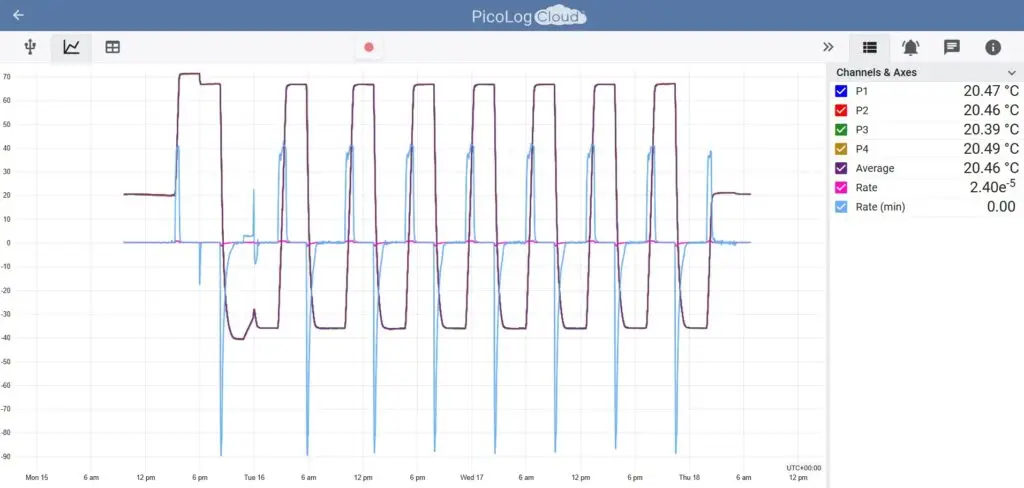
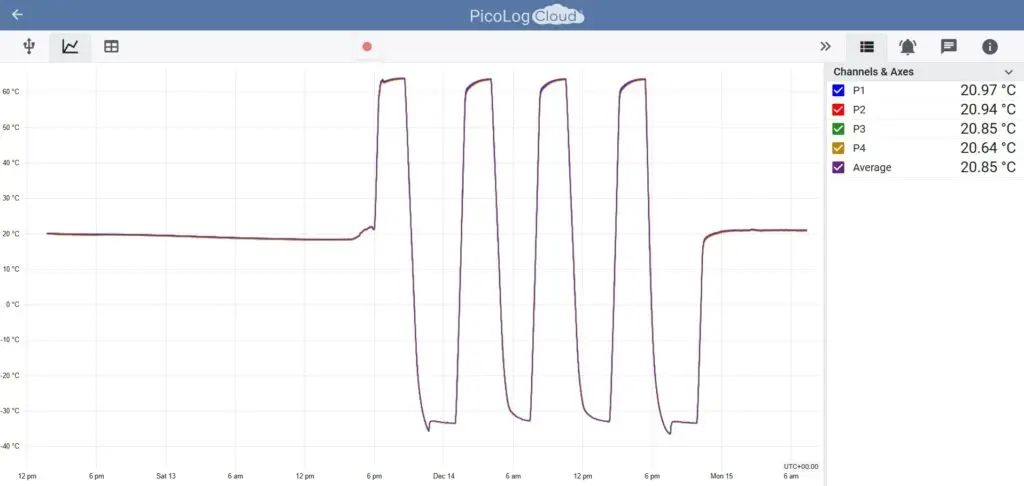
We also go through different test campaigns at qualification & acceptance level with different thermal range & number of cycles. Below are some of test logs from previous OBC-Hyper-Polar TVAC tests.
Test range & number of cycles is client choice. Previously we had Qualification (-40 – +70) & Acceptance levels (-35 – +65) with test logs copied below. For -55 environment, it can be managed with 1 Minco heater on chassis.
TVAC profile- Qualification level
EUT: OBC-Hyper-Polar with peripheral board
TVAC profile- Acceptance level
EUT: OBC-Hyper-Polar with peripheral board
The MPFS460TS is particularly interesting for next-generation onboard computers because it combines substantial FPGA resources with a multi-core RISC-V processor subsystem.
For an OBC architecture, the FPGA fabric can be allocated to deterministic functions such as:
- SpaceWire processing
- sensor interfaces
- payload data handling
- high-speed packet processing
- redundancy management
- hardware acceleration
- real-time control
- FPGA-based FDIR
- custom communications protocols
while the RISC-V subsystem can execute Linux, real-time software, telemetry and telecommand applications, file management, payload control, networking & mission applications. This heterogeneous architecture can reduce the number of discrete processing devices required in the flight computer.
All these technical advantages make MPFS460TS-FC1152M suitable for architectures where a significant amount of the spacecraft computer’s functionality is consolidated into one high-density SoC FPGA. The combination of large FPGA fabric + RISC-V processing + high-speed SerDes + military temperature range makes the MPFS460TS-FC1152M an interesting building block for aerospace computing.
For CAVU Aerospace, the MPFS460TS-FC1152M is particularly relevant to the development of high-performance flight computers where thermal range, processing capability and FPGA flexibility need to coexist in a single architecture. Rather than treating the FPGA simply as a programmable logic component, an SoC FPGA can become the central computing platform of the OBC—combining deterministic hardware processing with software-based mission applications. The −55°C to +125°C military-temperature capability provides an important foundation for demanding aerospace environments, while the MPFS460’s large FPGA fabric and RISC-V processing subsystem provide the computational resources needed for increasingly sophisticated onboard processing.
The important engineering principle, however, is that the component temperature grade is only one part of the flight qualification process. A complete OBC still requires appropriate thermal analysis, component selection, PCB design, environmental testing and, for space missions, a separate assessment of radiation effects. That’s where full product document list including FMEA, CIL, FDIR, Fault Tree Map, Worst Case Analysis, SPF, Reliability Analysis, Mechanical Analysis, Thermal Analysis, Radiation Assessment, PAP, QAP, COC makes difference.