Orbital Servicing, A New Era of Asset Management in Space
- July 26, 2026
- CAVU Aerospace UK
For much of the Space Age, satellites were designed with a simple operational philosophy: launch, operate until the end of their mission, and then accept their loss. They are mostly not designed to be dock with another spacecraft. Regardless of whether a spacecraft had exhausted its fuel, suffered a minor hardware failure or experienced orbital decay, replacement was often considered more practical than repair. Work on Hubble telescope based on Shuttle capabilities was quite extra-ordinary case.
As humanity’s dependence on space infrastructure continues to grow, this philosophy is changing. Modern satellites are no longer viewed as disposable spacecraft but as high-value physical assets that require lifecycle management, maintenance and servicing to maximise their operational lifetime.
Just as aircraft undergo scheduled maintenance, ships receive periodic overhauls and industrial equipment is continuously serviced, spacecraft are now entering an era where asset management extends beyond launch. Rather than replacing a functioning satellite because of a limited subsystem failure or depleted propulsion, operators increasingly seek methods to inspect, repair, reinforce and extend the life of assets already operating in orbit. Orbital servicing is becoming one of the most important technologies enabling a sustainable and economically efficient space industry. NASA mission to rescue Swift telescope & boost the orbit is great example of a new era. Private companies are awarded contracts in scale of $30M to attempt saving few hundred million dollars asset.
Today’s orbital infrastructure supports almost every aspect of modern society. Satellites provide global communications, internet connectivity, navigation and positioning, earth observation, weather forecasting, climate monitoring, scientific research, defence and security, disaster monitoring & many more. Many spacecrafts represent investments of hundreds of millions of dollars, while flagship missions such as the Hubble Space Telescope, the James Webb Space Telescope, and major Earth observation programmes represent multi-billion-dollar national investments. These spacecrafts are often technically healthy when their operational lifetime is threatened by issues such as fuel depletion, orbital decay, mechanical degradation, failed actuators, ageing batteries, damaged appendages & obsolete instruments. Replacing such assets may require a decade of development and another expensive launch campaign. Extending the life of an existing spacecraft by only a few years can therefore provide enormous scientific and financial value.
Orbital Asset Management
Orbital asset management is exactly like asset management practices on the ground. It applies established engineering maintenance principles to spacecraft operating in orbit. Rather than accepting the loss of an asset when problems arise, servicing spacecraft can restore, enhance or protect the satellite throughout its operational life. Typical servicing operations can be orbit maintenance and reboost, refuelling, mechanical repair, structural reinforcement, replacement of modular components, inspection and health assessment, deployment of upgraded payloads, attitude stabilisation, debris inspection, relocation to a new orbit & controlled de-orbiting at end of life. The objective is identical to terrestrial asset management: maximise operational availability while reducing replacement costs.
AI OnBoard Computers to Control Robotic Arms
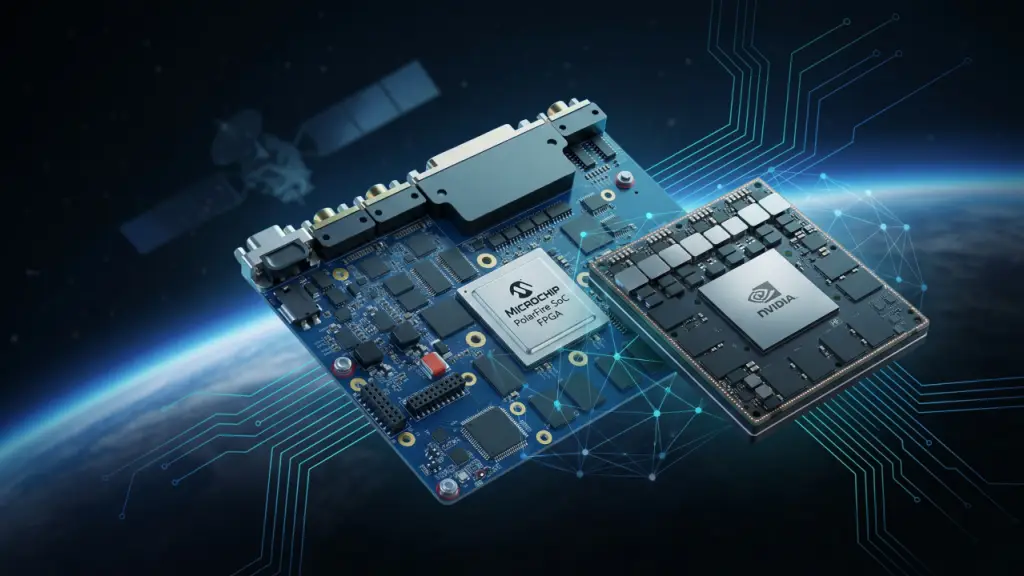
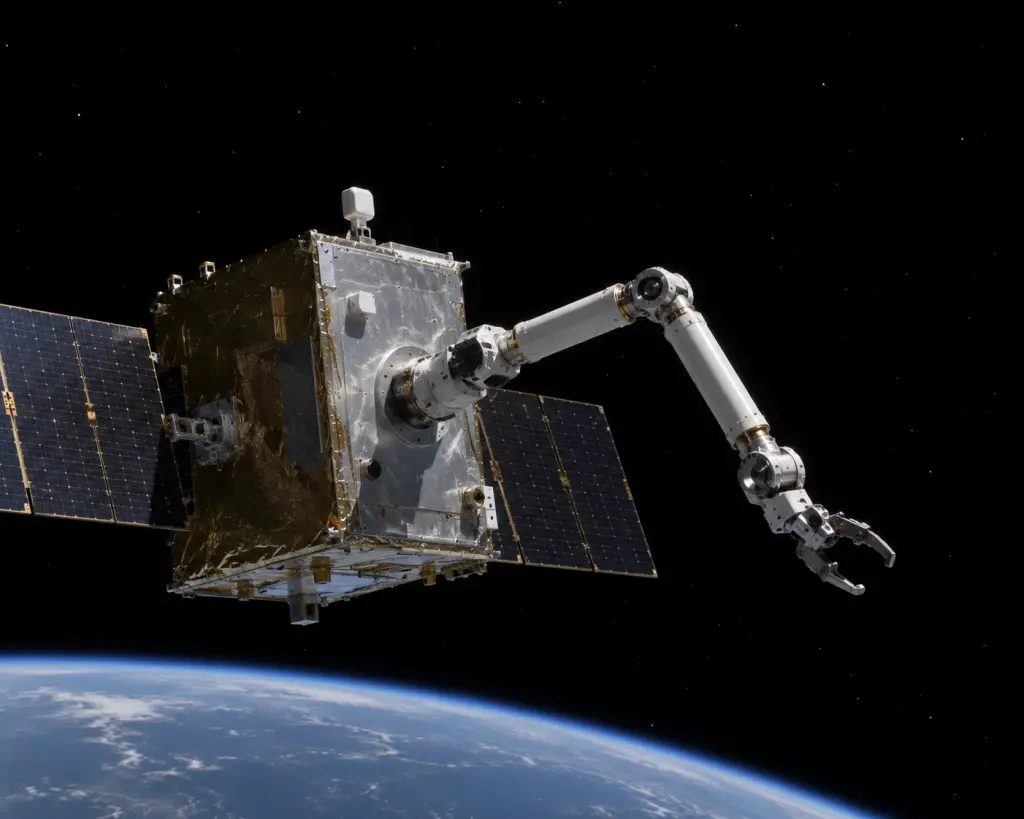
The concept of servicing spacecraft is not new. NASA’s Space Shuttle astronauts successfully serviced the Hubble Space Telescope on five separate missions between 1993 and 2009. Astronauts replaced scientific instruments, installed new batteries, exchanged gyroscopes and repaired electronic systems, extending Hubble’s scientific life by decades. Although enormously successful, crewed servicing missions are expensive and only practical for a limited number of spacecrafts in low Earth orbit. Shuttle arms capabilities were main factor & service spacecrafts should have quite few robotic arms with few degrees of freedom & intelligent capabilities to be able to engage in orbital service operations. AI onboard computers like pair of Microchip PolarFire with NVIDIA Jetson modules has been proved to be an efficient solution for this. The future of orbital maintenance is therefore expected to rely primarily on autonomous robotic servicing spacecraft capable of performing many of the same tasks without requiring astronauts.
A new generation of commercial servicing spacecraft is now being developed specifically to maintain satellites already in orbit. Instead of replacing an ageing satellite, a servicing vehicle can rendezvous with the spacecraft and perform operations such as orbit raising, station keeping, docking, inspection, mechanical manipulation, payload installation, life extension & end-of-life disposal. These vehicles effectively become the maintenance engineers of Earth’s orbital infrastructure.
LINK: Demonstrating the Future of Satellite Maintenance
One of the most important recent demonstrations of orbital servicing is the LINK mission. Rather than replacing NASA’s Neil Gehrels Swift Observatory, LINK demonstrated how a relatively small servicing spacecraft could rendezvous with an operational satellite and restore its orbit after years of atmospheric drag. Swift remained scientifically productive, but its altitude was gradually decreasing due to the residual atmosphere present in low Earth orbit. Instead of allowing the observatory to continue losing altitude until re-entry became inevitable, LINK successfully performed orbit-raising manoeuvres that restored orbital energy and extended the spacecraft’s expected operational lifetime.
Although relatively simple compared with future repair missions, LINK represents an important proof of concept for commercial orbital servicing and demonstrates that maintaining existing spacecraft can often be significantly more economical than replacing them. It’s all about risking $30M to try saving a $500M asset.
How Spacecraft Rendezvous Works
One of the most remarkable aspects of orbital servicing is that spacecraft do not simply fly directly toward one another. Both the servicing vehicle and its target are already travelling around Earth at approximately 7.5 to 7.8 km/s. Instead, engineers carefully manipulate orbital mechanics.
Matching the Orbital Plane- The servicing spacecraft is first launched into an orbit having nearly the same inclination and orbital plane as the target. This minimises the propellant required for rendezvous.
Orbital Phasing- If the servicing spacecraft needs to catch the target, it performs a small manoeuvre into a slightly lower orbit. Although this initially reduces its velocity, the lower orbit has a shorter orbital period. As a result, the servicing spacecraft gradually catches up with the target after several revolutions. If the spacecraft needs to fall behind, it instead enters a slightly higher orbit with a longer orbital period.
Orbit Matching- Once the desired separation has been achieved, another propulsion manoeuvre returns the servicing spacecraft to the same orbit as the target. Both spacecraft now travel together with almost identical velocity and orbital period.
Close-Proximity Operations- Once the distance decreases to a few kilometres, onboard navigation systems guide the servicing spacecraft using GPS (for LEO missions), Star trackers, Inertial navigation, Optical navigation cameras, LiDAR & Relative navigation algorithms. Small thruster firings gradually reduce the remaining separation while continuously maintaining safe approach trajectories.
Robotic Arms: Extending the Capability of Orbital Servicing
Rendezvous is only the first stage of an orbital servicing mission. Once the servicing spacecraft reaches the target, it must physically interact with another vehicle travelling at orbital velocity. This requires highly capable robotic manipulation systems.
Modern servicing spacecraft increasingly employ robotic arms equipped with multiple joints that provide several degrees of freedom. Depending on the complexity of the mission, robotic manipulators may range from simple 3-DoF mechanisms for basic positioning to sophisticated 6- or 7-DoF arms capable of approaching an object from almost any orientation.
A typical robotic servicing arm consists of rotational joints, brushless electric actuators, harmonic drive gearboxes, high-resolution position encoders, force and torque sensors, end-effectors designed for gripping, docking or tool exchange.
These manipulators must operate with exceptional precision because even a small unintended force can disturb the attitude of both spacecraft. Typical servicing tasks are grasping dedicated fixtures, capturing satellites without docking ports, opening access panels, installing replacement modules, connecting electrical or fluid interfaces, deploying reinforcement structures or positioning inspection cameras.
Artificial Intelligence and Onboard Computing
The increasing complexity of orbital servicing is driving a new generation of onboard computing platforms that combine high-performance processors with advanced artificial intelligence algorithms. Unlike traditional spacecraft, servicing vehicles cannot rely entirely on commands from Earth. Communications delays, limited contact windows and the need for rapid decision-making require a high degree of onboard autonomy. Modern AI-enabled flight computers can support robotic servicing by performing visual target recognition, relative pose estimation, autonomous trajectory planning, obstacle detection, collision avoidance, robotic arm motion planning, force-controlled manipulation & fault detection and recovery.
Machine vision algorithms continuously analyse images from multiple cameras to identify the target spacecraft and determine its precise position and orientation. At the same time, AI-based planning software calculates collision-free trajectories for the robotic arm while compensating for uncertainties in the target’s motion. For robotic manipulators with multiple degrees of freedom, onboard computers solve inverse kinematics in real time, determining the joint angles required to move the end-effector smoothly and accurately to its desired position. They can also fuse information from cameras, LiDAR, inertial sensors and joint encoders to maintain precise control throughout the servicing operation.
As onboard processors continue to increase in capability, AI that can be managed by pairing spaceborne computer like Microchip PolarFire FPGA with NVIDIA Jetson modules will enable servicing spacecraft to execute increasingly sophisticated tasks with reduced dependence on ground operators. Rather than issuing individual joint commands, operators may supervise higher-level objectives—such as “inspect this solar array” or “capture the servicing fixture”—while the onboard computer autonomously plans and executes the required arm motions.