
One Heck of 15 Days with Several Docking/ Undocking in Low Earth Orbit, Artemis III, Excitement Guaranteed for Artemis Generation
Credit: NASA
- October 29, 2026
- CAVU Aerospace UK
NASA’s Artemis III mission represents a crucial milestone in humanity’s return to the Moon. Planned for 2027 & will take 14-17 days. The mission has evolved from an anticipated lunar landing into a complex crewed test flight in low Earth orbit, designed to prepare for the first Artemis lunar landing, currently targeted for Artemis IV in 2028.
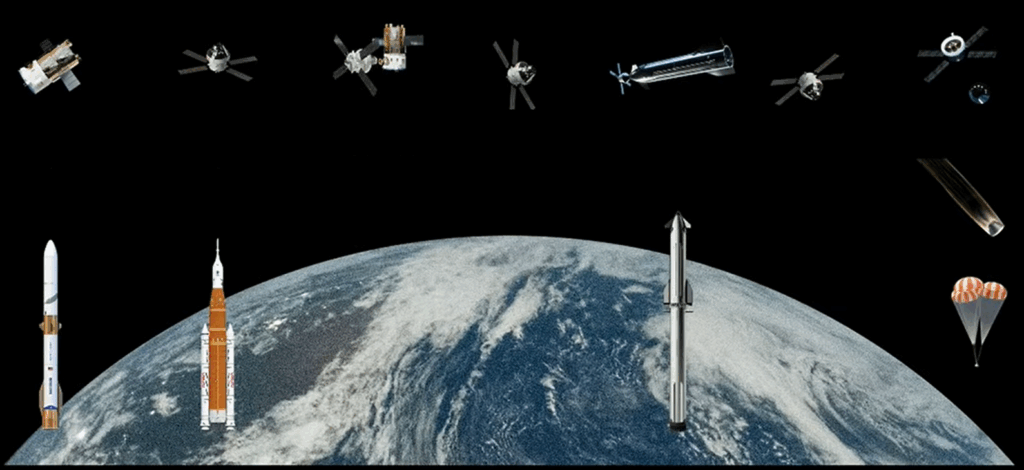
The Mission Profile
Artemis III will launch four astronauts aboard NASA’s Orion spacecraft, powered by the Space Launch System (SLS) rocket. Once in Earth orbit, the crew will conduct a series of demonstrations involving lunar lander test vehicles developed by SpaceX and Blue Origin.
The mission will test rendezvous and docking operations, spacecraft interfaces, communications, flight-control software and integrated systems. Depending on the final mission operations, astronauts will also evaluate the interior environment and life-support capabilities of a lander test vehicle. Orion’s systems, spacesuits and crew operations will undergo further testing before the spacecraft returns to Earth for splashdown in the Pacific Ocean.
By bringing together multiple spacecraft, launch vehicles and commercial partners, Artemis III will allow NASA to validate complex operations in space before attempting a crewed lunar landing.
The significance of Artemis III extends far beyond a single mission. It will help establish the operational foundations for a new era of sustained lunar exploration.
- Making lunar landings safer: Testing critical systems in Earth orbit will help identify technical challenges before astronauts undertake the more demanding journey to the lunar surface.
- Building a sustainable presence on the Moon: The experience gained will support future missions targeting the lunar South Pole, where NASA aims to develop a lasting human presence.
- Advancing commercial spaceflight: The mission will demonstrate how government spacecraft and commercially developed lunar landers can operate together.
- Preparing for Mars: Autonomous systems, reliable spacecraft operations, advanced life support and crew independence will all contribute to the capabilities needed for future human exploration of Mars.
Artemis III is therefore not simply a stepping stone to the next lunar landing. It is part of the process of turning ambitious exploration goals into repeatable, operational capabilities.
The Artemis generation will inherit a space programme built not only around reaching the Moon, but around learning how to work there, explore farther and eventually send humans to Mars. Each successful demonstration brings that future closer.