New Athena to expand Humanity Knowledge on Deep Space
- June 22, 2026
- CAVU Aerospace UK
ESA’s Next-Generation X-ray Observatory Poised to Transform Our Understanding of the Hot and Energetic Universe
NewAthena (New Advanced Telescope for High-ENergy Astrophysics) represents one of the most ambitious space science missions in development today. Led by the European Space Agency as a flagship Large-class mission within the Cosmic Vision programme, it is designed to be the largest and most powerful X-ray observatory ever built. Building on the original Athena concept selected in 2014, the mission was rescoped in 2023 to balance scientific excellence with cost constraints while retaining ground-breaking capabilities.
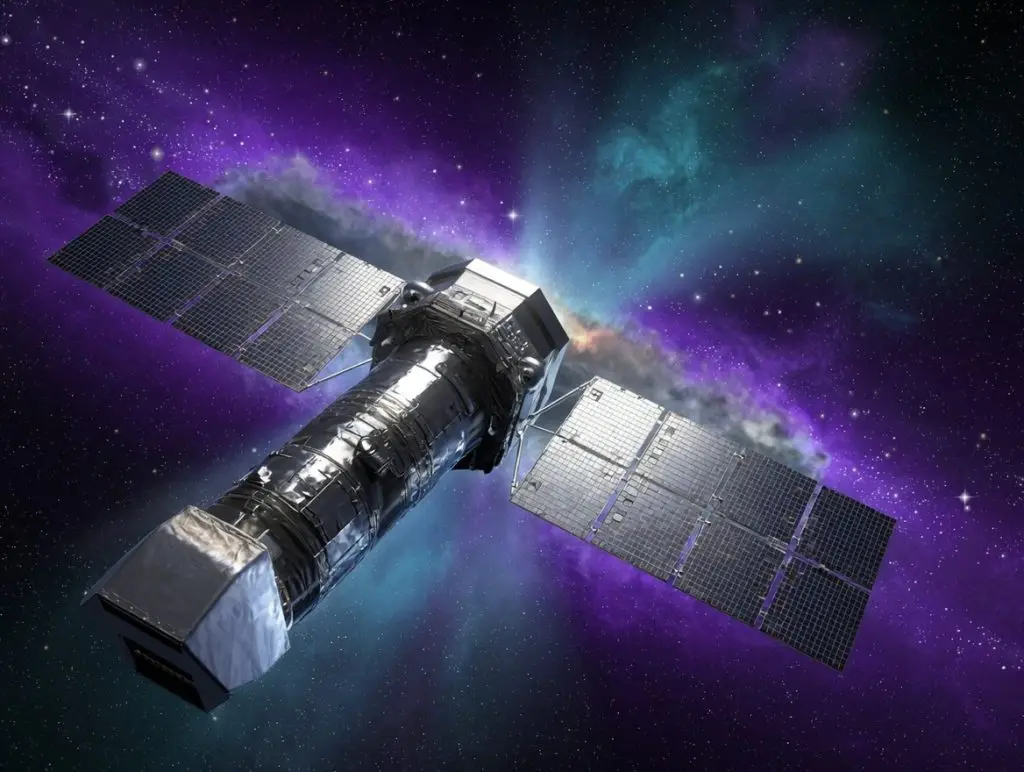
The spacecraft features a sophisticated modular design, including an Optical Module with an advanced Mirror Assembly, a Service Module with solar arrays, telescope components, and a Payload Compartment housing cutting-edge instruments. This architecture allows for precise X-ray observations of the universe’s most extreme phenomena.
NewAthena’s primary scientific objective is to explore the “Hot and Energetic Universe” — the physics of plasmas at temperatures of millions of degrees and the violent processes that release vast amounts of energy. Key goals include:
- Understanding the formation and evolution of large-scale cosmic structures: By mapping hot gas in galaxy clusters and filaments, NewAthena will reveal how the universe’s largest structures formed and evolved over cosmic time.
- Studying black holes and compact objects: It will observe accretion processes around supermassive black holes, stellar-mass black holes, and neutron stars, providing insights into how they grow and influence their surroundings.
- Probing supernova remnants and stellar explosions: High-resolution spectroscopy will detail the chemical enrichment of the interstellar medium and the life cycles of stars.
- Investigating high-energy transients: Observations of gamma-ray bursts, tidal disruption events, and other explosive phenomena will help decode extreme physics.
- Broader astrophysics: The observatory will support research on exoplanet atmospheres, white dwarfs, the interstellar medium, and many other topics through open time allocation.
NewAthena combines an unprecedentedly large collecting area, high angular resolution (around 9 arcsec), wide-field imaging, and revolutionary high-resolution spectroscopy. Its performance is expected to exceed current X-ray missions (such as Chandra and XMM-Newton) by factors of 10 to 50 in key metrics like survey speed and sensitivity.
- Selection and Redesign: Originally selected in 2014 as Athena. A major design-to-cost exercise led to the “NewAthena” approval in November 2023.
- Industrial Phase: Restarted in 2024.
- Adoption: Targeted for 2027.
- Launch: Planned for the late 2030s (current baseline around 2034–2037 timeframe) aboard an Ariane 6 rocket.
- Orbit: Sun-Earth L1 Lagrange point, approximately 1.5 million km from Earth, for stable operations with minimal interference.
The mission will operate for a nominal 4–5 years, with potential for extensions. International collaboration includes significant contributions from NASA and JAXA.
NewAthena Spacecraft: Key Components and Architecture
NewAthena architecture follows a classic space telescope layout with three primary sections: the Optical Module, the Service Module, and the Payload Compartment. The overall design features a 12-metre focal length for the X-ray telescope, enabling high sensitivity and resolution.

Optical Module located at the base of the spacecraft, the Optical Module houses the heart of the observatory: the Mirror Assembly Module (MAM). It uses innovative Silicon Pore Optics (SPO) technology — lightweight, modular mirrors made from silicon wafers that efficiently focus X-rays through grazing-incidence reflection.
This module provides the largest X-ray collecting area ever developed for a space mission, with an angular resolution of approximately 9 arcseconds. The design includes thermal baffles, stray-light protection, and precise alignment mechanisms to maintain optical performance in the harsh space environment. The modular SPO approach allows for mass production while keeping the mirror assembly relatively lightweight.
Service Module forms the central “bus” of the spacecraft, providing essential support functions for the entire mission. It contains:
- Power systems, including large solar arrays for electricity generation.
- Propulsion and attitude control systems (thrusters and reaction wheels).
- Thermal control subsystems (radiators, heaters, and multi-layer insulation) to manage temperatures at the Sun-Earth L1 point.
- Onboard computers, communications antennas, and data handling systems.
- Structural support for the telescope’s middle section (FMS — Focal Mechanism Structure or similar telescope framework).
The SVM also integrates the middle part of the telescope assembly and ensures overall spacecraft stability, power balance, and thermal management for the sensitive instruments.
Payload Compartment / Science Instruments
At the top of the spacecraft sits the Payload Compartment, which houses the two advanced scientific instruments positioned at the telescope’s focal plane:
- Wide Field Imager (WFI): A high-count-rate camera using DEPFET silicon sensors. It offers wide-field imaging (up to 40 arcmin) and moderate-resolution spectroscopy, ideal for surveying large sky areas and studying bright sources.
- X-ray Integral Field Unit (X-IFU): A cryogenic spectrometer with transition-edge sensors cooled to below 100 mK. It delivers high-spectral resolution (around 2.5–3.5 eV) for detailed studies of plasma temperatures, velocities, and chemical composition.
A movable mirror assembly allows switching between the two instruments. The Payload Compartment also includes supporting electronics, calibration sources, and shielding to minimize background noise.
NewAthena’s modular structure, with defined separation lines between the Optical Module, Service Module, and upper sections, facilitates assembly, testing, and potential future servicing concepts. Operating from the stable L1 halo orbit, this architecture enables the mission to achieve unprecedented sensitivity — up to 10–50 times better than previous X-ray observatories like XMM-Newton or Chandra.
This sophisticated breakdown allows NewAthena to tackle fundamental questions about black holes, galaxy clusters, and the cosmic web, pushing the frontiers of high-energy astrophysics.
Thermal Control Challenges at L1 and Management Solutions
Operating at the Sun-Earth L1 point presents unique thermal control challenges due to the spacecraft’s near-constant exposure to intense solar radiation. Unlike low Earth orbit missions that experience regular day-night cycles and eclipses, L1 provides a relatively stable but demanding thermal environment with continuous solar flux (approximately 1366 W/m²), minimal planetary albedo or infrared back-radiation from Earth, and a cold deep-space sink at ~2.7 K.
- High solar heat input: The spacecraft faces unrelenting solar heating on sunward surfaces, which can cause significant temperature gradients across the structure. Sensitive X-ray optics (like the Silicon Pore Optics mirror assembly) and instruments require extreme thermal stability to maintain alignment and performance.
- Cryogenic instrument demands: The X-ray Integral Field Unit (X-IFU) uses transition-edge sensors cooled to below 100 mK. Maintaining such ultra-low temperatures while rejecting heat from electronics and preventing parasitic heat leaks in a solar-heated environment is exceptionally difficult.
- Large structure and modularity: The tall, modular design with extended solar arrays and telescope focal length introduces complex thermo-elastic distortions. Differential heating could misalign the 12-meter focal length optics.
- Power and dissipation balance: High-power instruments and electronics generate internal heat that must be managed alongside external loads, while avoiding overheating of components or excessive cooling in shadowed areas.
Thermal Management Solutions: NewAthena employs a sophisticated Thermal Control System (TCS) combining passive and active techniques, standard for high-energy astrophysics missions but tailored to L1 conditions:
- Multi-Layer Insulation (MLI): Extensive use of MLI blankets on most external surfaces to minimize solar absorption and reduce radiative heat exchange with space. Gold or aluminized layers provide high reflectivity.
- Radiators and heat rejection: Dedicated optical solar reflectors (OSRs) and radiator panels, strategically placed on cooler faces (away from direct Sun or with low view factors), efficiently reject excess heat via thermal radiation to deep space.
- Thermal coatings and surface treatments: High-emissivity/low-absorptivity coatings on radiators and selective surfaces on the mirror assembly to control heat absorption and emission.
- Active heating: Electric heaters and thermostats maintain minimum temperatures during colder attitudes or commissioning phases, ensuring no components drop below survival limits.
- Heat pipes and conductive straps: For efficient internal heat transport from hot spots (e.g., electronics) to radiators.
- Cryogenic chain for instruments: Multi-stage mechanical coolers (including pulse-tube or Stirling coolers) combined with an Adiabatic Demagnetization Refrigerator (ADR) for the X-IFU, isolated by thermal shields and low-conductivity supports.
- Structural thermal design: The modular architecture (with separation lines) allows independent thermal zones, minimizing propagation of distortions. Finite-element thermal modeling ensures stability across mission phases.
These solutions ensure all subsystems remain within narrow operational temperature ranges (typically -20°C to +50°C for electronics, with much tighter tolerances for optics and detectors), balancing mass, power, and reliability constraints.
Helping Expand Human Knowledge of Deep Space
X-rays are invisible to optical telescopes and blocked by Earth’s atmosphere, making space-based observatories essential. NewAthena will open a new window into the “invisible” violent universe:
- Revealing hidden matter: Most normal (baryonic) matter in the universe exists as hot, diffuse gas detectable primarily in X-rays. NewAthena will map this cosmic web, helping solve mysteries about dark matter and dark energy’s influence on structure formation.
- Testing fundamental physics: Observations of black hole environments and neutron star mergers will test general relativity and nuclear physics under extreme conditions.
- Multi-messenger astronomy: By coordinating with gravitational wave detectors (like LIGO/Virgo), optical telescopes (like the ELT), and other observatories, NewAthena will provide comprehensive views of cosmic events.
- Inspiring future exploration: Data from NewAthena will inform the design of even more advanced missions and deepen our understanding of planetary system formation, potentially aiding the search for habitable worlds.
By dramatically expanding our view of high-energy processes, NewAthena will contribute fundamental knowledge that shapes cosmology, astrophysics, and even philosophical questions about humanity’s place in the cosmos. Its discoveries could redefine textbooks on how galaxies, stars, and black holes evolve.