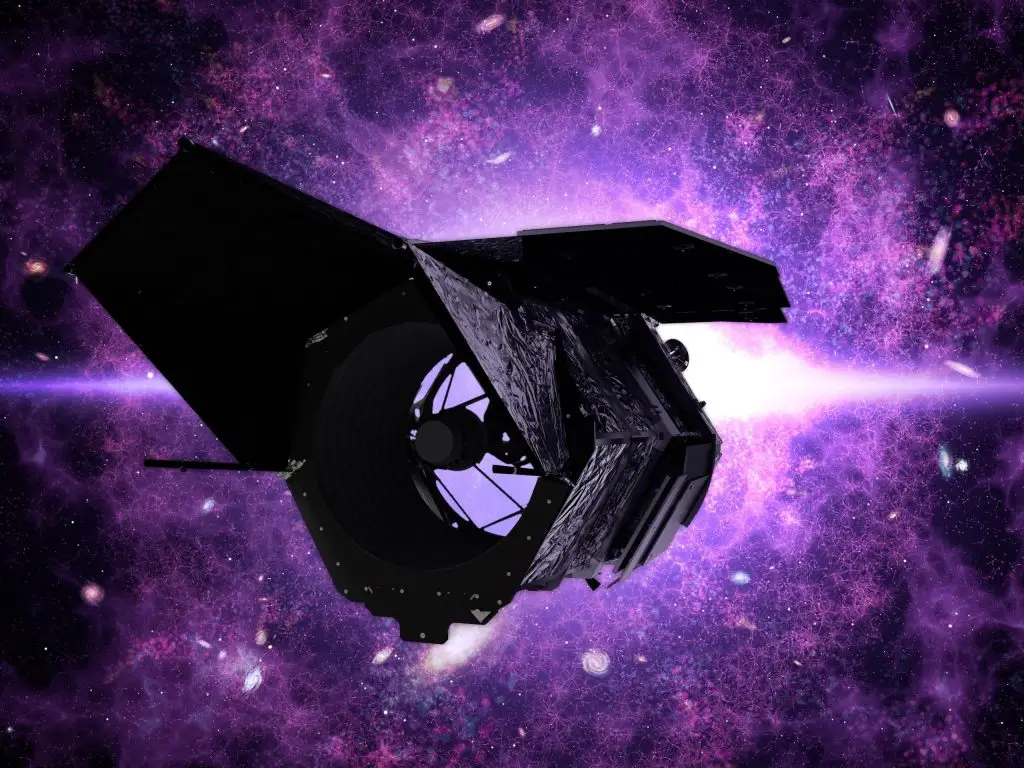
Nancy Grace Roman Space Telescope: 0.281 deg field of view & 300 Mega Pixel camera to expand our understanding of Deep Space & Dark Energy
Credit: NASA
- August 23, 2026
- CAVU Aerospace UK
Aug 2026 is a remarkable time for astronomers & human civilization. The NASA Nancy Grace Roman Space Telescope is designed to complement the Hubble Space Telescope by combining Hubble-like infrared sharpness with an extraordinarily larger field of view and is launched from Falcon Heave in Aug 2026. Its most striking capability is expected to be its ability to observe an area of sky roughly 200 times larger than Hubble’s infrared camera in a single pointing—allowing astronomers to move from studying individual cosmic objects to surveying enormous populations of galaxies, stars, and planets.
The Nancy Grace Roman Space Telescope is expected to transform astronomy by combining the sharpness associated with the Hubble Space Telescope with the survey power of an extraordinarily wide-field infrared camera. Rather than simply taking a more detailed picture of a single galaxy or nebula, Roman is designed to capture vast cosmic landscapes containing millions or even billions of objects.
At the heart of this capability is Roman’s Wide Field Instrument. With a field of view of approximately 0.281 square degrees, the WFI can observe about 200 times the area of Hubble’s WFC3/IR infrared camera in a single exposure, while maintaining comparable infrared spatial resolution. This difference represents one of the most important changes in astronomical observing capability: Hubble can examine the universe in extraordinary detail, while Roman can examine enormous populations of objects at similar detail.
Roman and Hubble have something remarkable in common: both telescopes use a 2.4-meter primary mirror. However, Roman’s modern optical design and enormous focal-plane array allow it to capture a dramatically larger region of the sky in every observation.
The Roman Wide Field Instrument contains 18 infrared detectors, each with 4,096 × 4,096 pixels, producing an imaging system with more than 300 million active pixels. Its plate scale of approximately 0.11 arcseconds per pixel is comparable to Hubble’s infrared imaging capability.
This enormous field of view changes the type of science astronomers can perform. Hubble has produced some of humanity’s most iconic images by concentrating on individual galaxies, nebulae, galaxy clusters, and tiny regions of the deep universe. Roman will extend this approach by creating large-scale, high-resolution maps of the cosmos. Imagine looking at a single neighbourhood with an extremely powerful camera. Hubble can reveal remarkable detail inside that neighbourhood. Roman, however, can photograph the entire city at similar infrared resolution. This is particularly important because many of astronomy’s biggest questions cannot be answered by studying only a few objects. Scientists need to observe millions or billions of galaxies to understand how the universe evolved statistically across cosmic time.
Roman is expected to observe more than a billion galaxies, creating one of the largest astronomical datasets ever collected from space.
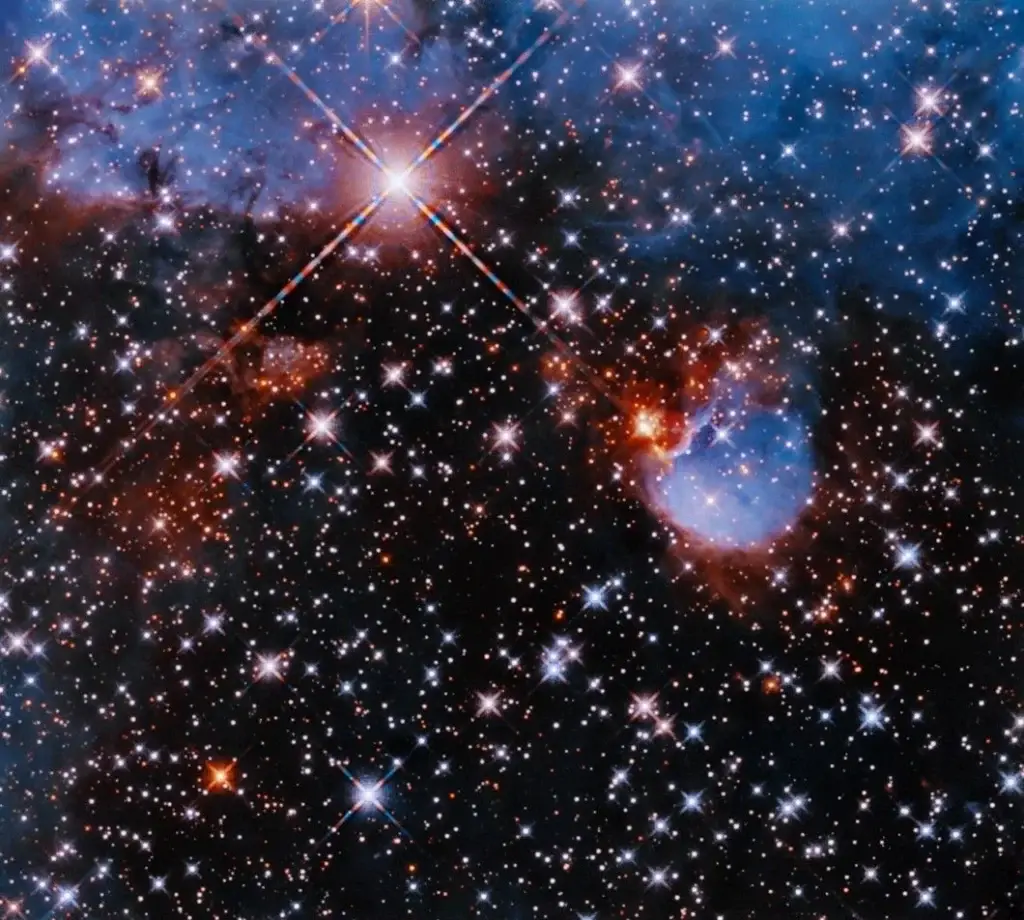
Mapping Dark Matter Across the Universe
One of Roman’s most important objectives will be to investigate the invisible structure of the universe.
Ordinary matter—the stars, planets, gas and galaxies we can see—represents only a small fraction of the universe’s total contents. Dark matter cannot be observed directly, but its gravity affects the paths of light travelling through space. Roman will exploit this effect through weak gravitational lensing. When light from distant galaxies passes through regions containing dark matter, gravity slightly distorts the observed shapes of those galaxies. The distortion of any individual galaxy is extremely small, but when astronomers measure millions of galaxies, the combined signal can reveal the distribution of invisible matter.
NASA estimates that Roman’s survey will observe more than one billion galaxies, with approximately 600 million galaxies detailed enough for weak-lensing measurements. This will allow astronomers to trace how cosmic structure has grown in three dimensions across much of the history of the universe. This is where Roman’s 200× field of view becomes particularly powerful. A narrow-field telescope can study gravitational lensing in selected regions. Roman can perform the same type of high-resolution observation across vast areas of the sky, producing a much more complete picture of the cosmic web.
Perhaps the biggest scientific question Roman will address is Why is the expansion of the universe accelerating? The discovery of cosmic acceleration, which helped establish the concept of dark energy, was based partly on observations of distant Type Ia supernovae. Roman will dramatically increase the scale of this research.
Roman’s wide-field surveys are expected to gather spectra from approximately 20 million galaxies, while its imaging surveys will observe vastly larger populations. By combining these independent measurements, astronomers will be able to test whether cosmic acceleration is truly caused by dark energy or whether our understanding of gravity itself may need modification on the largest scales. NASA expects Roman’s galaxy observations to enable measurements of the effects of dark energy with dramatically improved precision, while also providing an independent way to study the evolution of the universe.
Looking Further Back Into Cosmic History
Roman’s Wide Field Instrument will operate from approximately 0.5 to 2.3 microns, allowing it to observe deep into the infrared. This is crucial for studying the distant universe. Human is living on this planet only for 300,000 years & building instruments to look back to 4.6 billion years history of life & maybe 13.8 billion years ago since big bang. We are about to expand our understanding on universe & answer fundamental questions humanity always carry.
As the universe expands, light from distant galaxies is stretched toward longer wavelengths—a phenomenon known as cosmological redshift. Light that originally left a young galaxy in the ultraviolet or visible spectrum may arrive at Earth in infrared wavelengths. Roman will therefore be able to survey large populations of distant galaxies, including objects from periods when the universe was only about half a billion years old, roughly 4% of its present age. Instead of identifying a handful of exceptionally distant galaxies, Roman can investigate how entire populations of galaxies developed across cosmic time.
This will help astronomers address questions such as:
- When did the first large galaxies begin to form?
- How quickly did galaxies grow?
- How did star formation change over billions of years?
- How are galaxies connected to dark matter halos?
- How did the largest structures in the universe evolve?
The Nancy Grace Roman Space Telescope represents a fundamental shift in the scale of astronomical observation. Its 0.281 square-degree field of view, 300+ megapixel infrared camera, ~200× larger view than Hubble’s WFC3/IR, and ability to survey the sky up to 1,000 times faster than Hubble will allow astronomers to collect the enormous datasets required to study the universe statistically as well as individually.
Roman will not simply show astronomers more of the universe. It will allow them to understand the universe in a different way. By observing billions of galaxies, mapping the influence of dark matter, investigating the nature of dark energy, monitoring hundreds of millions of stars for planetary systems, and repeatedly imaging large regions of the sky to discover changing and transient events, Roman will create an unprecedented dynamic map of the cosmos.
Hubble taught humanity how much could be discovered by looking deeper. Roman will show what happens when we look deeper—and vastly wider—at the same time.
By the way, the telescope is named after Nancy Grace Roman, the NASA scientist often regarded as the “Mother of Hubble” for her pioneering role in advocating for and helping develop the concept of a large space telescope. Naming this mission after her is a fitting tribute to the people whose vision, determination, and hard work have delivered extraordinary achievements for humanity. Nancy Grace Roman played a crucial role in turning the idea of a space-based observatory into reality, helping pave the way for what eventually became the Hubble Space Telescope. Her name carries a powerful message:
Visionary ideas and hard work may take years to bear fruit, but their impact can ultimately change humanity’s understanding of the world—and the universe.