Mars' Moons: Tiny Companions with Big Scientific Importance
Credit: NASA, JPL- CalTech
- July 30, 2026
- CAVU Aerospace UK
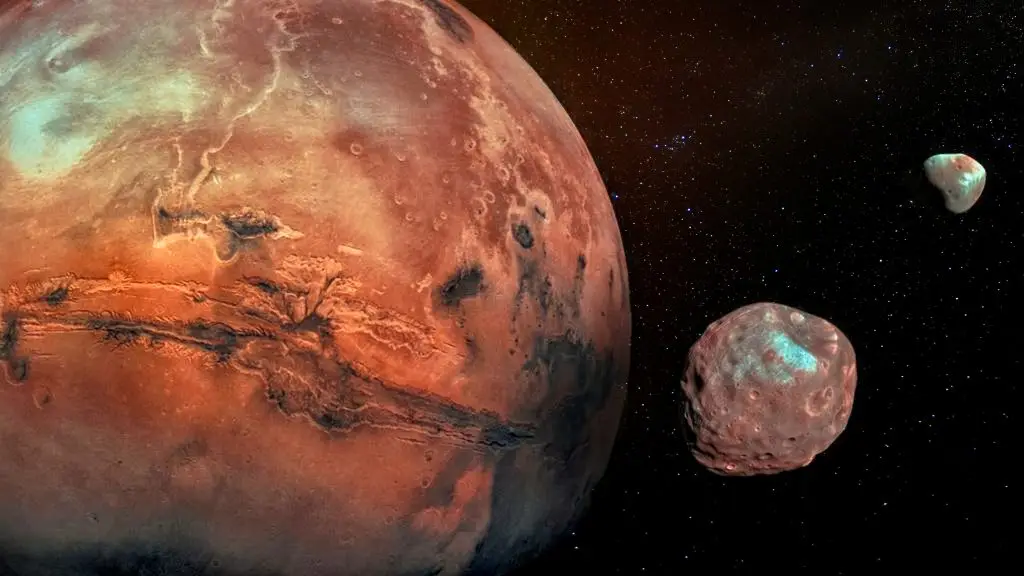
Mars is accompanied by two small natural satellites—Phobos and Deimos. Although they are tiny compared with Earth’s Moon, these mysterious bodies have become important scientific targets because they may preserve clues about the formation and evolution of the Martian system and the early Solar System. Their unusual shapes and dark, asteroid-like appearance have led scientists to debate whether they were captured asteroids or formed from debris created by a massive impact on Mars billions of years ago.
Perseverance along with other JPL’s instruments dropped or orbiting around the Mars are unlocking mysteries to help pave the way for making a second home for human civilization & start multiplanetary life!
Phobos– Phobos is the larger and closer of Mars’ two moons.
- Mean diameter: approximately 22.5 km
- Average orbital altitude: about 6,000 km above the Martian surface
- Orbital period: 7 hours 39 minutes
- Travels so quickly that it rises in the west and sets in the east.
- It is gradually spiralling inward toward Mars and is expected to either break apart into a ring or collide with the planet tens of millions of years from now.
Deimos– Deimos is the smaller and more distant Martian moon.
- Dimensions: approximately 15 × 12 × 11 km
- Orbital period: about 30.3 hours
- Orbits nearly 23,500 km from Mars’ surface
- Appears much smaller in the Martian sky than Phobos and moves slowly across it.
Unlike Phobos, Deimos is slowly drifting away from Mars. Its smoother appearance is caused by a thick layer of fine dust that partially fills many of its craters.
Perseverance Captures Deimos Before Sunrise
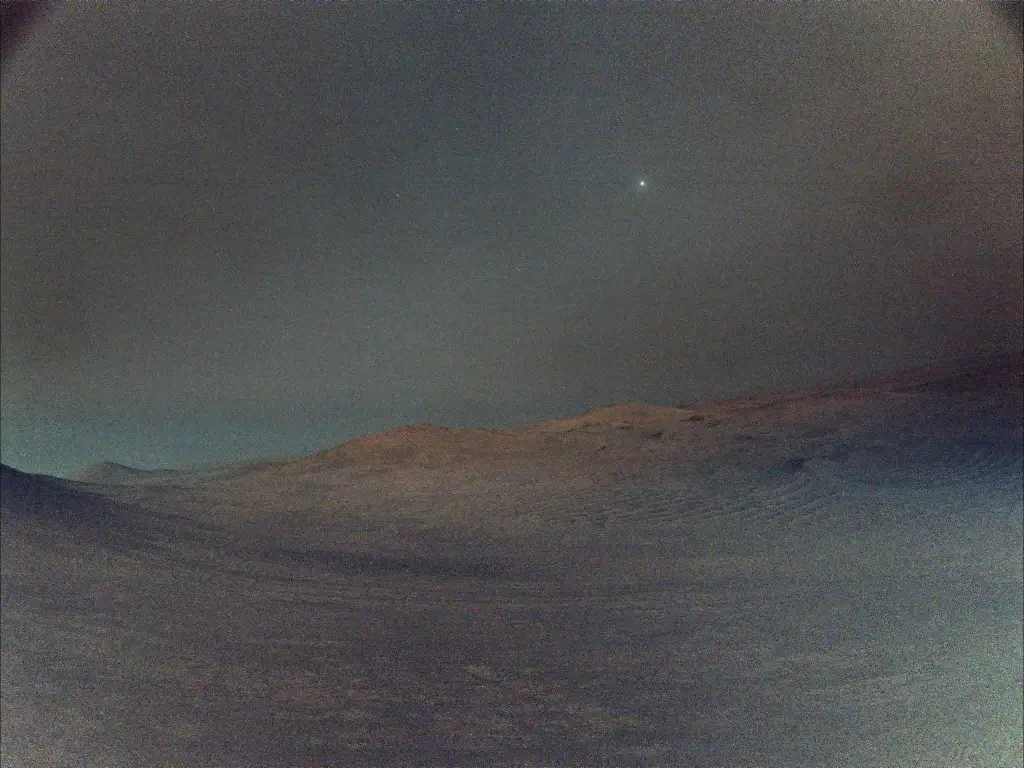
In one of the rover’s most striking astronomical observations, NASA’s Perseverance rover photographed Deimos shining above the horizon before dawn inside Jezero Crater.
The image was captured on 1 March 2025 (Sol 1433) using the rover’s Left Navigation Camera (Navcam). Because Deimos is extremely faint, the camera collected 16 separate exposures of 3.28 seconds each, combining them onboard into a single image with a total exposure of approximately 52 seconds.
The resulting photograph shows Deimos as a bright point of light suspended above the Martian landscape. Two additional bright objects visible in the sky are the stars Regulus and Algieba in the constellation Leo. Some of the white specks are caused by cosmic rays and digital noise generated during the long exposure.
Rather than revealing surface details of Deimos, the image demonstrates the remarkable sensitivity of Perseverance’s navigation cameras and provides scientists with valuable observations for refining the moon’s orbit and understanding the Martian sky from the planet’s surface.
Monitoring Phobos and Deimos from the surface of Mars provides valuable scientific data that complements observations made by orbiters. These measurements help scientists improve orbital models of both moons, better understand their origin and long-term evolution, refine models of Mars’ gravitational field & support planning for future robotic and human exploration missions.