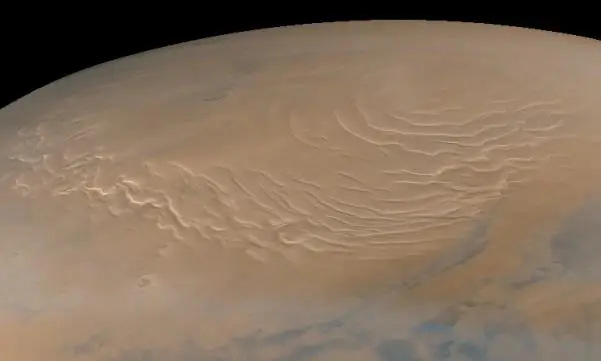
Mars Flyby Images with Multispectral Imager with resolution 1.14 kilometers per pixel
Credit: NASA-JPL, Arizona State University
- June 10, 2026
- CAVU Aerospace UK
In May 2026, NASA released a remarkable series of images of Mars captured during the Psyche spacecraft’s gravity-assist flyby. Among them were dramatic views of the Martian crescent, the south polar ice cap, and the massive Huygens Crater. These images were produced by one of the mission’s most important scientific instruments: the Psyche Multispectral Imager.
The instrument is not just an ordinary camera. It is a sophisticated scientific imaging system designed to study the composition, geology, and history of asteroid 16 Psyche — a mysterious metal-rich world orbiting between Mars and Jupiter.
The Psyche Multispectral Imager is a dual-camera scientific imaging system developed primarily by researchers at Arizona State University in collaboration with NASA Jet Propulsion Laboratory.
Its main purpose is to:
- map the surface of asteroid Psyche,
- identify minerals and metals,
- analyze crater structures,
- study geological processes,
- and help determine whether Psyche is truly the exposed core of an ancient protoplanet.
The instrument consists of two identical cameras:
- Imager A
- Imager B
These provide redundancy for reliability during the long deep-space mission. NASA confirmed that many of the famous Mars flyby images — including the crescent Mars and Huygens Crater scenes — were captured using Imager A.
Unlike a standard digital camera, the Psyche imager captures light in multiple wavelengths, including:
- visible light,
- near-infrared wavelengths,
- broadband panchromatic imaging,
- and filtered spectral bands.
This allows scientists to identify:
- metallic regions,
- silicate minerals,
- dust deposits,
- and possible chemical differences across planetary surfaces.
The system can also create:
- natural-color images,
- enhanced-color scientific images,
- and detailed geological maps.
For the Mars flyby, the imager captured thousands of observations to help engineers calibrate the cameras before arrival at asteroid Psyche in 2029.
Jim Bell, the instrument lead at Arizona State University, explained that the Mars dataset provides “unique and important opportunities” to test image-processing tools and characterize camera performance before asteroid operations begin.
On May 15, 2026, the Psyche spacecraft passed within about 2,864 miles (4,609 km) of Mars. The flyby was designed to use Mars’ gravity to accelerate the spacecraft toward the asteroid belt without consuming large amounts of propellant.
During the encounter, the multispectral imager recorded:
- crescent views of Mars,
- atmospheric haze scattering sunlight,
- polar ice formations,
- ancient crater systems,
- and rugged southern highlands.
One of the most famous images showed Mars as a glowing crescent suspended in darkness. NASA explained that the unusually bright edge of the crescent occurred because sunlight scattered through dust particles in the Martian atmosphere. Since the spacecraft approached Mars from a high phase angle, the planet appeared similar to a crescent Moon seen from Earth.
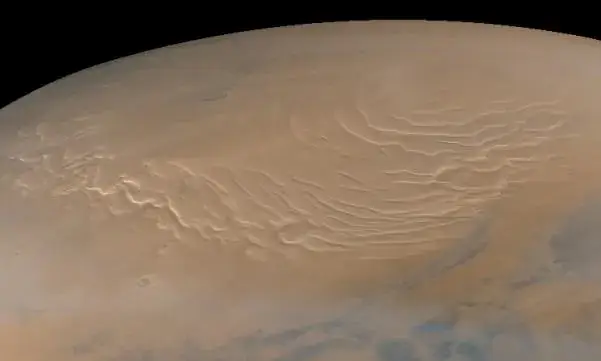
One of the most scientifically valuable images captured by the instrument was the detailed view of Mars’ south polar region — similar to the image you uploaded earlier.
The image revealed:
- bright frozen ice deposits,
- layered terrain,
- erosion troughs,
- cratered landscapes,
- and seasonal polar structures.
NASA reported the image resolution at roughly 1.14 kilometers per pixel, making it one of the sharpest polar views obtained during the flyby trajectory.
Scientists believe the dark streaks and curved patterns around the polar cap are linked to:
- sublimation of carbon-dioxide ice,
- wind erosion,
- and seasonal climate cycles on Mars.