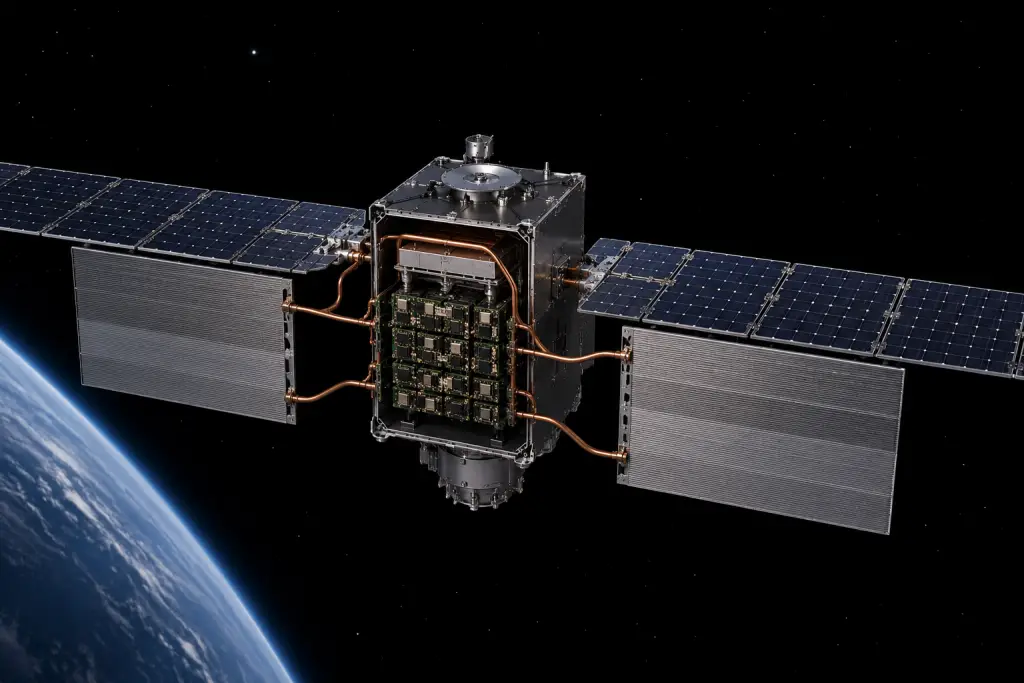
Managing NVIDIA-Based Onboard Computing with Radiative Cooling and Intelligent Thermal Control
- June 26, 2026
- CAVU Aerospace UK
The rapid adoption of AI in space is driving an unprecedented increase in onboard computing power. Modern Earth observation, autonomous navigation, edge processing, and ISR missions increasingly rely on accelerated computing platforms such as NVIDIA Jetson and NVIDIA Space Computing modules to process data directly in orbit rather than transmitting raw information to the ground.
However, higher computing performance creates a significant thermal challenge. Unlike terrestrial data centers where fans and liquid cooling systems reject heat through convection, spacecraft operate in a vacuum where convection is impossible. The only method of rejecting heat to space is thermal radiation.
As AI satellites evolve toward architectures similar to the proposed SpaceX AI satellite concepts, thermal management becomes one of the primary design constraints.
High-performance AI processors convert most electrical power directly into heat.
Typical power levels include:
Device | Typical Power |
NVIDIA Jetson Orin NX | 10–40 W |
NVIDIA Jetson AGX Orin | 15–75 W |
Multi-module AI payload | 100–500+ W |
Future AI Processing Cluster | >1 kW |
Nearly all consumed electrical energy eventually becomes thermal energy that must be removed from the electronics.
For a spacecraft carrying multiple NVIDIA AI modules, thermal rejection may become one of the largest subsystem requirements after power generation.
In orbit there is:
- No air
- No convection
- Negligible conductive heat transfer to the environment
Heat rejection occurs only through electromagnetic radiation.
The governing equation is the Stefan-Boltzmann law:
Q=εσAT4Q = \varepsilon \sigma A T^4Q=εσAT4
Where:
- Q = radiated power (W)
- ε = emissivity
- σ = Stefan-Boltzmann constant
- A = radiator area
- T = absolute temperature (K)
This fourth-power relationship means radiator performance increases dramatically as operating temperature rises.
While SpaceX has not publicly released complete thermal specifications for future AI-enabled satellites, discussions surrounding orbital AI computing consistently identify thermal rejection as one of the dominant engineering challenges.
Industry estimates suggest spacecraft radiators typically reject:
100–350 W/m²
depending on temperature, coating properties, orientation, and orbital environment.
Using this range:
Waste Heat | Required Radiator Area |
100 W | 0.3 – 1.0 m² |
500 W | 1.5 – 5.0 m² |
1 kW | 3 – 10 m² |
5 kW | 15 – 50 m² |
As onboard AI capability scales upward, radiator size rapidly becomes a spacecraft-driving parameter.
Thermal Architecture for NVIDIA-Based Space Computers
A practical thermal-control architecture consists of four stages:
Heat Generation
NVIDIA modules generate concentrated heat at:
- GPU dies
- Memory packages
- Power regulators
- High-speed interfaces
Local junction temperatures may exceed 80°C without adequate cooling.
Heat Collection
Heat is transferred from processors through:
- Cold plates
- Vapor chambers
- Heat spreaders
- Embedded heat pipes
Heat pipes remain among the most efficient passive thermal transport technologies used in modern spacecraft.
Heat Transport
For high-power AI payloads, pumped fluid loops may distribute thermal loads across spacecraft structures.
Advantages:
- Uniform temperature distribution
- Reduced hot spots
- Smaller localized radiator panels
- Scalability for future compute upgrades
Radiative Heat Rejection
Heat is ultimately transferred to external radiators.
Key radiator characteristics include:
- High emissivity coatings
- Low solar absorptivity
- Large view factor to deep space
- Minimal shadowing
Radiators are the final heat sink of the spacecraft thermal-control system.
The thermal environment of a spacecraft changes continuously:
- Eclipse transitions
- Solar beta angle variations
- AI workload fluctuations
- Battery charging cycles
- Payload operation schedules
A fixed thermal design is rarely optimal.
Research into variable-emissivity radiators demonstrates that actively managed thermal systems can significantly increase heat-rejection flexibility while reducing heater power consumption.
This creates demand for a dedicated spacecraft Thermal Control Unit (TCU).
Intelligent Thermal Management for Next-Generation AI Satellites
The CAVU Aerospace Thermal Control Unit is designed as the central intelligence layer of the spacecraft thermal-management system.
Core Functions
The TCU continuously acquires temperature data from:
- NVIDIA AI modules
- FPGA processing boards
- Battery packs
- Power electronics
- Payload instruments
- Propulsion components
- Radiator panels
- Coolant loops
The system then performs real-time thermal regulation.
Heater Control
The TCU drives spacecraft heaters to maintain:
- Survival temperatures
- Battery operating limits
- Instrument thermal stability
- Cold-start readiness
Maintaining proper temperature is just as important as cooling. NASA identifies active heater control as a fundamental spacecraft thermal-control requirement.
Coolant Loop Management
For liquid-cooled AI payloads, the TCU regulates:
- Pump operation
- Coolant flow rate
- Loop temperature
- Radiator loading
This allows heat generated by NVIDIA modules to be transported efficiently toward external radiators while minimizing power consumption.
Autonomous Thermal Optimization
Future software versions can implement:
- Predictive thermal models
- AI workload-aware cooling
- Orbit-position thermal forecasting
- Dynamic radiator utilization
The result is improved mission availability and increased onboard processing capability.
For modern spacecraft computing, a hybrid architecture combining:
- Microchip PolarFire FPGA
- NVIDIA AI Accelerators
- CAVU Aerospace TCU
offers a compelling solution.
The PolarFire FPGA provides:
- Radiation tolerance
- Deterministic real-time processing
- Sensor interfaces
- Spacecraft control functions
Meanwhile NVIDIA modules provide:
- AI inference
- Computer vision
- Autonomous decision-making
- Edge analytics
The TCU ensures thermal stability across the entire architecture.
As spacecraft evolve toward AI-driven autonomous platforms, thermal management is becoming a mission-enabling technology rather than a supporting subsystem.
For NVIDIA-powered satellites, radiator performance directly determines available computing capability. Every additional watt of onboard processing ultimately requires a corresponding thermal-rejection capability through spacecraft radiators.
The combination of:
- PolarFire FPGA computing
- NVIDIA AI acceleration
- High-efficiency radiators
- Intelligent thermal control
creates a scalable architecture for future Earth observation, defense, communications, and autonomous space missions.
The CAVU Aerospace Thermal Control Unit (TCU) forms the critical bridge between heat generation and heat rejection—continuously monitoring spacecraft temperatures, driving heaters, managing coolant circulation, and ensuring that onboard AI computing operates safely and efficiently throughout the mission lifecycle.