
Lunar Reconnaissance Orbiter for Mapping the Future of Space Exploration
Pictures Credit: NASA
- April 25, 2026
- CAVU Aerospace UK
Space exploration is not just about curiosity or technological ambition—it is a crucial step in safeguarding the future of life on Earth. Our planet exists in a dynamic and sometimes hazardous cosmic environment. Throughout history, catastrophic events such as the Cretaceous–Paleogene extinction event have shown that life on Earth can be vulnerable to external threats like asteroid impacts.
Today, one of the key goals of space exploration is planetary defense: detecting near-Earth objects early and developing the capability to respond if a danger emerges. Missions led by organizations like NASA are already monitoring asteroids and testing deflection technologies, ensuring that humanity is better prepared than ever before.
Beyond protection, space exploration is also about long-term survival. Becoming a multi-planetary species—living and operating beyond Earth—would reduce the risk of a single catastrophic event ending human civilization. Expanding into space opens new possibilities for resources, energy, and scientific discovery, helping humanity thrive rather than merely survive.
Why the Moon?
The Moon is the natural first step in this journey. It is close to Earth, relatively accessible, and serves as an ideal testing ground for the technologies and systems required for deeper space missions. Establishing a sustained human presence on the Moon allows us to learn how to live and work in harsh extra-terrestrial environments.
Importantly, the lunar surface—especially near the south pole—may contain water ice, which can be used for drinking, oxygen production, and even rocket fuel. This makes the Moon not just a destination, but a potential hub for future exploration missions to Mars and beyond.
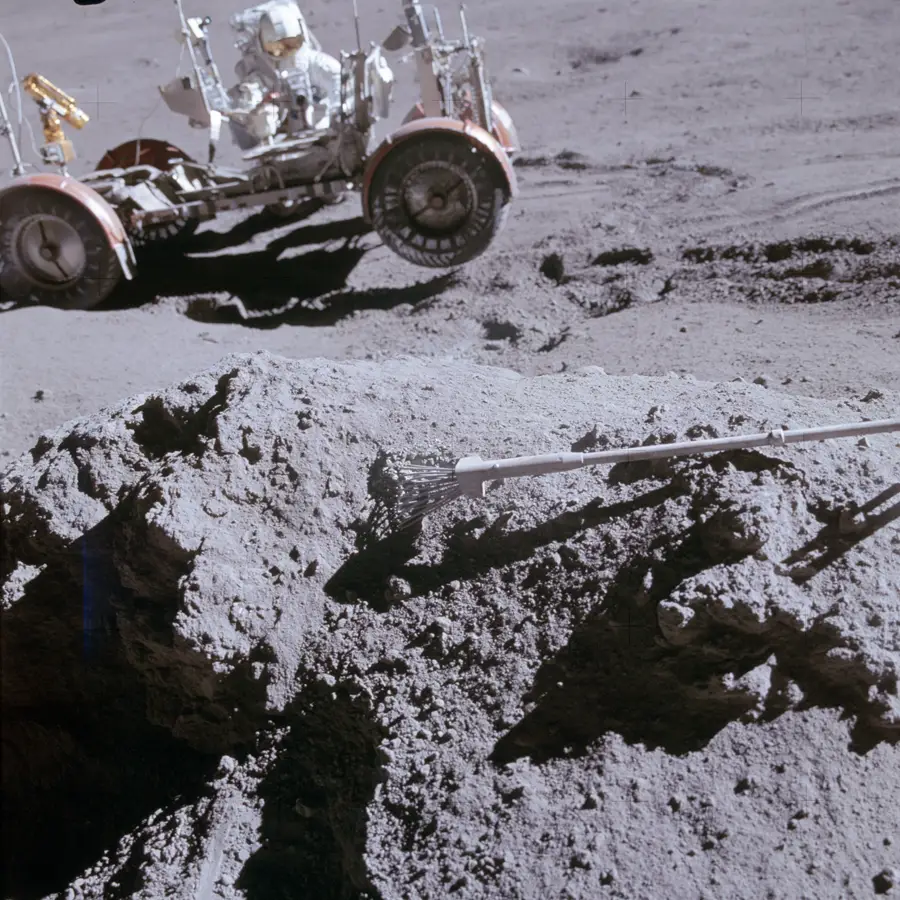
Humanity’s journey to the Moon began with the historic Apollo program, which first landed astronauts on the lunar surface in 1969. Missions like Apollo 15 expanded our scientific understanding and demonstrated advanced exploration capabilities, including the use of the Lunar Roving Vehicle.
Today, NASA’s Artemis program is building on that legacy, aiming to return humans to the Moon and establish a sustainable presence. Artemis will not only land the first woman and the next man on the lunar surface, but also lay the groundwork for future missions to Mars.
Looking even further ahead, the Moon will serve as a stepping stone for deep space exploration—supporting scientific research, enabling new industries, and ultimately helping humanity extend its reach across the solar system.
Lunar Reconnaissance Orbiter: Mapping the Future of Moon Exploration
Since its launch in 2009, the Lunar Reconnaissance Orbiter (LRO) has been transforming our understanding of Earth’s closest celestial neighbor. As NASA’s longest-operating lunar orbiter, LRO plays a central role in preparing the Moon for the next era of human and robotic exploration.
A Mission That Changed Lunar Science
Orbiting just 50 km above the lunar surface, LRO has spent over a decade collecting an extraordinary volume of high-resolution data. Its instruments have mapped the Moon in 3D, measured surface temperatures across day and night cycles, analyzed its composition, and assessed the radiation environment—critical information for future missions.
This data is not just scientific—it’s practical. LRO enables NASA and its international and commercial partners to identify safe landing sites for spacecraft and astronauts. It has also been instrumental in pinpointing regions near the Moon’s south pole that may contain water ice and receive near-continuous sunlight—two key resources for sustaining long-term exploration.
Launch and Orbital Journey
LRO launched alongside the Lunar Crater Observation and Sensing Satellite (LCROSS) in June 2009. After being propelled into space by a Centaur upper stage, the spacecraft entered lunar orbit on June 23, 2009, executing a critical engine burn on the Moon’s far side.
Following a series of orbital adjustments, LRO settled into a nearly circular polar orbit, enabling global coverage of the lunar surface. Its primary mission began in September 2009 and was initially planned for just one year—but its success has extended its operation far beyond expectations.
Key Scientific Contributions
Over the years, LRO has delivered ground-breaking discoveries and datasets:
- Global Mapping: Creation of the most detailed topographic maps of the Moon ever produced.
- Temperature Analysis: Comprehensive day-night temperature profiles across the lunar surface.
- Radiation Monitoring: Insights into the harsh lunar radiation environment, essential for astronaut safety.
- Water Ice Detection: Strong evidence of water ice in permanently shadowed craters, particularly near the poles—confirmed by scientists in 2018.
Initially managed by NASA’s Exploration Systems Mission Directorate, LRO operations were transferred in 2010 to the Science Mission Directorate, reflecting its growing importance as a scientific asset.
Revisiting Apollo Legacy
LRO doesn’t just look forward—it also looks back. The orbiter has captured remarkably detailed images of historic landing sites, including that of Apollo 15.
In July 1971, astronauts David Scott and James Irwin landed near Hadley Rille in Mare Imbrium. They spent nearly three days on the lunar surface, conducting experiments, performing spacewalks, and collecting 77 kg of lunar samples. Their mission marked the beginning of the advanced “J-class” Apollo missions, featuring extended stays and the use of the Lunar Roving Vehicle.
Modern LRO imagery, taken from as low as 25 km altitude, reveals the Apollo 15 landing site in stunning detail—showing the descent stage of the Lunar Module and even the tracks left behind by the rover. These images serve as both scientific data and a powerful reminder of humanity’s first steps beyond Earth.
Today, LRO continues to operate, delivering fresh insights and supporting mission planning for upcoming lunar exploration efforts, including NASA’s Artemis program. Its legacy is not only one of discovery, but of enabling the next giant leap.
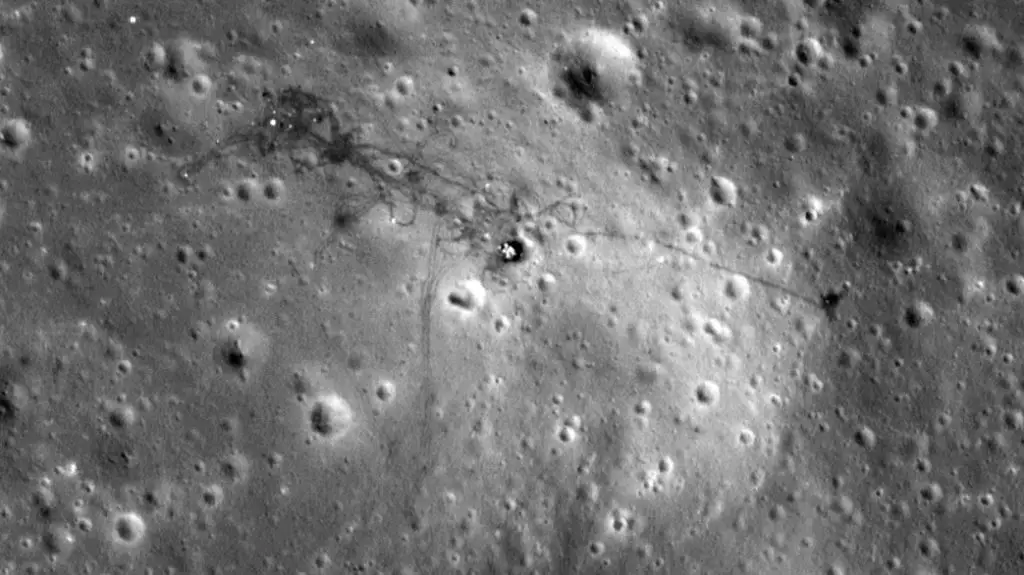
LRO in 2010 depicts the tracks that Apollo 15 astronauts David Scott and James Irwin