
Lucky to See Mars Blue Sunsets
- October 14, 2026
- CAVU Aerospace UK
On Earth, sunsets are famous for their spectacular red, orange and pink colours. On Mars, the scene is remarkably different: as the Sun approaches the horizon, the sky around it can turn a distinctive blue. This unusual phenomenon is not caused by a blue Martian atmosphere. It is the result of the way fine dust particles in the Martian atmosphere interact with sunlight.
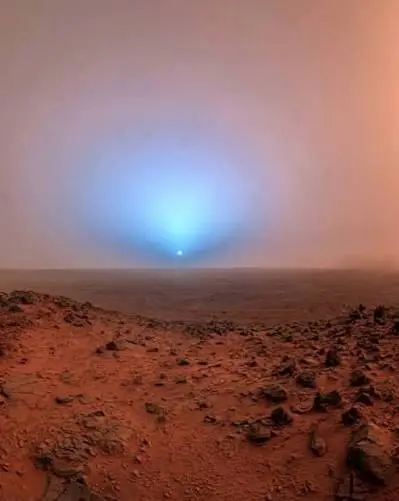
Mars has a very thin atmosphere, with a surface pressure less than 1% of Earth’s. Despite this, its atmosphere contains enormous quantities of extremely fine dust. The dust is primarily made from minerals containing iron, which gives the Martian surface and atmosphere their characteristic reddish appearance. These tiny particles are important because they interact with sunlight differently from the gas molecules that dominate Earth’s atmosphere. During the Martian day, dust scatters sunlight through the atmosphere, producing the familiar yellow, orange and reddish appearance of the Martian sky. But as the Sun approaches the horizon, something interesting happens.
Sun Turning Blue
At sunset, sunlight must travel through a much longer path through the atmosphere before reaching an observer on the surface. The fine Martian dust preferentially scatters red and orange wavelengths away from the direct path of sunlight. As a result, the light travelling directly from the setting Sun contains a relatively larger proportion of shorter, blue wavelengths. The consequence is a striking blue glow surrounding the Sun. This is almost the opposite of what happens on Earth.
Mars Red Sky
On Earth, the blue daytime sky is primarily produced by Rayleigh scattering, where tiny gas molecules scatter shorter wavelengths of light much more efficiently than longer wavelengths. Mars has a very different atmospheric environment. Its atmosphere is extremely thin and is dominated by carbon dioxide, while suspended dust particles play a major role in the way sunlight is scattered. The result is a sky that generally appears yellowish, orange or butterscotch-coloured rather than blue. At sunset, the long optical path through the dusty atmosphere changes the balance of light reaching the observer, producing the characteristic blue region around the Sun.
The phenomenon has been observed by several robotic missions operating on the Martian surface. NASA’s Mars rovers have photographed sunsets showing the distinctive blue colour surrounding the setting Sun. These images provide more than just spectacular views—they are also useful observations of the interaction between sunlight, atmospheric dust and the Martian environment. A sunset on Mars therefore gives us a natural experiment in planetary atmospheric physics. The same Sun is illuminating both Earth and Mars, but the two planets produce dramatically different colours because their atmospheres are different.