Live Data Management in Thermal Control, Programmable Logging Rate in TCU
- March 3, 2026
- CAVU Aerospace UK
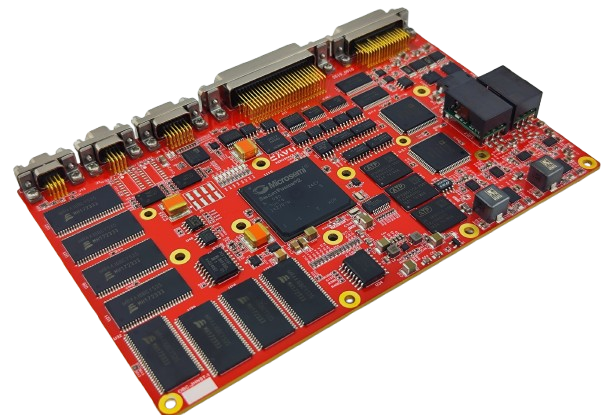
Satellite developers are quite often concerned with downlink constraints. Usually, spacecrafts will not be able to provide live data along its orbit & system design team are looking to store data within the TCU. Data is thermistor temperatures; heater current consumption and goal is to retrieve all the data at once. TCU std. version provides onboard storage capacity of 8 GB. Assuming continuous logging of all 100 thermistor channels and 48 heater-current channels at 1 Hz, with no data overwrite, it can store approximately 45 days of data.
Another advantage is programmable logging rate which can be configured down to 0.1 Hz or even lower (e.g. 0.01 Hz) without any issue.
One important point to consider is whether you prefer:
- Logging instantaneous values at a low rate, or
- Logging at a higher internal rate and storing averaged data at a lower rate.
For most of space missions, we often implement two logical tables:
- A higher-rate internal log (e.g. 1 Hz) for detailed thermal behavior tracking
- A lower-rate log (e.g. 0.1 Hz or 0.01 Hz) containing averaged values intended for downlink
This approach minimizes downlink volume while still preserving detailed onboard data if needed. Alternatively, system designer may:
- Log at 1 Hz
- Retrieve data between time₁ and time₂ every Nth record
For example:
- Log at 1 Hz
- Read every 10th record → equivalent to 0.1 Hz
- Read every 100th record → equivalent to 0.01 Hz
This gives flexibility depending on operational mode and downlink budget.
The architecture is robust and supports all of these strategies.