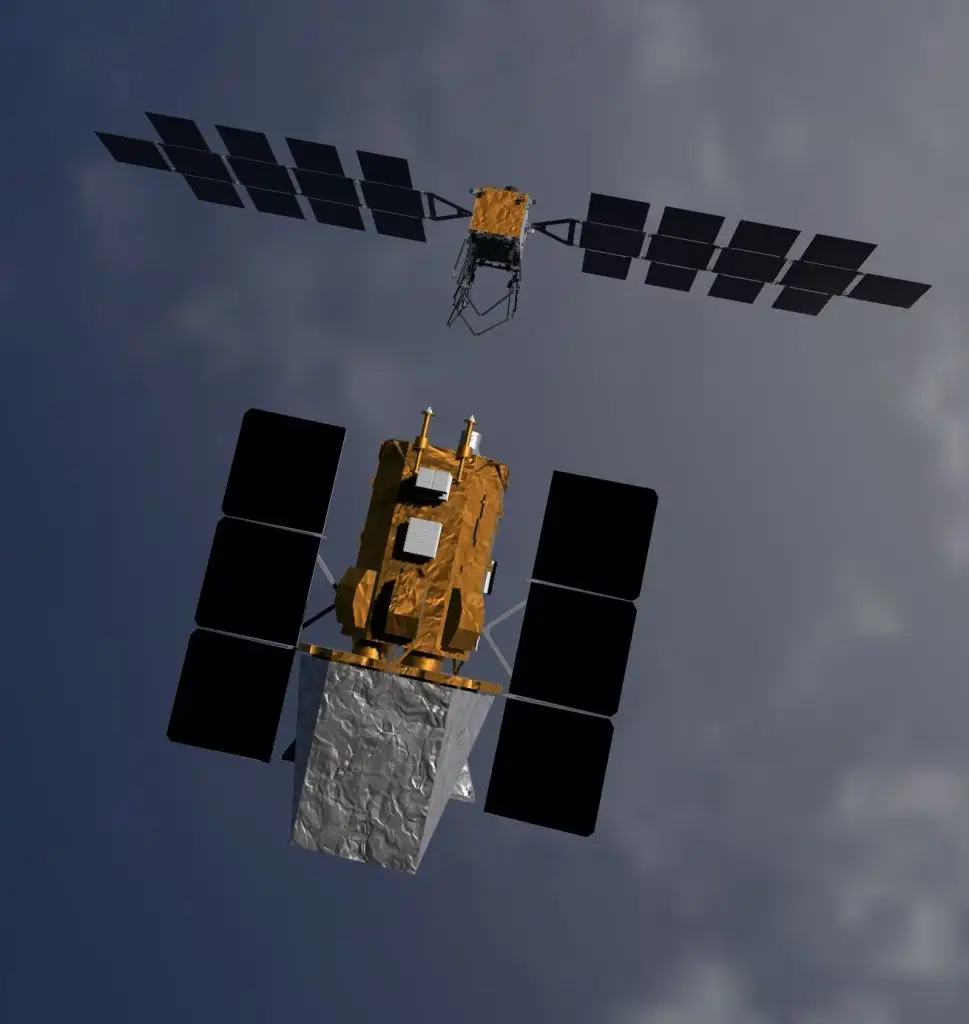
LINK, First of Many Orbital Service & Rescue Missions
Credit: NASA, Katalyst
- July 7, 2026
- CAVU Aerospace UK
Katalyst has launched LINK to boost NASA’s SWIFT observatory this week. This is potentially a landmark moment for spaceflight. If Katalyst’s LINK mission succeeds, it will demonstrate something that until recently was considered nearly impossible: extending the life of a scientific spacecraft that was never designed to be serviced.
The interesting part is that Swift was NOT designed for orbital boosting. Unlike the Space Shuttle-serviced Hubble Space Telescope, Swift has:
- no docking port,
- no refuelling interface,
- no grapple fixture intended for servicing,
- no propulsion system capable of raising its own orbit after launch.
Instead, LINK is performing what is essentially external robotic servicing. It will rendezvous with Swift, inspect it, grab it using robotic arms, and then use LINK’s own propulsion system to slowly raise the combined spacecraft to a higher orbit over roughly two months. Swift never fires any engines because it has none. That makes this mission far more significant than simply saving one telescope.
SWIFT Orbital Observatory
Swift launched in 2004 with an expected lifetime of only two years. Twenty-two years later it is still scientifically productive, but increasing solar activity during the current solar cycle has heated Earth’s upper atmosphere, increasing atmospheric drag in low Earth orbit. That has caused Swift to lose altitude much faster than engineers predicted. NASA estimated it would re-enter Earth’s atmosphere later this year unless its orbit was raised.
Swift was not designed for servicing.
In fact, almost every NASA science satellite launched before the last decade assumed that once fuel was exhausted or orbit decayed, the mission would simply end.
The servicing philosophy was launch, operate & deorbit naturally or remain abandoned. Only Hubble was intentionally designed for astronauts to repair because it launched during the Space Shuttle era. Everything else—including Swift, Chandra X-ray Observatory and many Earth-observation satellites—was effectively “single-use.” LINK is proving that this assumption may no longer be necessary.
The key innovation is autonomous rendezvous. LINK carries cameras, lidar, navigation sensors, robotic arms & electric propulsion. Rather than relying on a docking adapter already installed on Swift, LINK identifies structural features that are safe to grasp.
Once attached, the pair become one spacecraft. The thrust comes entirely from LINK. Think of it like a tugboat pushing a powerless ship into a new harbor.
Historically there have been four generations of spacecraft operations:
- Disposable spacecraft
- Human-serviced spacecraft (Hubble)
- Refuellable military satellites
- Autonomous robotic servicing
LINK may become the first operational example of Generation 4. If successful, the economics change dramatically. Instead of replacing a $500 million observatory, NASA spends about $30 million extending its life by several years.
Unlike Swift, Hubble actually has several advantages. It already has astronaut handrails, grapple fixtures, servicing access points & extensive engineering documentation. NASA has already studied robotic reboost concepts for Hubble, and researchers are actively publishing science cases showing why extending Hubble into the 2030s would have enormous scientific value. Future servicing could include:
- orbit raising
- attitude-control upgrades
- replacement propulsion modules
- new power systems
- potentially even new instruments
Several commercial companies have expressed interest in servicing Hubble in the coming years.
LINK is really a proof-of-concept for an entirely new industry. Imagine future robotic spacecraft routinely performing extending telescope missions, refuelling satellites & replacing failed electronics modules. Spacecraft could become more like aircraft—maintained and upgraded rather than discarded.