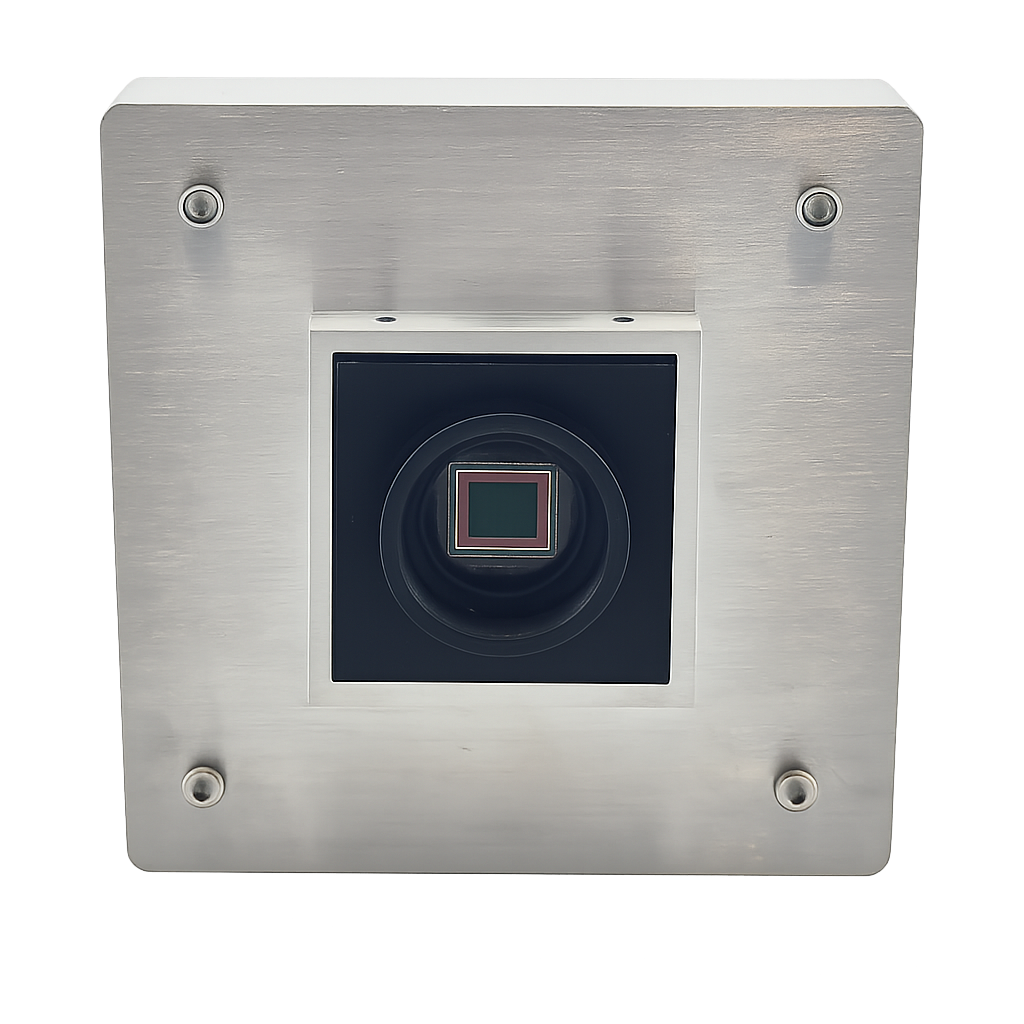
Intelligent Imaging Solution with LDU Camera Series, Integrating Sony Sensors, PolarFire FPGA, and NVIDIA Jetson
- April 10, 2026
- CAVU Aerospace UK
As aerospace missions demand increasingly sophisticated imaging capabilities, the focus is shifting from standalone components to fully integrated imaging ecosystems. CAVU Aerospace UK has embraced this approach with the LDU345 satellite camera—delivering a powerful, end-to-end solution that combines industry-leading sensor technology, advanced FPGA-based data handling, and GPU-accelerated edge computing. Here are the main features:
- Hardware-accelerated imaging on Microchip PolarFire SoC FPGA, delivering low-power, deterministic, high-throughput performance
- RAW 12-bit Bayer pipeline with zero compression, preserving full dynamic range and low-noise image quality
- Real-time, lossless center cropping in hardware, maintaining native resolution without scaling artifacts
- Integration with NVIDIA Jetson via up to 4-lane MIPI CSI-2, enabling high-bandwidth image streaming
- Dual CLI/GUI control interfaces for flexible operation and system integration
- Radiation-tolerant design with SEU immunity, requiring no scrubbing or recovery, ensuring continuous operation in space.
At its core, the LDU345 is not just a camera—it is a complete imaging pipeline built on three key technological pillars:
Sony Imaging Technology: Precision at the Sensor Level
The LDU345 leverages advanced Sony imaging sensors, globally recognized for their exceptional image quality, sensitivity, and reliability in demanding environments.
- High dynamic range for capturing detail in challenging lighting conditions
- Low noise performance, critical for space and low-light imaging
- Proven reliability in aerospace and industrial applications
- Support for multiple resolutions, including 5 MP, 16 MP, and 51 MP variants
This sensor foundation ensures that the raw data captured is of the highest possible quality—an essential requirement for any downstream processing or analysis.
Microchip PolarFire FPGA
On the camera board itself, the LDU345 integrates a Microchip PolarFire FPGA, forming the backbone of its real-time data acquisition and preprocessing capabilities.
This FPGA layer is responsible for:
- Sensor interfacing and precise timing control
- High-speed data capture and buffering
- Real-time preprocessing (such as formatting, filtering, and data conditioning)
- Customizable logic for mission-specific requirements
PolarFire FPGAs are particularly well-suited for aerospace applications due to their low power consumption, radiation tolerance characteristics, and deterministic performance—ensuring reliability in mission-critical environments.
NVIDIA Jetson- Intelligence at the Edge
Completing the imaging pipeline is the integration with NVIDIA Jetson modules, which bring powerful GPU acceleration and AI capabilities directly to the edge.
System can perform:
- Real-time AI inference (object detection, classification, tracking)
- Advanced image processing (enhancement, stitching, feature extraction)
- Onboard data analytics and decision-making
- Intelligent data reduction to optimize bandwidth and storage
By processing data at the point of capture, missions can dramatically reduce latency and dependency on ground-based systems—enabling faster, smarter responses.
The true strength of the LDU345 solution lies in how these three technologies work together as a cohesive system:
- Sony Sensors capture high-fidelity image data
- PolarFire FPGA ensures efficient, real-time data acquisition and pre-processing
- NVIDIA Jetson transforms data into actionable intelligence through AI and GPU acceleration
This seamless flow—from photon capture to intelligent insight—creates a highly efficient and scalable imaging architecture.
This integrated approach unlocks new possibilities across a wide range of applications:
- Earth observation satellites with onboard analytics
- Autonomous UAVs capable of real-time decision-making
- Precision agriculture using AI-driven insights
- Defence and surveillance systems requiring rapid response
- Scientific missions demanding high-resolution, high-integrity data
To support this architecture, manufacturers should provides robust software packages compatible with both Raspberry Pi and NVIDIA Jetson platforms. These include:
- Camera control and data acquisition APIs
- High-throughput data pipelines
- Integration with NVIDIA tools such as CUDA, TensorRT, and DeepStream
- Support for AI/ML frameworks like TensorFlow and PyTorch
This enables developers to quickly deploy complete imaging solutions without complex integration challenges.
The LDU345 represents a new generation of aerospace imaging systems—where sensor excellence, deterministic hardware processing, and AI-driven intelligence converge into a single, unified platform.
By combining Sony imaging technology, Microchip PolarFire FPGA architecture, and NVIDIA Jetson edge computing, CAVU Aerospace UK delivers more than a camera—it delivers a complete, intelligent imaging solution designed to meet the evolving demands of modern aerospace missions.