
Implementing a Radiation-Tolerant OBC with 6×1Gb Ethernet Using PolarFire SoC FPGA
- April 6, 2026
- CAVU Aerospace UK
As spacecraft architectures evolve toward distributed, high-throughput systems, the On-Board Computer (OBC) is no longer just a controller—it is the central data router, processor, and reliability backbone of the mission.
The OBC-Hypr-Polar, developed by Cavu Aerospace UK, is designed around this philosophy. By combining a PolarFire SoC FPGA with six 1Gb Ethernet interfaces and a high-reliability power subsystem using Glenair Micro-D connectors, the system achieves both performance and mission-grade robustness.
The OBC-Hypr-Polar is built around the Microchip Technology PolarFire SoC FPGA, which integrates:
- Multi-core RISC-V processors for software-defined control
- FPGA fabric for deterministic, parallel data handling
- Low-power architecture ideal for space platforms
- Radiation-tolerant design suitable for LEO and deep-space missions
This hybrid approach allows:
- Hardware-accelerated Ethernet switching and packet handling
- Real-time payload interfacing
- Software flexibility for mission updates
High-Speed Networking: 6× Independent 1Gb Ethernet Ports
The OBC-Hypr-Polar provides six isolated Gigabit Ethernet interfaces, enabling:
Distributed Spacecraft Architectures
Each subsystem (payload, ADCS, communications, storage) can operate as a network node, reducing centralized bottlenecks.
Redundancy and Fault Tolerance
Multiple Ethernet links allow:
- Cross-strapping between subsystems
- Ring or mesh redundancy
- Graceful degradation under failure
FPGA-Based Networking
Using the PolarFire FPGA fabric, the OBC can implement:
- Deterministic Ethernet switching
- Custom packet routing
- Time-Sensitive Networking (TSN)
Multi-Interface Support
Beyond Ethernet, the system integrates:
- LVDS for high-speed sensor interfaces
- Serial I/O for legacy subsystems and housekeeping
- ADC interface for analog telemetry acquisition
- JTAG-USB debug for development and diagnostics
This ensures compatibility across a wide range of spacecraft subsystems.
Power Subsystem: FMEA-Driven Reliability Engineering
A comprehensive Failure Modes and Effects Analysis (FMEA) identified the power subsystem as the highest-risk element in the OBC.
Failures in power delivery can result in:
- Complete system shutdown
- FPGA latch-up or reset
- Data corruption or mission loss
To mitigate these risks, the OBC-Hypr-Polar incorporates:
- Radiation-Tolerant DC/DC Conversion
- Stable operation across temperature extremes
- Protection against transients and single-event effects
- High efficiency to reduce thermal load
- High-Reliability Power Interconnect
Glenair Micro-D Connector (IGMPM2-B112R-CBRT-SU-.109)
The OBC uses a Glenair Micro-D combo connector, specifically designed for power and signal integration in harsh environments.
Why This Connector Matters
a) High Current Capability in Compact Form
- Approximately 13A per contact
- Enables reliable power delivery without bulky connectors
- Ideal for compact spacecraft avionics
b) Combo Micro-D Architecture
The connector combines:
- Power contacts
- Signal contacts
- Compact Micro-D footprint
This reduces:
- Connector count
- Harness complexity
- Potential failure points
c) Ruggedized PCB Mount Design
- Right-angle PCB mounting with encapsulation support
- Epoxy-sealed contacts improve:
- Resistance to vibration
- Resistance to thermal cycling
- Ensures mechanical integrity during launch conditions
d) Space-Grade Materials
- Beryllium copper contacts for high conductivity and durability
- Gold plating for corrosion resistance and low contact resistance
- Aluminum alloy shell with protective finish for strength and EMI shielding
e) Wide Operating Temperature Range
- Typically −55°C to +150°C
- Suitable for:
- Low Earth Orbit thermal cycling
- Deep space missions
f) Mechanical Reliability
- High mating cycle durability
- Secure locking mechanism
- Strong resistance to vibration and shock
Engineering Impact of Using Glenair Power Connectors
Improved Reliability
By reducing connector-related failure modes such as:
- Intermittent contact
- Mechanical wear
- Thermal degradation
Reduced System Risk
The power interface becomes:
- Mechanically stable
- Electrically robust
- Environmentally resilient
Optimized Mass and Volume
Compared to traditional circular connectors:
- Smaller footprint
- Lower mass
Higher integration density
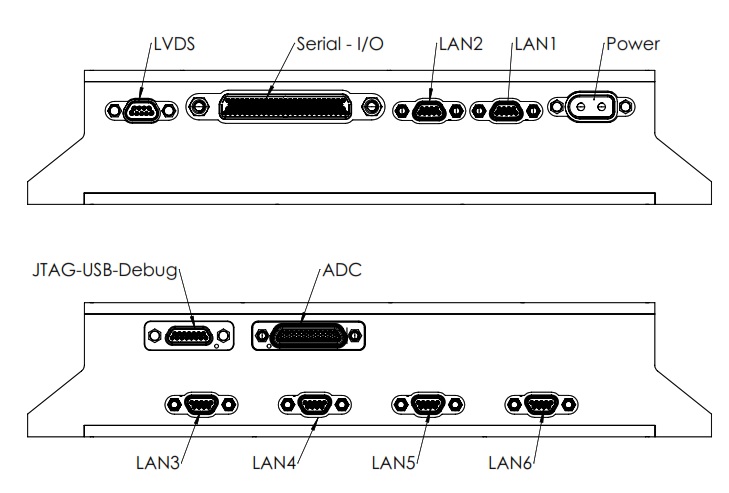
Mechanical and System Integration
The connector layout of the OBC-Hypr-Polar is designed for:
- Clear separation of:
- Power
- Data
- Debug interfaces
- Simplified harness routing
- Reduced electromagnetic interference between high-speed and power lines
Why PolarFire SoC and Glenair is a Strong Combination
Aspect | PolarFire SoC FPGA | Glenair Micro-D Connector |
Reliability | Radiation-tolerant logic | Rugged mechanical and electrical interface |
Power Efficiency | Low-power FPGA fabric | High-current, low-loss connection |
Integration | Multi-function SoC | Power and signal in a single connector |
Space Suitability | Single-event upset resilient design | Proven aerospace heritage |