
Humanity's First Planetary Defence Experiences, Watching the sky & changing the trajectory of asteroids
- September 1, 2026
- CAVU Aerospace UK
On 15 February 2013, an asteroid arrived at Earth without warning. We couldn’t see this coming because simply it was coming from side of Sun & hard to be detected. Travelling at roughly 19 kilometres per second, a space rock estimated to be about 17–20 metres across entered the atmosphere over the Russian city of Chelyabinsk. It did not reach the ground as a single object. Instead, it exploded approximately 20–30 kilometres above the surface, producing an enormous airburst and scattering fragments that eventually fell as meteorites. NASA estimates that the object was roughly 18 metres across and weighed around 11,000 tonnes.
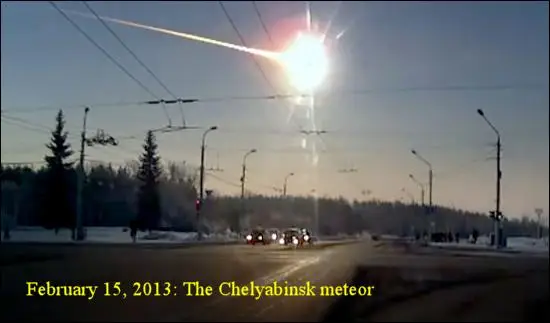
The asteroid was relatively small by cosmic standards. Yet its explosion damaged thousands of buildings and injured more than a thousand people, primarily because of the powerful shock wave and shattered glass.
Chelyabinsk was a reminder of something uncomfortable: an asteroid does not have to be large enough to destroy civilisation to be dangerous. And perhaps more importantly, the asteroid had not been identified as an imminent threat before it arrived. That event became one of the defining reminders for modern planetary defence: detecting an asteroid is only the first step. Humanity eventually needs the ability to do something about it.
Earth is continuously surrounded by near-Earth objects, asteroids and comets whose orbits bring them relatively close to Earth’s orbit. Most are completely harmless. But a small fraction is classified as Potentially Hazardous Asteroids. NASA’s current definition considers an asteroid potentially hazardous when its orbit can bring it within 0.05 astronomical units of Earth’s orbit and it is sufficiently large, corresponding to an absolute magnitude of 22 or brighter. This does not mean that these objects are going to hit Earth.
It means that their size and orbital geometry make them important objects to monitor.
The potential threat exists across an enormous range of scales:
- 10–30 m: objects like Chelyabinsk can produce powerful atmospheric explosions and regional damage.
- 50–150 m: an impact could devastate a large region and potentially produce effects extending across countries.
- ~150–300 m: an impact could cause catastrophic regional or continental consequences.
- ~1 km: an impact could produce global climatic and environmental consequences.
- Several kilometres: impacts can become civilisation-threatening and resemble the type of event associated with major mass extinctions.
We certainly don’t want go to extinct the same way previous dominant species went. We want to defend our planet & keep our dominance. So, Planetary defence begins with observation. Ground-based optical telescopes, radar observations and dedicated surveys have progressively expanded humanity’s ability to discover near-Earth objects.
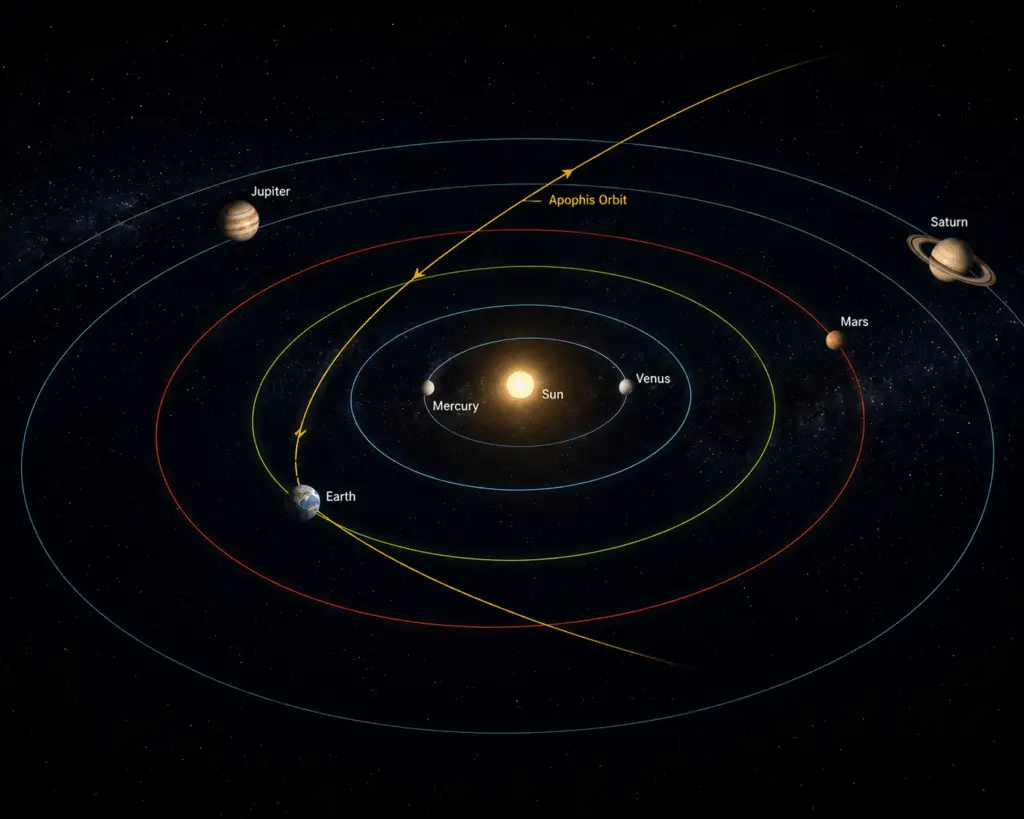
We need to be able to detect whatever is on the Earth way & if something is making a cross on it’s way, we need to send a scout spacecraft to clear the orbit for our planet. Humanity as dominant species on the Earth needs to do it to save life on this planet. IT’s not saving planet, it’s about life.
Finding an asteroid is not enough. Scientists need to know what it is made of, how large it really is, how it rotates, whether it is a solid body or a loose collection of rocks, and how its surface and internal structure might respond to an impact. Several missions have transformed our understanding of asteroids. Japan’s Hayabusa mission demonstrated that a spacecraft could rendezvous with an asteroid, interact with its surface and return material to Earth. Its successor, Hayabusa2, travelled to the near-Earth asteroid Ryugu, performed surface operations and returned asteroid material to Earth in 2020. NASA’s OSIRIS-REx took this concept even further. It travelled to near-Earth asteroid Bennu, mapped the object in detail, collected material from its surface and returned the sample capsule to Earth in September 2023. It was NASA’s first asteroid sample-return mission. The Bennu mission also had an important planetary-defence dimension. Bennu is a near-Earth asteroid whose orbit is carefully studied because of its future close approaches to Earth. OSIRIS-REx provided scientists with extremely detailed measurements of its physical characteristics and trajectory.
The spacecraft has now been renamed OSIRIS-APEX and is continuing its journey toward another important asteroid: Apophis.
The biggest milestone in planetary defence came on 26 September 2022. NASA’s Double Asteroid Redirection Test (DART) deliberately crashed a spacecraft into the asteroid moonlet Dimorphos. This was a rehearsal. DART was humanity’s first full-scale demonstration of a technique known as a kinetic impactor—using a spacecraft travelling at high speed to strike an asteroid and alter its velocity. The target was Dimorphos, the smaller companion of the roughly 805-metre asteroid Didymos. DART’s spacecraft deliberately collided with Dimorphos & it worked. The impact changed Dimorphos’s orbital period around Didymos by approximately 33 minutes, demonstrating that a spacecraft can measurably alter the motion of an asteroid. Subsequent analysis showed that the impact also changed the orbital characteristics of the binary system around the Sun.
Humanity is beginning to practise. For most of human history, an asteroid impact was considered something that simply happened to Earth. There was nothing humanity could do. Today, that assumption is changing. We have built systems to discover near-Earth objects, calculate their trajectories & can send spacecraft to orbit asteroids, land on them, collect samples and brought them back to Earth & most importantly, we can deliberately crashed a spacecraft into one and change its orbit.
Space computing is a massive portion of the work in whole detection, navigation, attitude control & making change in trajectory, specially most of operations are millions of miles away from earth when it takes minutes to have commands from the earth, so whole operation has to be very fast & autonomous as objects are flying with interplanetary speed. This is only possible with reliable highly capable AI computers.
AI enables flight computers like Typhoon-Edge as pai of PolarFire FPGA with NVIDIA Jetson GPUs are effectively work in autonomous operation of spacecrafts with highly reliable operation in deep space & high-precision computing. Computers receive information from multiple onboard cameras to adjust positions & navigate spacecraft to improve change of mission success.