
High-Speed Frame Grabber for 127 Megapixel Earth Observation Cameras
- July 17, 2026
- CAVU Aerospace UK
The evolution of Earth Observation satellites is driving demand for increasingly powerful imaging payloads. Modern commercial and scientific missions are moving toward very large-format image sensors capable of delivering sub-meter resolution, wide-area imaging, and enhanced spectral information. However, capturing and storing data from these high-performance sensors presents a significant challenge: a single image frame can contain hundreds of megabytes of raw data, requiring an advanced high-speed processing and storage architecture.
To address this challenge, CAVU Aerospace has developed a high-performance Command & Data Handling Unit (CDHU) and space-qualified frame grabber architecture designed to interface with 127 Megapixel-class cameras, providing reliable image capture, buffering, processing, and storage capability for demanding Earth Observation applications.
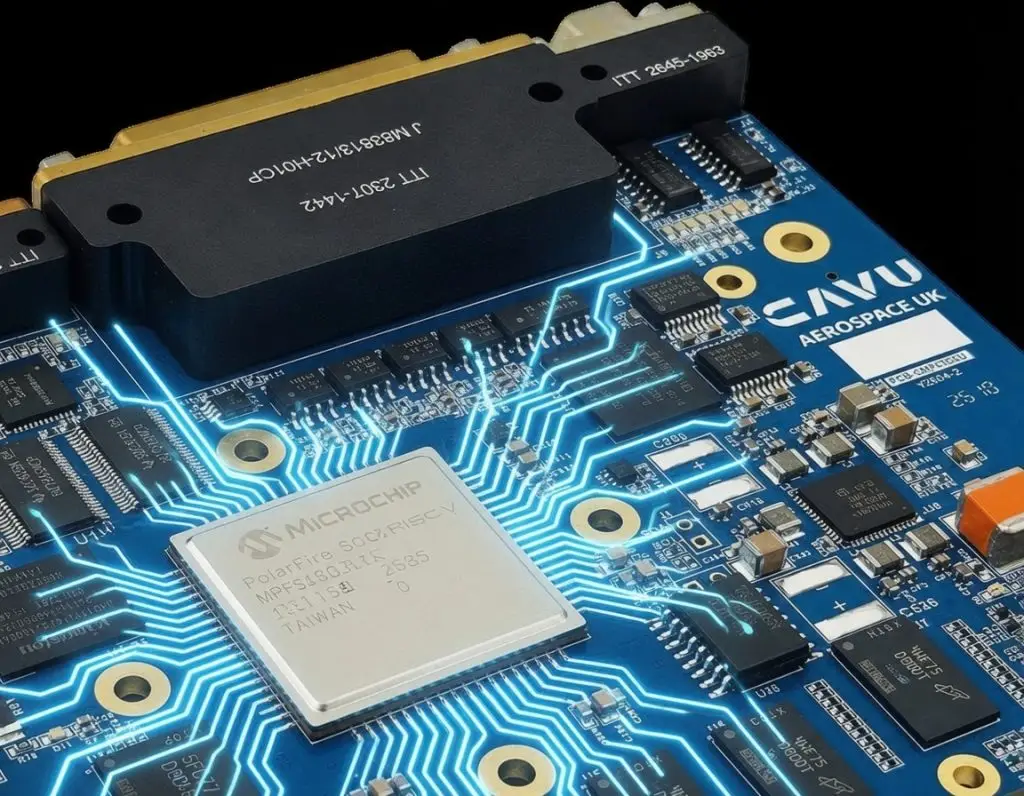
The architecture is based on a Microchip PolarFire® SoC FPGA platform, combining programmable FPGA fabric for deterministic high-speed data acquisition with an embedded processor subsystem for satellite command, control, telemetry and payload management.
Handling Gigabit-Scale Camera Data in Space
High-resolution imaging sensors generate extremely large data streams. For a 127 Megapixel sensor operating with a 10-bit RAW output, each image frame can reach approximately 160 MB, requiring an incoming data rate approaching:
- ~798 MB/s at 5 frames per second
- ~1.6 GB/s at 10 frames per second
Such data rates exceed the capability of conventional satellite computers and require a dedicated payload data path optimized for continuous streaming.
CAVU’s frame grabber architecture solves this challenge through a dedicated FPGA-based acquisition pipeline:
Camera Interface → FPGA Processing Fabric → DDR4 High-Speed Buffer → High-Speed Storage → Satellite Data System
The FPGA fabric performs real-time camera reception, data alignment, packetization and DMA transfer, ensuring that the payload data path remains independent from spacecraft software activities.
FPGA-Based Deterministic Image Acquisition
Unlike processor-only solutions, FPGA-based image acquisition provides:
- Deterministic latency
- Parallel data processing
- High-throughput streaming
- Reliable operation for demanding space environments
The PolarFire SoC architecture uses FPGA fabric as the primary high-speed acquisition engine. Camera data is received through high-speed interfaces, converted into AXI-stream data paths, and transferred into an 8 GB ECC-protected DDR4 ring buffer.
This architecture separates payload data handling from the embedded processor subsystem:
- FPGA Fabric DDR4: dedicated for high-rate image acquisition
- Processor LPDDR4 memory: dedicated for operating system, command handling, telemetry and application software
This separation prevents software activities from interrupting the critical imaging pipeline.
Flexible Camera Interface Support
The CAVU frame grabber architecture supports multiple high-speed camera interfaces depending on mission requirements.
Camera Link Interface
For current-generation EO cameras, the system supports Camera Link Full / 80-bit interfaces.
The FPGA-based receiver performs:
- LVDS deserialisation
- Lane synchronisation
- Pixel alignment
- Frame and line validation
- RAW image packing
- DMA transfer into memory
This enables direct connection to industrial and space-qualified high-resolution camera systems.
CoaXPress High-Speed Interface
For future ultra-high-resolution missions, the architecture supports CoaXPress interfaces.
A CoaXPress implementation enables:
- 10 fps imaging capability
- Multi-gigabit sensor interfaces
- Large burst image acquisition
- Future camera technology upgrades
The architecture analysed by CAVU supports a 10 fps, 200-frame imaging sequence while continuously streaming data to non-volatile storage.
High-Speed Space Storage Architecture
A major challenge in satellite imaging is not only capturing data but storing it reliably.
CAVU’s architecture supports scalable storage configurations:
Configuration Options:
Configuration | Storage Architecture | Capability |
Entry configuration | Dual eMMC | Burst imaging applications |
High-performance configuration | NVMe + eMMC | Continuous 5 fps 127MP imaging |
Maximum performance configuration | Dual NVMe + eMMC | High-speed imaging missions |
The high-performance configuration combines:
- PCIe Gen2 NVMe storage
- Dual HS400 eMMC storage
- FPGA DMA engines
- DDR4 buffering
providing more than 2 GB/s sustained storage bandwidth.
This allows continuous capture of 127 Megapixel images at 5 fps without increasing buffer occupancy.
Architecture
The modular architecture provides a scalable upgrade path:
Current EO Missions
- 127 Megapixel cameras
- Camera Link interfaces
- Continuous 5 fps acquisition
- High-capacity onboard storage
Future Missions
- CoaXPress cameras
- Higher frame rates
- Larger sensors
- Edge processing integration
- AI-based image processing
The architecture supports future expansion by maintaining unused FPGA resources and flexible SERDES connectivity for additional high-speed interfaces.
Space-Optimised Command & Data Handling
Beyond image acquisition, the unit provides complete payload management functionality:
- Camera commanding
- Payload configuration
- Telemetry generation
- Health monitoring
- Data formatting
- Storage management
- Communication with spacecraft OBC
By integrating these functions into a single payload electronics unit, satellite manufacturers can reduce:
- Payload complexity
- Harness requirements
- Mass
- Power consumption
- Development time
Key Performance Highlights
CAVU High-Speed Camera Frame Grabber / CDHU
Parameter | Capability |
Target sensor class | 127 Megapixel EO cameras |
Processing technology | Microchip PolarFire SoC FPGA |
Raw image format | Up to 10-bit RAW |
Frame size | ~160 MB/frame |
Continuous capture | 5 fps demonstrated architecture |
High-speed mode | 10 fps CoaXPress architecture |
Buffer memory | 8 GB ECC DDR4 |
Storage | NVMe SSD + eMMC |
Storage bandwidth | >2 GB/s |
Interfaces | Camera Link, CoaXPress, PCIe |
Application | Earth Observation satellites |