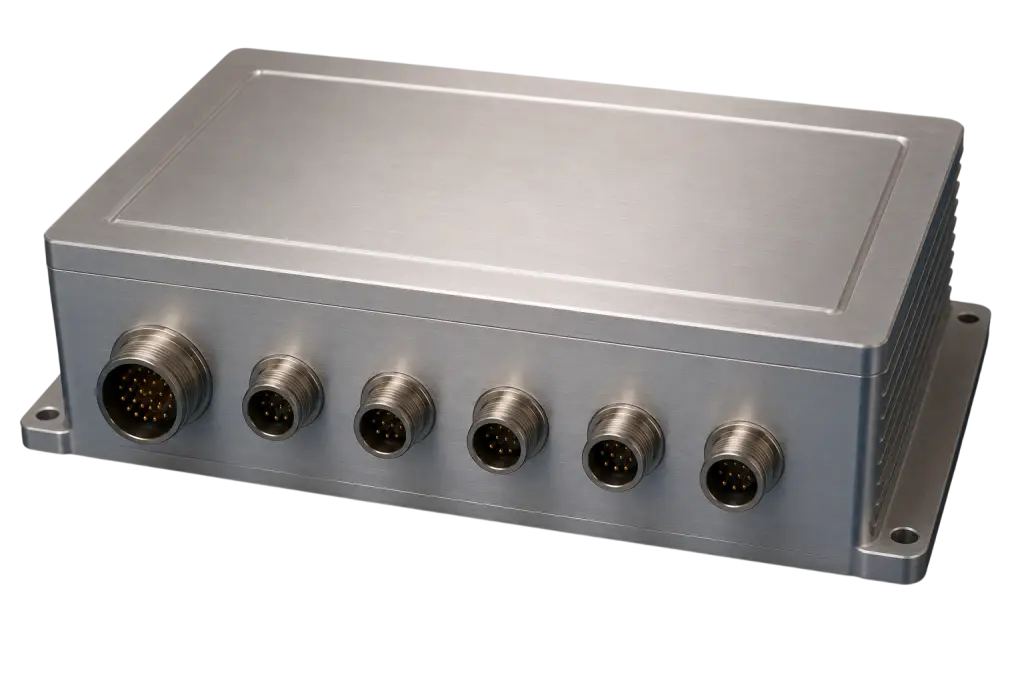
Hermetic Flight Computers: Designing Electronics, Chassis & Connectors to Work in Vacuum, Dust and Harsh Environments
- July 24, 2026
- CAVU Aerospace UK
Planetary exploration missions are pushing onboard electronics far beyond the conditions experienced by conventional Earth-orbiting satellites. Modern rovers, landers and surface science platforms must survive launch vibrations, deep-space vacuum, atmospheric entry, and years of operation in environments containing abrasive dust, chemically reactive gases, moisture, and extreme temperature variations. Sometimes flight computers of rockets are also exposed to hazardous gas like Helium, Oxygen, Methane, Ammonia etc. Internal oxygen & moisture content should be below 1 ppm. Flight computer must survive in those atmospheric conditions, vacuum & harsh environment.
For these missions, environmental protection is as important as radiation tolerance and computing performance. A flight computer that is perfectly suited for low earth orbit may not survive prolonged exposure to lunar dust, Martian regolith, or chemically aggressive gases without additional protection. One increasingly adopted solution is the use of a hermetically sealed flight computer, combining a welded hermetic chassis with hermetic electrical connectors. This approach creates a controlled internal environment that protects the electronics throughout every phase of the mission—from launch and cruise through deep space to planetary surface operations.
Traditional spacecraft avionics are designed primarily for vacuum operation. Typical onboard computers are housed in precision-machined aluminium enclosures with removable covers sealed using elastomer O-rings or conductive EMI gaskets. Standard space-qualified connectors, such as Micro-D or Nano-D, provide excellent electrical performance but are generally not hermetic.
For satellites operating continuously in orbit, this is rarely a problem because the surrounding environment contains no airborne dust, atmospheric oxygen, humidity, corrosive chemicals or liquid water. The enclosure mainly provides mechanical protection, electromagnetic shielding and thermal conduction to the spacecraft structure & designers choose thickness, coating & material of chassis to comply with mission requirements. For hermetic flight computers, design team also deal with connectors & special Elastomer between chassis or welding & lid.
Surface missions or rockets expose avionics to hazards rarely encountered by orbital spacecraft.
Hermetic Chassis
A hermetic enclosure is designed to prevent the exchange of gases, moisture and contaminants between the internal electronics compartment and the external environment. It’ll be achieved with using special Elastomer in chassis & lid.
Rather than allowing the internal atmosphere to equalise with the surroundings, the enclosure forms a permanently sealed pressure vessel. After assembly, the enclosure is typically filled with dry nitrogen, high-purity argon or ultra-dry clean air before final sealing. This controlled atmosphere remains trapped inside throughout the mission, maintaining extremely low humidity and protecting sensitive electronic assemblies against corrosion and contamination.
A hermetic flight computer enclosure is significantly different from a conventional electronics housing. Typical construction includes CNC-machined aluminium alloy (6061-T6 or 7075-T6), Titanium or stainless-steel inserts where required, Electron-beam or laser-welded seams, Metal-to-metal sealing interfaces, Precision-machined connector mounting surfaces & Helium leak-tested assembly. Unlike conventional enclosures that rely primarily on elastomer seals, the welded structure itself becomes the primary environmental barrier.
Every potential leak path—including connectors, fasteners and inspection ports—is carefully engineered to maintain hermetic integrity throughout launch vibration, thermal cycling and long-duration operation.
Hermetic Connectors
The connector is one of the most critical components of any hermetically sealed electronics enclosure. Unlike standard electrical connectors, hermetic connectors are designed so that each electrical conductor passes through a permanent gas-tight barrier. The connector body typically consists of stainless steel or titanium shell, gold-plated electrical contacts, glass-to-metal or ceramic-to-metal seals, nickel or gold surface plating & environmental sealing interface to the chassis.
Each individual contact pin is completely surrounded by a compression glass or ceramic insulator that is permanently fused to both the metallic shell and the conductor. This creates simultaneous functions like: electrical insulation between adjacent pins, mechanical support for each contact & hermetic sealing against gas leakage. Because the glass is permanently bonded during manufacture, gases cannot migrate along the electrical contacts into the enclosure. Typical hermetic connectors achieve helium leak rates better than 1 × 10⁻⁸ atm·cc/s, with many aerospace-qualified products achieving even lower leakage.
Connector Integration with the Flight Computer Chassis
Hermetic connectors are normally mounted directly into the machined enclosure wall. The connector flange becomes part of the pressure boundary. Depending on the design, connectors may be laser welded, electron-beam welded, brazed, metal-gasket sealed or welded into removable hermetic bulkheads. This ensures there is no leakage path between the connector body and the enclosure.
Once installed, the connector effectively becomes an integral structural element of the chassis.
Cabling Between Connector and PCB
One of the advantages of hermetic connectors is that only the external interface is exposed to the environment. Inside the sealed enclosure, the designer can use conventional high-reliability interconnect techniques because the internal atmosphere remains clean, dry and contamination-free. Several approaches are commonly used including Direct PCB Mounting, Harnessed Connections or Board-to-Board Architectures.
Operation in Both Vacuum and Harsh Atmospheric Environments
A hermetically sealed flight computer offers a unique advantage: the same hardware can operate reliably throughout every mission phase. During launch and orbital cruise, it functions like a conventional space-qualified avionics unit, resisting vacuum, radiation and thermal cycling. After landing, the sealed enclosure prevents dust, moisture and reactive gases from reaching the electronics. The internal environment remains unchanged, regardless of external pressure or atmospheric composition.
This makes hermetic packaging particularly attractive for lunar rovers, Martian exploration vehicles, planetary landers, atmospheric probes, sample-return missions, industrial aerospace systems operating in harsh environments like rockets.