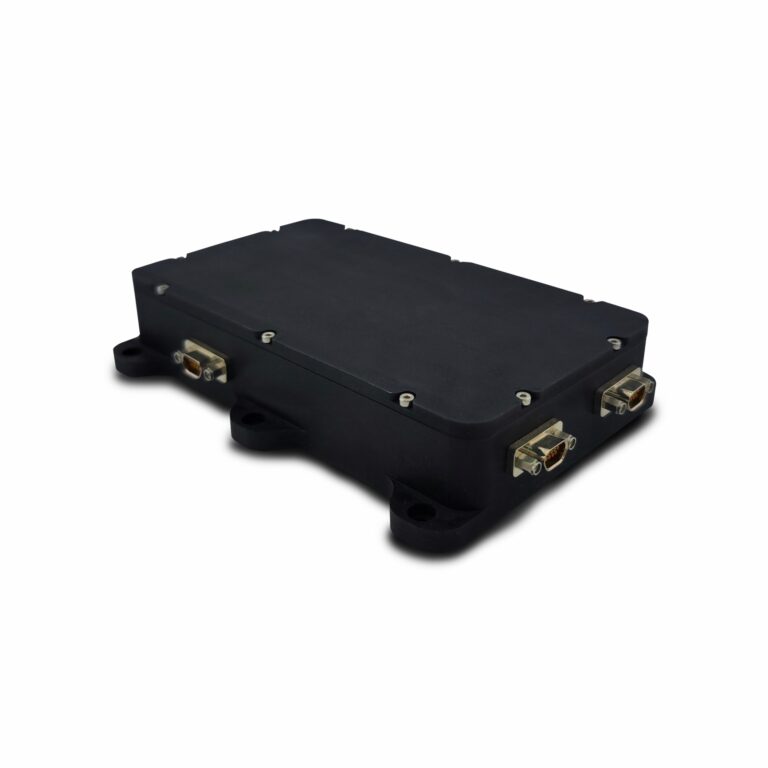
H.264 Video recording solutions; Trade-off between compression efficiency and robustness
- February 23, 2026
- CAVU Aerospace UK
These encoders are built on our OBC-Polar computing platform series (PolarFire SoC based), with an FPGA RTL-based video encoder pipeline integrated alongside the Linux control/software stack.
VREC supports two H.264 operating modes depending on the mission trade-off between compression efficiency and robustness / per-frame access:
- H.264 I/P (Inter-frame) encoding
Uses I + P frames to achieve higher compression efficiency (better quality per bitrate). The published capability supports up to 4K (3840×2160) @ 60 fps. - H.264 I-Frame (All-Intra) encoding
Encodes I-frames only, meaning each frame is independent (useful for deterministic per-frame access and more localized error impact). The published capability is up to 1080p @ 60 fps.
Both modes generate an ITU-T H.264 Annex-B compliant NAL byte stream output
Chroma subsampling / pixel format
- Encoder input (accepted): YCbCr 4:2:2, 8-bit per component (Y, Cb, Cr).
- Encoded bitstream (output): H.264/AVC, YCbCr 4:2:0 video content.
- Output stream framing: ITU-T H.264 Annex B compliant NAL byte stream.
Input support / pre-processing stage (before the encoder)
Many camera sources provide RAW Bayer, RGB, or alternative YUV layouts. Therefore, VREC includes an FPGA RTL-based input conditioning stage to convert common input formats into the encoder-acceptable format (YCbCr 4:2:2, 8-bit/component).
Supported input families (via configurable pre-processing/adapters):
- RAW Bayer: RAW8 / RAW10 / RAW12
Typical chain: RAW Bayer → debayer/demosaic → RGB → color-space conversion → YCbCr 4:2:2 (8-bit). - RGB: RGB888, RGB565, RGB8 (mono/greyscale)
Typical chain: RGB → color-space conversion → YCbCr 4:2:2 (8-bit). - YUV / YCbCr formats (from bridges and camera interfaces):
- YCbCr 4:2:2 packed (e.g., YUYV/UYVY) → direct feed (or light adapter) to encoder input
- YCbCr 4:2:0 semi-planar (e.g., NV12/NV21) → converted to YCbCr 4:2:2 prior to encode. NV12 is defined as a two-plane YUV 4:2:0 format (Y plane + interleaved CbCr plane).
This approach keeps the external camera input flexible while maintaining a deterministic encoder-facing format.
Encoder operating envelope
- Maximum encode capability: up to 4K (3840×2160) @ 60 fps per stream.
- Low-latency behavior: designed for minimal latency; for example, a low-latency configuration ~252 µs at 1080p.
- Bitrate range: Configurable 1 Mbps to 80 Mbps per stream.
Simultaneous streams
Simultaneous streams are achieved by deploying multiple parallel encoder pipelines in the FPGA logic. For the common operating point of 4K @ 30 fps:
- CubeSat platform (OBC-Cube-Polar / MPFS250 class): up to 2 simultaneous streams
- Larger platform (OBC-HYPR-Polar / MPFS460 class): up to 4 simultaneous streams
Video input and platform context
- Video input (selectable front-end): CSI-2 / HDMI / CameraLink (Base/Medium/Full) / SDI / CoaXPress / SD / Composite / etc.
- Networking: Dual 1G Ethernet
- Storage: dual 256 GB eMMC configured in pSLC mode (80 GB + 80 GB)
- Plus the rest of the general OBC-Cube-Polar / OBC-HYPR-Polar platform capabilities (SpaceWire, LVDS, CAN, UART variants, etc.).
Encoder summary Specifications:
Item | H.264 Encoder (I/P – inter-frame) | H.264 I-Frame Encoder (All-Intra) |
Encoder type | FPGA RTL-based H.264/AVC pipeline | |
Frame types | I + P frames (inter-frame prediction enabled) | I-frames only (each frame encoded independently) |
Encode input requirement | YCbCr 4:2:2, 8-bit/component | |
Encoded video format | YCbCr 4:2:0 (H.264/AVC) | |
Output stream format | ITU-T H.264 Annex-B NAL byte stream | |
Max resolution / fps (per stream) | Up to 4K (3840×2160) @ 60 fps (config dependent) | Up to 1080p @ 60 fps |
Latency (engineering note) | Low-latency capable (configuration dependent) | Low-latency and robust (no inter-frame dependencies) |
Bitrate operating range (per stream) | 1 Mbps to 80 Mbps (configurable) | |
Compression efficiency | Higher efficiency due to inter-frame prediction (better quality per bitrate) | Lower efficiency vs I/P (but simpler and more error-contained) |
Robustness to link loss | If packets are lost, artifacts can persist until next I-frame (depends on GOP) | Loss impacts are more localized (no dependency chain between frames) |
Best-fit use cases | Bandwidth/storage constrained recording; longer duration video | Deterministic per-frame access, simpler post-processing, robustness-focused links |
Simultaneous streams @ 4K @ 30 fps | Up to 2 (CubeSat platform / OBC-Cube-Polar class) or up to 4 (larger / OBC-HYPR-Polar class) | Not applicable at 4K (I-Frame is 1080p-class); multi-stream counts depend on selected 1080p/720p operating point |
Video inputs (front-end options) | CSI-2 / HDMI / CameraLink (Base/Med/Full) / SDI / CoaXPress / SD / Composite / etc. | |
Storage / host context | Dual eMMC in pSLC mode; Dual 1G Ethernet; plus standard OBC-Polar I/O (SpaceWire, LVDS, CAN, UART variants, etc.) | |
Software | Linux BSP available for recorder control + custom application development | |