
gRPC Communication Protocol for Payload Systems, Case: TCU
- March 2, 2026
- CAVU Aerospace UK
This document describes the use of the gRPC communication protocol on the Ethernet interfaces of the Thermal Control Unit within payload systems supplied by CAVU Aerospace.
The description applies to the command, telemetry, and monitoring interfaces between the TCU and external systems, including payload controllers, spacecraft On-Board Computers, GSE, and AIT systems.
The TCU is a payload subsystem responsible for:
- Thermal regulation of payload elements
- Control of heaters and thermal control loops
- Monitoring of thermal sensors and fault conditions
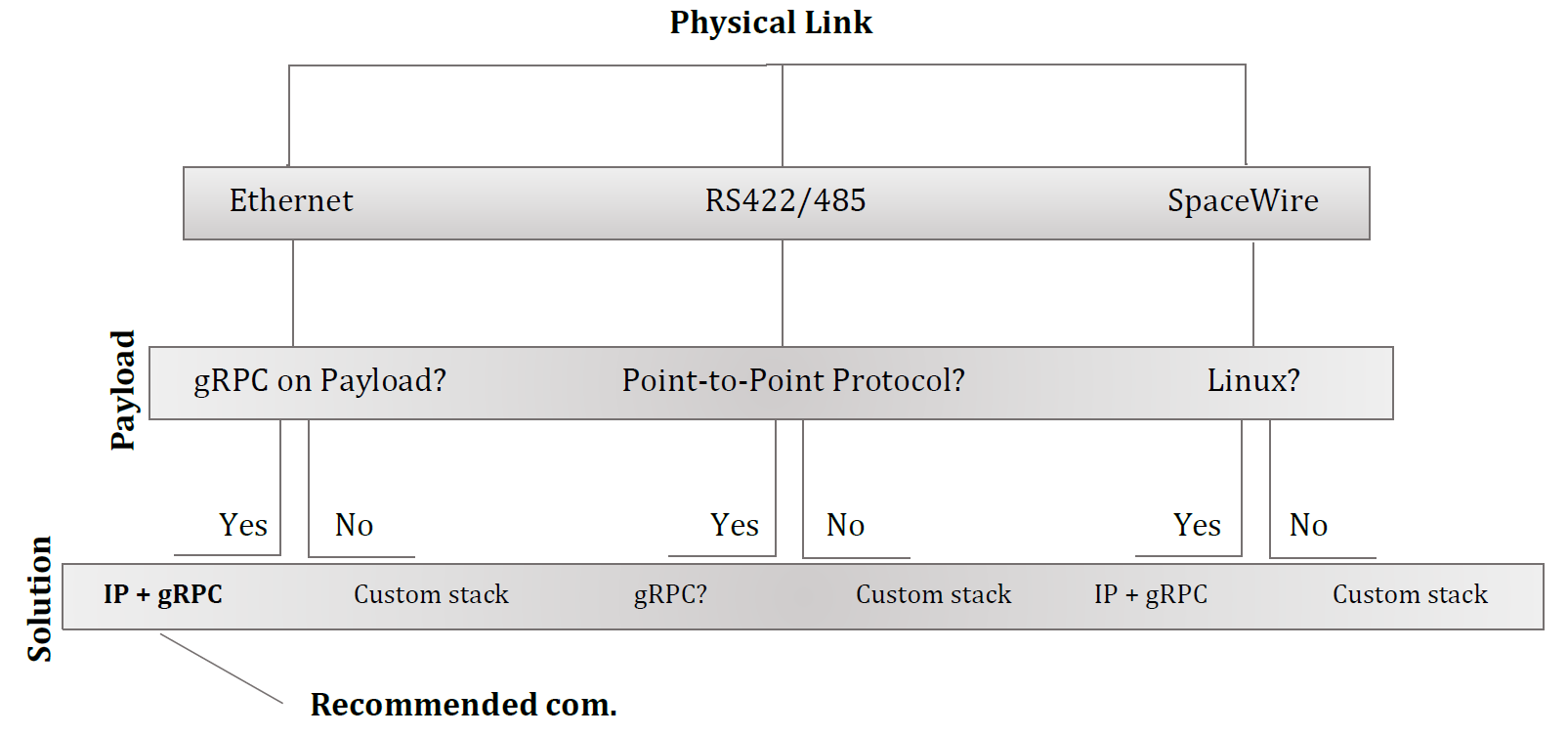
The TCU is connected to the payload or platform network via Ethernet, providing an IP-based communication interface.
Communication Architecture & Protocol
The TCU implements gRPC as the application-layer communication protocol over Ethernet.
gRPC operates over HTTP/2 and uses Protocol Buffers for data serialization and interface definition.
This protocol is selected to:
- Minimise communication overhead
- Provide strongly defined and version-controlled interfaces
- Support scalable and service-oriented architectures
Interface Characteristics
The gRPC interface shall:
- Operate over standard Ethernet and IP networking
- Support persistent client-server connections
- Enable multiple simultaneous client connections
- Use binary-encoded Protobuf messages
Functions
The TCU exposes gRPC services enabling external systems to:
- Enable and disable heaters
- Configure thermal control modes
- Update temperature setpoints
- Configure control loop parameters
Command acknowledgements shall be returned through the same gRPC communication channel.
The TCU provides thermal telemetry through gRPC services, including:
- Temperature measurements
- Heater states
- Control loop status
- Fault and warning information
Telemetry shall be available via:
- On-demand requests
- Continuous server-side or bi-directional streaming services
Fault Reporting
The TCU shall expose fault and event reporting services allowing:
- Retrieval of current fault status
- Notification of newly detected faults
- Support for diagnostic and maintenance activities
Interface Definition Language
All gRPC services, messages, and data structures shall be defined using Protocol Buffer (.proto) files.
The .proto definitions shall:
- Serve as the authoritative interface specification
- Be subject to configuration management
- Be used for automatic generation of client and server code
Version Control
Interface versions shall be managed to ensure:
- Backward compatibility where applicable
- Controlled evolution of services
- Traceability between interface versions and subsystem releases
Performance Considerations
The gRPC interface is intended for:
- Supervisory control
- Configuration management
- Telemetry and health monitoring
Time-critical and hard real-time thermal control functions shall be executed internally within the TCU and shall not rely on the gRPC interface.
The gRPC interface supports:
- Transport Layer Security (TLS)
- Client and server authentication mechanisms
- Access control to prevent unauthorised commanding
Security mechanisms shall be configurable in accordance with mission-level security requirements.
Assembly, Integration, and Test
The gRPC over Ethernet interface facilitates:
- Subsystem-level functional testing
- Thermal verification and validation
- Use of standard IP-based test equipment and software tools
This interface reduces the need for dedicated test interfaces during AIT.
Application Package
The delivered application package includes the networking services and middleware required for communication between the TCU and the host platform. The following services are supported:
- HTTP service interface over TCP
- HTTP/2 transport layer
- gRPC communication framework with Proto3 payload handling
- NTP time synchronization (UDP port 123)
- TFTP file transfer service (UDP port 69)
Ethernet and Hardware Interface
- PHY interface: RMII
- Ethernet link rates: 10 / 100 Mbps
- Typical TCP throughput on a 100 Mbps link: approximately 60–95 Mbps depending on traffic profile and packet size
Networking Stack and Capacity:
The networking architecture is implemented using an RTOS-based environment:
- Operating system: FreeRTOS
- TCP/IP stack: lwIP
Supported network profile:
- IPv4 communication
- DHCP client support
Current network capacity configuration:
- Concurrent TCP sessions: up to 8 active TCP PCBs
- Listening server sockets: up to 4 TCP listening PCBs
- UDP sockets: 4 UDP PCBs
These parameters can be tuned depending on the final application requirements and memory allocation.
HTTP/2 and gRPC Profile:
The current implementation supports the following operational characteristics:
- HTTP/2 concurrent streams: up to 8 streams per connection
- HTTP/2 header block size: 512 bytes
- Per-stream request payload budget: 512 bytes
- Per-stream pending response buffer: 320 bytes
The gRPC implementation supports:
- Unary RPC calls
- Streaming RPC
- Bidirectional streaming